Q6FTM0
Gene name |
CAGL0G01430g |
Protein name |
Leucine aminopeptidase 2 |
Names |
Epoxide hydrolase, Leukotriene A-4 hydrolase homolog, LTA-4 hydrolase |
Species |
Candida glabrata (strain ATCC 2001 / CBS 138 / JCM 3761 / NBRC 0622 / NRRL Y-65) (Yeast) (Torulopsis glabrata) |
KEGG Pathway |
cgr:CAGL0G01430g |
EC number |
3.3.2.10: Ether hydrolases |
Protein Class |
|
Descriptions
The autoinhibited protein was predicted that may have potential autoinhibitory elements via cis-regPred.
Autoinhibitory domains (AIDs)
Target domain |
|
Relief mechanism |
|
Assay |
cis-regPred |
Accessory elements
No accessory elements
Autoinhibited structure

Activated structure
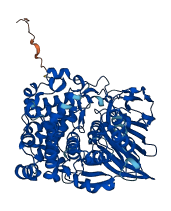
1 structures for Q6FTM0
| Entry ID | Method | Resolution | Chain | Position | Source |
|---|---|---|---|---|---|
| AF-Q6FTM0-F1 | Predicted | AlphaFoldDB |
No variants for Q6FTM0
| Variant ID(s) | Position | Change | Description | Diseaes Association | Provenance |
|---|---|---|---|---|---|
| No variants for Q6FTM0 | |||||
No associated diseases with Q6FTM0
3 regional properties for Q6FTM0
Functions
| Description | ||
|---|---|---|
| EC Number | 3.3.2.10 | Ether hydrolases |
| Subcellular Localization |
|
|
| PANTHER Family | ||
| PANTHER Subfamily | ||
| PANTHER Protein Class | ||
| PANTHER Pathway Category | No pathway information available | |
4 GO annotations of cellular component
| Name | Definition |
|---|---|
| fungal-type vacuole lumen | The volume enclosed within the vacuolar membrane of a vacuole, the shape of which correlates with cell cycle phase. An example of this structure is found in Saccharomyces cerevisiae. |
| multivesicular body | A type of endosome in which regions of the limiting endosomal membrane invaginate to form internal vesicles; membrane proteins that enter the internal vesicles are sequestered from the cytoplasm. |
| nucleus | A membrane-bounded organelle of eukaryotic cells in which chromosomes are housed and replicated. In most cells, the nucleus contains all of the cell's chromosomes except the organellar chromosomes, and is the site of RNA synthesis and processing. In some species, or in specialized cell types, RNA metabolism or DNA replication may be absent. |
| NVT complex | A protein complex that is capable of contributing to protein localization by the NVT pathway. In fission yeast, the Nvt complex consists of Ape2, Lap2 and Nbr1. |
4 GO annotations of molecular function
| Name | Definition |
|---|---|
| aminopeptidase activity | Catalysis of the hydrolysis of a single N-terminal amino acid residue from a polypeptide chain. |
| epoxide hydrolase activity | Catalysis of the reaction: an epoxide + H2O = a glycol. |
| metallopeptidase activity | Catalysis of the hydrolysis of peptide bonds by a mechanism in which water acts as a nucleophile, one or two metal ions hold the water molecule in place, and charged amino acid side chains are ligands for the metal ions. |
| zinc ion binding | Binding to a zinc ion (Zn). |
5 GO annotations of biological process
| Name | Definition |
|---|---|
| cellular lipid metabolic process | The chemical reactions and pathways involving lipids, as carried out by individual cells. |
| cytoplasm to vacuole transport by the NVT pathway | A pathway targeting soluble cytosolic proteins to the vacuole lumen. It uses a selective autophagy receptor protein Nbr1, which is an ortholog of mammalian NBR1, and is remotely related to S. cerevisiae Cvt pathway receptor protein Atg19. Similar to the Cvt pathway, the cargos transported by this pathway are hydrolases, which presumably contribute to the hydrolytic activities in the vacuole lumen. Different from the Cvt pathway, this pathway does not require the macroautophagy machinery, but instead relies on the ESCRT machinery for cargo sequestration. This pathway is observed in the fission yeast S. pombe. |
| peptide catabolic process | The chemical reactions and pathways resulting in the breakdown of peptides, compounds of 2 or more (but usually less than 100) amino acids where the alpha carboxyl group of one is bound to the alpha amino group of another. |
| protein catabolic process | The chemical reactions and pathways resulting in the breakdown of a protein by the destruction of the native, active configuration, with or without the hydrolysis of peptide bonds. |
| proteolysis | The hydrolysis of proteins into smaller polypeptides and/or amino acids by cleavage of their peptide bonds. |
No homologous proteins in AiPD
| UniProt AC | Gene Name | Protein Name | Species | Evidence Code |
|---|---|---|---|---|
| No homologous proteins | ||||
| 10 | 20 | 30 | 40 | 50 | 60 |
| MINRLIQRIV | PFSRPLSTVK | KTMLTPFLES | KRPQQSPEYD | YSTLSNYKSF | QIKHTTLNFL |
| 70 | 80 | 90 | 100 | 110 | 120 |
| LSFEKSTVSG | DVVFDLTTLK | EAVKHIDLDT | SYLDVNEVLV | DDKPVEFKIE | ERKQPLGSKL |
| 130 | 140 | 150 | 160 | 170 | 180 |
| VIAAELEAER | QFKLRVKFST | TKDCTALQWL | TPQQTSGDKP | YMFSQLEAIH | ARALFPCFDT |
| 190 | 200 | 210 | 220 | 230 | 240 |
| PSYKSTFTAN | IESTLPVVFS | GIATGSTPNG | ESTVYHFKQD | IPIPAYLVGI | ASGDLVSASI |
| 250 | 260 | 270 | 280 | 290 | 300 |
| GPRSKVYTEP | HRLDDCVWEF | SNDVEKFIKT | AENLIFDYEW | GTYDILVNVD | SYPYGGMESP |
| 310 | 320 | 330 | 340 | 350 | 360 |
| NMTFATPTLI | AHDKTNIDVI | AHELAHSWSG | NLVTNCSWNH | FWLNEGWTVY | IERRIVGALH |
| 370 | 380 | 390 | 400 | 410 | 420 |
| GEPTRHFSAL | IGWSDLENSI | NSMRNPEKFS | TLVQNLNDGT | DPDDAFSTVP | YEKGFNLLFH |
| 430 | 440 | 450 | 460 | 470 | 480 |
| LETVLGGPQE | FDPFIRHYFK | KFARQSLDTF | QFLDTLFEFF | ENKREILENV | DWETWLFKPG |
| 490 | 500 | 510 | 520 | 530 | 540 |
| MPPKPQFITT | MADNVFSLVN | KWIVKAQELK | TTEEFSKEFS | ESDLSEFNSN | QVVLFLEELV |
| 550 | 560 | 570 | 580 | 590 | 600 |
| AQNCVPVESK | IEWSKYSVAS | ESLLSIYKKQ | VTESQNAEVV | FKNYKFQTTA | RIQPSYQQLA |
| 610 | 620 | 630 | 640 | 650 | |
| NWLGTVGRMK | FVRPGYRLLN | AVDRDLAIAT | FEKLKDTYHP | ICKQLVKQDL | EL |