Q6FTG6
Gene name |
FYV10 (CAGL0G02651g) |
Protein name |
Protein FYV10 |
Names |
|
Species |
Candida glabrata (strain ATCC 2001 / CBS 138 / JCM 3761 / NBRC 0622 / NRRL Y-65) (Yeast) (Torulopsis glabrata) |
KEGG Pathway |
cgr:CAGL0G02651g |
EC number |
|
Protein Class |
|
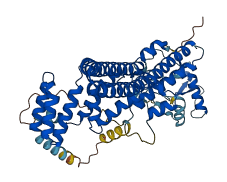
Descriptions
The autoinhibited protein was predicted that may have potential autoinhibitory elements via cis-regPred.
Autoinhibitory domains (AIDs)
Target domain |
|
Relief mechanism |
|
Assay |
cis-regPred |
Accessory elements
No accessory elements
Autoinhibited structure

Activated structure
1 structures for Q6FTG6
| Entry ID | Method | Resolution | Chain | Position | Source |
|---|---|---|---|---|---|
| AF-Q6FTG6-F1 | Predicted | AlphaFoldDB |
No variants for Q6FTG6
| Variant ID(s) | Position | Change | Description | Diseaes Association | Provenance |
|---|---|---|---|---|---|
| No variants for Q6FTG6 | |||||
No associated diseases with Q6FTG6
3 GO annotations of cellular component
| Name | Definition |
|---|---|
| cytoplasm | The contents of a cell excluding the plasma membrane and nucleus, but including other subcellular structures. |
| GID complex | A protein complex with ubiquitin ligase activity that is involved in proteasomal degradation of fructose-1,6-bisphosphatase (FBPase) and phosphoenolpyruvate carboxykinase during the transition from gluconeogenic to glycolytic growth conditions. In S. cerevisiae, the GID (Glucose Induced degradation Deficient) complex consists of Vid30p, Rmd5p, Vid24p, Vid28p, Gid7p, Gid8p, and Fyv10p. |
| nucleus | A membrane-bounded organelle of eukaryotic cells in which chromosomes are housed and replicated. In most cells, the nucleus contains all of the cell's chromosomes except the organellar chromosomes, and is the site of RNA synthesis and processing. In some species, or in specialized cell types, RNA metabolism or DNA replication may be absent. |
2 GO annotations of molecular function
| Name | Definition |
|---|---|
| metal ion binding | Binding to a metal ion. |
| ubiquitin protein ligase activity | Catalysis of the transfer of ubiquitin to a substrate protein via the reaction X-ubiquitin + S -> X + S-ubiquitin, where X is either an E2 or E3 enzyme, the X-ubiquitin linkage is a thioester bond, and the S-ubiquitin linkage is an amide bond: an isopeptide bond between the C-terminal glycine of ubiquitin and the epsilon-amino group of lysine residues in the substrate or, in the linear extension of ubiquitin chains, a peptide bond the between the C-terminal glycine and N-terminal methionine of ubiquitin residues. |
3 GO annotations of biological process
| Name | Definition |
|---|---|
| negative regulation of apoptotic process | Any process that stops, prevents, or reduces the frequency, rate or extent of cell death by apoptotic process. |
| negative regulation of gluconeogenesis | Any process that stops, prevents, or reduces the frequency, rate or extent of gluconeogenesis. |
| proteasome-mediated ubiquitin-dependent protein catabolic process | The chemical reactions and pathways resulting in the breakdown of a protein or peptide by hydrolysis of its peptide bonds, initiated by the covalent attachment of ubiquitin, and mediated by the proteasome. |
No homologous proteins in AiPD
| UniProt AC | Gene Name | Protein Name | Species | Evidence Code |
|---|---|---|---|---|
| No homologous proteins | ||||
| 10 | 20 | 30 | 40 | 50 | 60 |
| MAETTSLINE | PDVDFHLKLN | QHSFNIPYEQ | LQRNSRYLNR | LIEKEIDELN | SHYERLNIAL |
| 70 | 80 | 90 | 100 | 110 | 120 |
| GSGNIEGDKK | ALQELKDIIR | SVEIFEKRLQ | KRVNEEVPIL | KRLEVRINFF | KELENAKQQV |
| 130 | 140 | 150 | 160 | 170 | 180 |
| ADITPLMEWY | LKFTNILIGD | YLTRHTTSNS | SPELGLPGVT | FLEQEGIQDL | LDTDILLTGN |
| 190 | 200 | 210 | 220 | 230 | 240 |
| RISTALVDNH | DLRPLLDWIN | DSKSYLKKNG | SRLEFEARFQ | QYIELLKASE | YEEAIKCFQD |
| 250 | 260 | 270 | 280 | 290 | 300 |
| YLLKFVNTNF | NELTHASGLL | LSINYCKEIM | KAKASERSAI | LTKDDGNPLE | NEIRAYKYFF |
| 310 | 320 | 330 | 340 | 350 | 360 |
| HKKPKIVEQQ | HVKPVDLSYM | NLSQNTDFEK | YMLLLDDKRW | GLLNELFLKD | YYSLYGISQN |
| 370 | 380 | 390 | 400 | 410 | 420 |
| DPLLIYLSLG | ISTLKTRECL | HHRRVAKSSS | PLVDKKVEEE | VLQNSCPVCD | KTFAPIAESL |
| 430 | 440 | 450 | 460 | 470 | 480 |
| PFAHHTQSQL | FDDPIMLPNG | NIYEAKRLKR | LAKYLVDIKA | IELGETEVID | PIDKQIYNEA |
| DFITMYPT |