Q6FPT1
Gene name |
ATP25 (CAGL0J01199g) |
Protein name |
ATPase synthesis protein 25, mitochondrial |
Names |
|
Species |
Candida glabrata (strain ATCC 2001 / CBS 138 / JCM 3761 / NBRC 0622 / NRRL Y-65) (Yeast) (Torulopsis glabrata) |
KEGG Pathway |
cgr:CAGL0J01199g |
EC number |
|
Protein Class |
|
Descriptions
The autoinhibited protein was predicted that may have potential autoinhibitory elements via cis-regPred.
Autoinhibitory domains (AIDs)
Target domain |
|
Relief mechanism |
|
Assay |
cis-regPred |
Accessory elements
No accessory elements
Autoinhibited structure

Activated structure
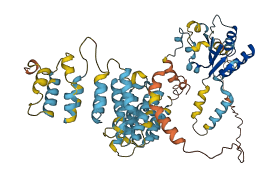
1 structures for Q6FPT1
| Entry ID | Method | Resolution | Chain | Position | Source |
|---|---|---|---|---|---|
| AF-Q6FPT1-F1 | Predicted | AlphaFoldDB |
No variants for Q6FPT1
| Variant ID(s) | Position | Change | Description | Diseaes Association | Provenance |
|---|---|---|---|---|---|
| No variants for Q6FPT1 | |||||
No associated diseases with Q6FPT1
1 regional properties for Q6FPT1
| Type | Name | Position | InterPro Accession |
|---|---|---|---|
| domain | ATP25 mRNA stabilisation domain | 321 - 601 | IPR025210 |
1 GO annotations of cellular component
| Name | Definition |
|---|---|
| mitochondrial inner membrane | The inner, i.e. lumen-facing, lipid bilayer of the mitochondrial envelope. It is highly folded to form cristae. |
No GO annotations of molecular function
| Name | Definition |
|---|---|
| No GO annotations for molecular function |
2 GO annotations of biological process
| Name | Definition |
|---|---|
| mitochondrial gene expression | The process in which a mitochondrial gene's sequence is converted into a mature gene product or products (proteins or RNA). This includes the production of an RNA transcript as well as any processing to produce a mature RNA product or an mRNA or circRNA (for protein-coding genes) and the translation of that mRNA or circRNA into protein. Protein maturation is included when required to form an active form of a product from an inactive precursor form. |
| mRNA stabilization | Prevention of degradation of mRNA molecules. In the absence of compensating changes in other processes, the slowing of mRNA degradation can result in an overall increase in the population of active mRNA molecules. |
No homologous proteins in AiPD
| UniProt AC | Gene Name | Protein Name | Species | Evidence Code |
|---|---|---|---|---|
| No homologous proteins | ||||
| 10 | 20 | 30 | 40 | 50 | 60 |
| MQSLLQLKHY | PLLTSYLEVL | STQKLHYMLR | IRSIARPIVR | RPWANAARVT | GISGTRIQVP |
| 70 | 80 | 90 | 100 | 110 | 120 |
| FPSSVRWYSD | REPQTEPVVK | DEESEHVPWY | MRLEDDSLKS | LNEDISKQHE | VRLPDDCPDS |
| 130 | 140 | 150 | 160 | 170 | 180 |
| LHILVKHLQK | QLALRDILVF | DLKNQRLADP | ENYRLKMCDY | VIICTAMSTK | HCERSYVEIN |
| 190 | 200 | 210 | 220 | 230 | 240 |
| KLLKNEYGVS | GYVEGQVNPN | DEKKRLKRLA | RKNNLGRTNI | RRNALNSTEE | SSWYMIDCHV |
| 250 | 260 | 270 | 280 | 290 | 300 |
| DSIFLNILTE | NRRYEMNLEE | LYAPLNEKHL | YEKSEHSMHI | NTNNRSQAFD | SLEEEDNVLL |
| 310 | 320 | 330 | 340 | 350 | 360 |
| ALRKLAQQKR | QYSTESPARS | LRNELVKENF | DSSKKLLADN | PELREQLVKV | AISTIEQIRD |
| 370 | 380 | 390 | 400 | 410 | 420 |
| STGASINTEK | WYKFVSHNVP | LVIQDTTFWD | SYLKFLLLLN | DCNSQTYSYK | RLIPDYLVTK |
| 430 | 440 | 450 | 460 | 470 | 480 |
| RSMGEELTAD | DITTFLSVIS | ERVNPQNYWD | LVKANTQVVE | ALRLFDEEVI | FTDAILSKVI |
| 490 | 500 | 510 | 520 | 530 | 540 |
| KTLTTNSNEH | KLHSFYEVIK | FLVWKYEKEI | PINTLETILK | TLINFGEYDY | LLRLWTTKIG |
| 550 | 560 | 570 | 580 | 590 | 600 |
| YNVGSKDTRP | WKVFLKAITE | TQDVELIRLI | IEKGCLLDIS | RGKVDVDPQL | AVLLKTAFKT |
| 610 | 620 | ||||
| VDPENLIYND | QQRLLIPSSA | TRQ |