Q6FKP2
Gene name |
PAN3 |
Protein name |
PAN2-PAN3 deadenylation complex subunit PAN3 |
Names |
PAB1P-dependent poly(A)-specific ribonuclease, Poly(A)-nuclease deadenylation complex subunit 3, PAN deadenylation complex subunit 3 |
Species |
Candida glabrata (strain ATCC 2001 / CBS 138 / JCM 3761 / NBRC 0622 / NRRL Y-65) (Yeast) (Torulopsis glabrata) |
KEGG Pathway |
cgr:CAGL0L09889g |
EC number |
|
Protein Class |
|
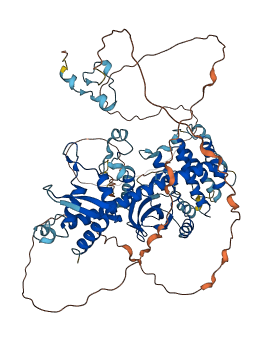
Descriptions
The autoinhibited protein was predicted that may have potential autoinhibitory elements via cis-regPred.
Autoinhibitory domains (AIDs)
Target domain |
|
Relief mechanism |
|
Assay |
cis-regPred |
Accessory elements
No accessory elements
Autoinhibited structure

Activated structure
1 structures for Q6FKP2
| Entry ID | Method | Resolution | Chain | Position | Source |
|---|---|---|---|---|---|
| AF-Q6FKP2-F1 | Predicted | AlphaFoldDB |
No variants for Q6FKP2
| Variant ID(s) | Position | Change | Description | Diseaes Association | Provenance |
|---|---|---|---|---|---|
| No variants for Q6FKP2 | |||||
No associated diseases with Q6FKP2
1 GO annotations of cellular component
| Name | Definition |
|---|---|
| PAN complex | A complex that possesses poly(A)-specific ribonuclease activity; catalyzes the message-specific shortening of mRNA poly(A) tails. Contains at least two subunits, known as Pan2p and Pan3p in Saccharomyces. |
3 GO annotations of molecular function
| Name | Definition |
|---|---|
| ATP binding | Binding to ATP, adenosine 5'-triphosphate, a universally important coenzyme and enzyme regulator. |
| metal ion binding | Binding to a metal ion. |
| poly(A) binding | Binding to a sequence of adenylyl residues in an RNA molecule, such as the poly(A) tail, a sequence of adenylyl residues at the 3' end of eukaryotic mRNA. |
3 GO annotations of biological process
| Name | Definition |
|---|---|
| mRNA processing | Any process involved in the conversion of a primary mRNA transcript into one or more mature mRNA(s) prior to translation into polypeptide. |
| nuclear-transcribed mRNA poly(A) tail shortening | Shortening of the poly(A) tail of a nuclear-transcribed mRNA from full length to an oligo(A) length. |
| postreplication repair | The conversion of DNA-damage induced single-stranded gaps into large molecular weight DNA after replication. Includes pathways that remove replication-blocking lesions in conjunction with DNA replication. |
No homologous proteins in AiPD
| UniProt AC | Gene Name | Protein Name | Species | Evidence Code |
|---|---|---|---|---|
| No homologous proteins | ||||
| 10 | 20 | 30 | 40 | 50 | 60 |
| MDKINPDWAR | DVPCRNVIIY | GFCKKKTEGC | PFKHDDDDIA | TPTSTPKVAD | TVPAPSGVIQ |
| 70 | 80 | 90 | 100 | 110 | 120 |
| QPSKISVSSL | PSLNSQPSST | APTSAPNATA | HTGSKSQVPK | FNAKASASFT | PMSKAADGTQ |
| 130 | 140 | 150 | 160 | 170 | 180 |
| ETQAPYLESP | VAGSPGPILK | AGTPVSFMQP | NIYSTTPVPS | PASMAMPNVV | MPPNDMGSPD |
| 190 | 200 | 210 | 220 | 230 | 240 |
| LGLQQQSHMV | NLDGSIQQNY | QERPNVLMRD | SSMPLTMGTS | GSRPMLDQQI | HSISGLSNTS |
| 250 | 260 | 270 | 280 | 290 | 300 |
| GPQPPGLLQS | MNGASMDMGL | PMNLRYPTIY | PPTHSILQYH | LYAPDPPPQL | EIALKENERT |
| 310 | 320 | 330 | 340 | 350 | 360 |
| PRMLFIPNDL | REELVKRNLA | SLQLFPSGGN | LPHIVKDYFG | LVPLDFHQRS | SVKDRYKKHK |
| 370 | 380 | 390 | 400 | 410 | 420 |
| NSLYKVFSNV | DGRIYLLRRI | HDVNISDPTI | ISKTFQKWSK | IDSSNVVALK | DLFLTTAFGD |
| 430 | 440 | 450 | 460 | 470 | 480 |
| SSLGIVYDYY | PNATSLYEAH | FVNYPTVEVT | EDLLWSYAVQ | ILNGLREIHN | TNGVNIGDLD |
| 490 | 500 | 510 | 520 | 530 | 540 |
| CDKIILTGKG | RIKISAGAEY | DIMNMCCPED | NEDDDNEEKL | RKRNFVDLGE | ILFKLASKMC |
| 550 | 560 | 570 | 580 | 590 | 600 |
| NCHGKDVANL | AQVSEKLKNL | IKSLAFEQLH | DYVNVATIIE | KYIGLDVVFK | VMEAQQTYSE |
| 610 | 620 | 630 | 640 | 650 | 660 |
| YAENVLSREL | ENGRLFRLIC | KLNFIFGRVE | NRLDINWSEP | GDKFVIVLFY | DYVFHQIDPN |
| 670 | 680 | 690 | 700 | 710 | |
| TGKPVTDLTH | VLRCLNKLDA | GVEENILLVT | PDELNTAVVS | YKKVKELVDK | TFRAMTL |