Q6FI27
Gene name |
GSK3B |
Protein name |
Glycogen synthase kinase-3 beta |
Names |
|
Species |
Homo sapiens (Human) |
KEGG Pathway |
hsa:2932 |
EC number |
|
Protein Class |
|
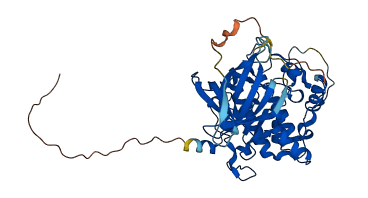
Descriptions
The autoinhibited protein was predicted that may have potential autoinhibitory elements via cis-regPred.
Autoinhibitory domains (AIDs)
Target domain |
|
Relief mechanism |
|
Assay |
cis-regPred |
Accessory elements
No accessory elements
Autoinhibited structure

Activated structure
0 structures for Q6FI27
| Entry ID | Method | Resolution | Chain | Position | Source |
|---|
No variants for Q6FI27
| Variant ID(s) | Position | Change | Description | Diseaes Association | Provenance |
|---|---|---|---|---|---|
| No variants for Q6FI27 | |||||
1 associated diseases with Q6FI27
[MIM: 609821]: Bleeding disorder, platelet-type, 8 (BDPLT8)
A condition characterized by mild to moderate mucocutaneous bleeding, and excessive bleeding after surgery or trauma. The defect is due to severe impairment of platelet response to ADP resulting in defective platelet aggregation. {ECO:0000269|PubMed:11196645, ECO:0000269|PubMed:12578987, ECO:0000269|PubMed:25428217}. Note=The disease is caused by variants affecting the gene represented in this entry.
Without disease ID
- A condition characterized by mild to moderate mucocutaneous bleeding, and excessive bleeding after surgery or trauma. The defect is due to severe impairment of platelet response to ADP resulting in defective platelet aggregation. {ECO:0000269|PubMed:11196645, ECO:0000269|PubMed:12578987, ECO:0000269|PubMed:25428217}. Note=The disease is caused by variants affecting the gene represented in this entry.
1 regional properties for Q6FI27
| Type | Name | Position | InterPro Accession |
|---|---|---|---|
| domain | GPCR, rhodopsin-like, 7TM | 42 - 298 | IPR017452 |
3 GO annotations of cellular component
| Name | Definition |
|---|---|
| cytoplasm | The contents of a cell excluding the plasma membrane and nucleus, but including other subcellular structures. |
| nucleoplasm | That part of the nuclear content other than the chromosomes or the nucleolus. |
| plasma membrane | The membrane surrounding a cell that separates the cell from its external environment. It consists of a phospholipid bilayer and associated proteins. |
3 GO annotations of molecular function
| Name | Definition |
|---|---|
| ATP binding | Binding to ATP, adenosine 5'-triphosphate, a universally important coenzyme and enzyme regulator. |
| protein serine/threonine kinase activity | Catalysis of the reactions: ATP + protein serine = ADP + protein serine phosphate, and ATP + protein threonine = ADP + protein threonine phosphate. |
| tau-protein kinase activity | Catalysis of the reaction: ATP + tau-protein = ADP + O-phospho-tau-protein. |
7 GO annotations of biological process
| Name | Definition |
|---|---|
| glycogen metabolic process | The chemical reactions and pathways involving glycogen, a polydisperse, highly branched glucan composed of chains of D-glucose residues in alpha-(1->4) glycosidic linkage, joined together by alpha-(1->6) glycosidic linkages. |
| negative regulation of developmental process | Any process that stops, prevents or reduces the rate or extent of development, the biological process whose specific outcome is the progression of an organism over time from an initial condition (e.g. a zygote, or a young adult) to a later condition (e.g. a multicellular animal or an aged adult). |
| negative regulation of signal transduction | Any process that stops, prevents, or reduces the frequency, rate or extent of signal transduction. |
| protein phosphorylation | The process of introducing a phosphate group on to a protein. |
| regulation of cellular component organization | Any process that modulates the frequency, rate or extent of a process involved in the formation, arrangement of constituent parts, or disassembly of cell structures, including the plasma membrane and any external encapsulating structures such as the cell wall and cell envelope. |
| rhythmic process | Any process pertinent to the generation and maintenance of rhythms in the physiology of an organism. |
| Wnt signaling pathway | The series of molecular signals initiated by binding of a Wnt protein to a frizzled family receptor on the surface of the target cell and ending with a change in cell state. |
No homologous proteins in AiPD
| UniProt AC | Gene Name | Protein Name | Species | Evidence Code |
|---|---|---|---|---|
| No homologous proteins | ||||
| 10 | 20 | 30 | 40 | 50 | 60 |
| MSGRPRTTSF | AESCKPVQQP | SAFGSMKVSR | DKDGSKVTTV | VATPGQGPDR | PQEVSYTDTK |
| 70 | 80 | 90 | 100 | 110 | 120 |
| VIGNGSFGVV | YQAKLCDSGE | LVAIKKVLQD | KRFKNRELQI | MRKLDHCNIV | RLRYFFYSSG |
| 130 | 140 | 150 | 160 | 170 | 180 |
| EKKDEVYLNL | VLDYVPETVY | RVARHYSRAK | QTLPVIYVKL | YMYQLFRSLA | YIHSFGICHR |
| 190 | 200 | 210 | 220 | 230 | 240 |
| DIKPQNLLLD | PDTAVLKLCD | FGSAKQLVRG | EPNVSYICSR | YYRAPELIFG | ATDYTSSIDV |
| 250 | 260 | 270 | 280 | 290 | 300 |
| WSAGCVLAEL | LLGQPIFPGD | SGVDQLVEII | KVLGTPTREQ | IREMNPNYTE | FKFPQIKAHP |
| 310 | 320 | 330 | 340 | 350 | 360 |
| WTKVFRPRTP | PEAIALCSRL | LEYTPTARLT | PLEACAHSFF | DELRDPNVKL | PNGRDTPALF |
| 370 | 380 | 390 | 400 | 410 | |
| NFTTQELSSN | PPLATILIPP | HARIQAAAST | PTNATAASDA | NTGDRGQTNN | AASASASNST |