Q6F494
Gene name |
pckG (pck, TK1405) |
Protein name |
Phosphoenolpyruvate carboxykinase [GTP] |
Names |
PEP carboxykinase, PEPCK, GTP-dependent phosphoenolpyruvate carboxykinase, GTP-PEPCK, PckTk |
Species |
Thermococcus kodakarensis (strain ATCC BAA-918 / JCM 12380 / KOD1) (Pyrococcus kodakaraensis (strain KOD1)) |
KEGG Pathway |
tko:TK1405 |
EC number |
4.1.1.32: Carboxy-lyases |
Protein Class |
|
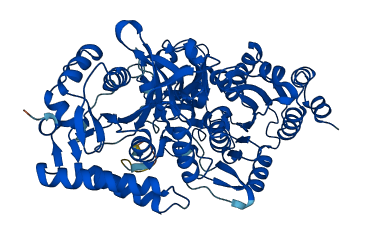
Descriptions
The autoinhibited protein was predicted that may have potential autoinhibitory elements via cis-regPred.
Autoinhibitory domains (AIDs)
Target domain |
|
Relief mechanism |
|
Assay |
cis-regPred |
Accessory elements
No accessory elements
Autoinhibited structure

Activated structure
1 structures for Q6F494
| Entry ID | Method | Resolution | Chain | Position | Source |
|---|---|---|---|---|---|
| AF-Q6F494-F1 | Predicted | AlphaFoldDB |
No variants for Q6F494
| Variant ID(s) | Position | Change | Description | Diseaes Association | Provenance |
|---|---|---|---|---|---|
| No variants for Q6F494 | |||||
No associated diseases with Q6F494
3 regional properties for Q6F494
| Type | Name | Position | InterPro Accession |
|---|---|---|---|
| conserved_site | Phosphoenolpyruvate carboxykinase, GTP-utilising, conserved site | 268 - 276 | IPR018091 |
| domain | Phosphoenolpyruvate carboxykinase, C-terminal P-loop domain | 244 - 603 | IPR035077 |
| domain | Phosphoenolpyruvate carboxykinase, GTP-utilising, N-terminal | 29 - 239 | IPR035078 |
Functions
| Description | ||
|---|---|---|
| EC Number | 4.1.1.32 | Carboxy-lyases |
| Subcellular Localization |
|
|
| PANTHER Family | ||
| PANTHER Subfamily | ||
| PANTHER Protein Class | ||
| PANTHER Pathway Category | No pathway information available | |
1 GO annotations of cellular component
| Name | Definition |
|---|---|
| cytosol | The part of the cytoplasm that does not contain organelles but which does contain other particulate matter, such as protein complexes. |
3 GO annotations of molecular function
| Name | Definition |
|---|---|
| GTP binding | Binding to GTP, guanosine triphosphate. |
| manganese ion binding | Binding to a manganese ion (Mn). |
| phosphoenolpyruvate carboxykinase (GTP) activity | Catalysis of the reaction: GTP + oxaloacetate = GDP + phosphoenolpyruvate + CO2. |
6 GO annotations of biological process
| Name | Definition |
|---|---|
| cellular response to glucose stimulus | Any process that results in a change in state or activity of a cell (in terms of movement, secretion, enzyme production, gene expression, etc.) as a result of a glucose stimulus. |
| gluconeogenesis | The formation of glucose from noncarbohydrate precursors, such as pyruvate, amino acids and glycerol. |
| glycerol biosynthetic process from pyruvate | The chemical reactions and pathways resulting in the formation of glycerol, 1,2,3-propanetriol, from other compounds, including pyruvate. |
| propionate catabolic process | The chemical reactions and pathways resulting in the breakdown of propionate, the anion derived from propionic acid. |
| response to lipid | Any process that results in a change in state or activity of a cell or an organism (in terms of movement, secretion, enzyme production, gene expression, etc.) as a result of a lipid stimulus. |
| response to starvation | Any process that results in a change in state or activity of a cell or an organism (in terms of movement, secretion, enzyme production, gene expression, etc.) as a result of a starvation stimulus, deprivation of nourishment. |
No homologous proteins in AiPD
| UniProt AC | Gene Name | Protein Name | Species | Evidence Code |
|---|---|---|---|---|
| No homologous proteins | ||||
| 10 | 20 | 30 | 40 | 50 | 60 |
| MNALERLEKL | LDKEQFEKVK | AIDNPELHEF | LAEWIEWLEP | DKVFVCTDSP | EDEGYVRWKA |
| 70 | 80 | 90 | 100 | 110 | 120 |
| LYYGEERMLE | TPNHTVHYDN | YYDQARDKAN | TAILLPGGKK | LPYINTKDRD | EGLKEIRELM |
| 130 | 140 | 150 | 160 | 170 | 180 |
| KGIMKGKELF | VCFFVLGPKN | SIFTIPAVQL | TDSAYVAHSE | FILYRKGYEE | FKRLGRSARF |
| 190 | 200 | 210 | 220 | 230 | 240 |
| FRFVHSAGEL | DERKTSKNLD | KRRIYIDLED | ETVYSVNTQY | GGNTIGLKKL | AFRLTIKRAV |
| 250 | 260 | 270 | 280 | 290 | 300 |
| EEGWLSEHMF | LMRVNGPHGR | KTYFTGAYPS | MCGKTSTAMI | PWENIVGDDL | TFILPVNGIA |
| 310 | 320 | 330 | 340 | 350 | 360 |
| RGANVEKGVF | GIIQGVNPED | DPIIWQVLHS | PVEIIFSNVL | VKDGKPYWND | MGIEIPDEGE |
| 370 | 380 | 390 | 400 | 410 | 420 |
| NHSGKWWRGK | KDAEGNEIPP | SHKNARFTVS | LEHFPNVDME | ALENPCGVEV | GGMIFGGRDA |
| 430 | 440 | 450 | 460 | 470 | 480 |
| DTWPPVREAF | NWEHGVITMG | ASLESETTAA | TLGKEGVRAF | NPMAILDFMS | VHLGDYLRNY |
| 490 | 500 | 510 | 520 | 530 | 540 |
| LEFGRKLKKT | PKIFAVNYFL | RENGVWLNHK | LDKAVWLKWM | ELRVHGDVEA | IETPIGYIPK |
| 550 | 560 | 570 | 580 | 590 | 600 |
| YKDLAKLFKD | VLNKEYTKED | YERQFKIRVP | ELLAKIDRIE | EIYRKLDNVP | EELFKVLEEE |
| 610 | 620 | ||||
| RQRLLEAREK | YGDYISPFAL | EGE |