Q6EV69
Gene name |
POFUT1 (FUT12) |
Protein name |
GDP-fucose protein O-fucosyltransferase 1 |
Names |
Peptide-O-fucosyltransferase 1, O-FucT-1 |
Species |
Pan troglodytes (Chimpanzee) |
KEGG Pathway |
ptr:449504 |
EC number |
2.4.1.221: Hexosyltransferases |
Protein Class |
|
Descriptions
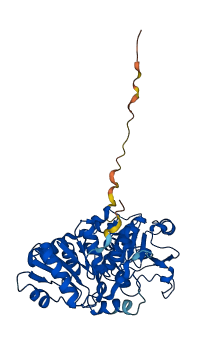
The autoinhibited protein was predicted that may have potential autoinhibitory elements via cis-regPred.
Autoinhibitory domains (AIDs)
Target domain |
|
Relief mechanism |
|
Assay |
cis-regPred |
Accessory elements
No accessory elements
Autoinhibited structure

Activated structure
1 structures for Q6EV69
| Entry ID | Method | Resolution | Chain | Position | Source |
|---|---|---|---|---|---|
| AF-Q6EV69-F1 | Predicted | AlphaFoldDB |
No variants for Q6EV69
| Variant ID(s) | Position | Change | Description | Diseaes Association | Provenance |
|---|---|---|---|---|---|
| No variants for Q6EV69 | |||||
No associated diseases with Q6EV69
No regional properties for Q6EV69
| Type | Name | Position | InterPro Accession |
|---|---|---|---|
| No domain, repeats, and functional sites for Q6EV69 | |||
Functions
| Description | ||
|---|---|---|
| EC Number | 2.4.1.221 | Hexosyltransferases |
| Subcellular Localization |
|
|
| PANTHER Family | ||
| PANTHER Subfamily | ||
| PANTHER Protein Class | ||
| PANTHER Pathway Category | No pathway information available | |
2 GO annotations of cellular component
| Name | Definition |
|---|---|
| endoplasmic reticulum | The irregular network of unit membranes, visible only by electron microscopy, that occurs in the cytoplasm of many eukaryotic cells. The membranes form a complex meshwork of tubular channels, which are often expanded into slitlike cavities called cisternae. The ER takes two forms, rough (or granular), with ribosomes adhering to the outer surface, and smooth (with no ribosomes attached). |
| membrane | A lipid bilayer along with all the proteins and protein complexes embedded in it an attached to it. |
2 GO annotations of molecular function
| Name | Definition |
|---|---|
| fucosyltransferase activity | Catalysis of the transfer of a fucosyl group to an acceptor molecule, typically another carbohydrate or a lipid. |
| peptide-O-fucosyltransferase activity | Catalysis of the transfer of an alpha-L-fucosyl residue from GDP- beta-L-fucose to the serine hydroxy group of a protein acceptor. |
9 GO annotations of biological process
| Name | Definition |
|---|---|
| angiogenesis | Blood vessel formation when new vessels emerge from the proliferation of pre-existing blood vessels. |
| fucose metabolic process | The chemical reactions and pathways involving fucose, or 6-deoxygalactose, which has two enantiomers, D-fucose and L-fucose. |
| heart development | The process whose specific outcome is the progression of the heart over time, from its formation to the mature structure. The heart is a hollow, muscular organ, which, by contracting rhythmically, keeps up the circulation of the blood. |
| nervous system development | The process whose specific outcome is the progression of nervous tissue over time, from its formation to its mature state. |
| Notch signaling pathway | The series of molecular signals initiated by an extracellular ligand binding to the receptor Notch on the surface of a target cell, and ending with the regulation of a downstream cellular process, e.g. transcription. |
| protein O-linked fucosylation | The process of transferring a fucosyl group to a serine or threonine residues in a protein acceptor molecule, to form an O-linked protein-sugar linkage. |
| protein O-linked glycosylation | A protein glycosylation process in which a carbohydrate or carbohydrate derivative unit is added to a protein via the hydroxyl group of peptidyl-serine, peptidyl-threonine, peptidyl-hydroxylysine, or peptidyl-hydroxyproline, or via the phenol group of peptidyl-tyrosine, forming an O-glycan. |
| regulation of Notch signaling pathway | Any process that modulates the frequency, rate or extent of the Notch signaling pathway. |
| somitogenesis | The formation of mesodermal clusters that are arranged segmentally along the anterior posterior axis of an embryo. |
1 homologous proteins in AiPD
| UniProt AC | Gene Name | Protein Name | Species | Evidence Code |
|---|---|---|---|---|
| Q9H488 | POFUT1 | GDP-fucose protein O-fucosyltransferase 1 | Homo sapiens (Human) | PR |
| 10 | 20 | 30 | 40 | 50 | 60 |
| MGAAAWARPL | SVSFLLLLLP | LPGMPAGSWD | PAGYLLYCPC | MGRFGNQADH | FLGSLAFAKL |
| 70 | 80 | 90 | 100 | 110 | 120 |
| LNRTLAVPPW | IEYQHHKPPF | TNLHVSYQKY | FKLEPLQAYH | RVISLEDFME | KLAPTHWPPE |
| 130 | 140 | 150 | 160 | 170 | 180 |
| KRVAYCFEVA | AQRSPDKKTC | PMKEGNPFGP | FWDQFHVSFN | KSELFTGISF | SASYREQWSQ |
| 190 | 200 | 210 | 220 | 230 | 240 |
| RFSPKEHPVL | ALPGAPAQFP | VLEEHRPLQK | YMVWSDEMVK | TGEAQIHAHL | VRPYVGIHLR |
| 250 | 260 | 270 | 280 | 290 | 300 |
| IGSDWKNACA | MLKDGTAGSH | FMASPQCVGY | SRSTAAPLTM | TMCLPDLKEI | QRAVKLWVRS |
| 310 | 320 | 330 | 340 | 350 | 360 |
| LDAQSVYVAT | DSESYVPELQ | QLFKGKVKVV | SLKPEVAQVD | LYILGQADHF | IGNCVSSFTA |
| 370 | 380 | ||||
| FVKRERDLQG | RPSSFFGMDR | PPKLRDEF |