Q6DVA0
Gene name |
Lemd2 (Lem2) |
Protein name |
LEM domain-containing protein 2 |
Names |
Nuclear envelope transmembrane protein 25, NET25 |
Species |
Mus musculus (Mouse) |
KEGG Pathway |
mmu:224640 |
EC number |
|
Protein Class |
|
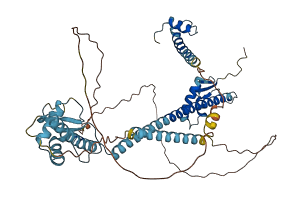
Descriptions
The autoinhibited protein was predicted that may have potential autoinhibitory elements via cis-regPred.
Autoinhibitory domains (AIDs)
Target domain |
|
Relief mechanism |
|
Assay |
cis-regPred |
Accessory elements
No accessory elements
Autoinhibited structure

Activated structure
1 structures for Q6DVA0
| Entry ID | Method | Resolution | Chain | Position | Source |
|---|---|---|---|---|---|
| AF-Q6DVA0-F1 | Predicted | AlphaFoldDB |
18 variants for Q6DVA0
| Variant ID(s) | Position | Change | Description | Diseaes Association | Provenance |
|---|---|---|---|---|---|
| rs252677237 | 47 | D>N | No | EVA | |
| rs214440318 | 114 | G>D | No | EVA | |
| rs214440318 | 114 | G>V | No | EVA | |
| rs246129012 | 116 | F>L | No | EVA | |
| rs3389437748 | 164 | P>T | No | EVA | |
| rs107619511 | 168 | R>C | No | EVA | |
| rs246681276 | 189 | A>V | No | EVA | |
| rs108358764 | 221 | L>I | No | EVA | |
| rs108509733 | 232 | G>A | No | EVA | |
| rs108509733 | 232 | G>V | No | EVA | |
| rs3407588486 | 313 | A>V | No | EVA | |
| rs242082060 | 384 | A>T | No | EVA | |
| rs3407698693 | 403 | I>L | No | EVA | |
| rs3389438349 | 415 | E>D | No | EVA | |
| rs3389407375 | 423 | V>A | No | EVA | |
| rs3389404965 | 465 | M>L | No | EVA | |
| rs3389445450 | 467 | R>* | No | EVA | |
| rs3389414804 | 482 | R>W | No | EVA |
No associated diseases with Q6DVA0
Functions
6 GO annotations of cellular component
| Name | Definition |
|---|---|
| chromatin | The ordered and organized complex of DNA, protein, and sometimes RNA, that forms the chromosome. |
| endoplasmic reticulum | The irregular network of unit membranes, visible only by electron microscopy, that occurs in the cytoplasm of many eukaryotic cells. The membranes form a complex meshwork of tubular channels, which are often expanded into slitlike cavities called cisternae. The ER takes two forms, rough (or granular), with ribosomes adhering to the outer surface, and smooth (with no ribosomes attached). |
| integral component of nuclear inner membrane | The component of the nuclear inner membrane consisting of the gene products and protein complexes having at least some part of their peptide sequence embedded in the hydrophobic region of the membrane. |
| nuclear envelope | The double lipid bilayer enclosing the nucleus and separating its contents from the rest of the cytoplasm; includes the intermembrane space, a gap of width 20-40 nm (also called the perinuclear space). |
| nuclear membrane | Either of the lipid bilayers that surround the nucleus and form the nuclear envelope; excludes the intermembrane space. |
| spindle | The array of microtubules and associated molecules that forms between opposite poles of a eukaryotic cell during mitosis or meiosis and serves to move the duplicated chromosomes apart. |
1 GO annotations of molecular function
| Name | Definition |
|---|---|
| chromatin DNA binding | Binding to DNA that is assembled into chromatin. |
8 GO annotations of biological process
| Name | Definition |
|---|---|
| heart formation | The developmental process pertaining to the initial formation of the heart from unspecified parts. This process begins with the specific processes that contribute to the appearance of the heart field and the arrival of cardiac neural crest to the heart region. The process ends when the structural rudiment is recognizable. |
| negative regulation of BMP signaling pathway | Any process that stops, prevents, or reduces the frequency, rate or extent of the BMP signaling pathway. |
| negative regulation of MAPK cascade | Any process that stops, prevents, or reduces the frequency, rate or extent of signal transduction mediated by the MAPKKK cascade. |
| negative regulation of protein kinase B signaling | Any process that stops, prevents, or reduces the frequency, rate or extent of protein kinase B signaling, a series of reactions mediated by the intracellular serine/threonine kinase protein kinase B. |
| neurogenesis | Generation of cells within the nervous system. |
| nuclear envelope organization | A process that is carried out at the cellular level which results in the assembly, arrangement of constituent parts, or disassembly of the nuclear envelope. |
| protein localization to chromatin | Any process in which a protein is transported to, or maintained at, a part of a chromosome that is organized into chromatin. |
| skeletal muscle cell differentiation | The process in which a relatively unspecialized cell acquires specialized features of a skeletal muscle cell, a somatic cell located in skeletal muscle. |
No homologous proteins in AiPD
| UniProt AC | Gene Name | Protein Name | Species | Evidence Code |
|---|---|---|---|---|
| No homologous proteins | ||||
| 10 | 20 | 30 | 40 | 50 | 60 |
| MAGLSDLELR | RELQALGFQP | GPITDTTRNV | YRNKLRRLRG | EARLRDDERL | REDAGPREDA |
| 70 | 80 | 90 | 100 | 110 | 120 |
| GPRGPERQRE | EARLREEAPL | RARPAASVLR | SEPWPLSPSP | PAPSAASDAS | GPYGNFGASA |
| 130 | 140 | 150 | 160 | 170 | 180 |
| SPWAASRGLS | YPPHAGPGPL | RRRASVRGSS | EDDEDTRTPD | RHAPGRGRHW | WAPPSASARP |
| 190 | 200 | 210 | 220 | 230 | 240 |
| HSALLGADAR | PGLKGSRTGS | AGAGRTRPEV | GRWLERCLSR | LLLWASLGLL | LGFLAILWVK |
| 250 | 260 | 270 | 280 | 290 | 300 |
| MGKPSAPQEA | EDNMKLLPVD | CERKTDEFCQ | AKQKAALLEL | LHELYNFLAI | QAGNFECGNP |
| 310 | 320 | 330 | 340 | 350 | 360 |
| EKLKSKCIPV | LEAQEYIANV | TSSPSSRFKA | ALTWILSSNK | DVGIWLKGED | PSELATTVDK |
| 370 | 380 | 390 | 400 | 410 | 420 |
| VVCLESARPR | MGIGCRLSRA | LLTAVTHVLI | FFWCLAFLWG | LLILLKYRWR | KLEEEEQAMY |
| 430 | 440 | 450 | 460 | 470 | 480 |
| EMVKKIIDVV | QDHYVDWEQD | MERYPYVGIL | HVRDSLIPPQ | SRRRMKRVWD | RAVEFLASNE |
| 490 | 500 | 510 | |||
| SRIQTESHRV | AGEDMLVWRW | TKPSSFSDSE | R |