Q6DBR6
Gene name |
stac3 |
Protein name |
SH3 and cysteine-rich domain-containing protein 3 |
Names |
|
Species |
Danio rerio (Zebrafish) (Brachydanio rerio) |
KEGG Pathway |
dre:445111 |
EC number |
|
Protein Class |
|
Descriptions
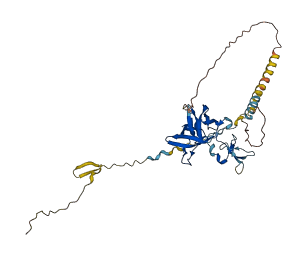
The autoinhibited protein was predicted that may have potential autoinhibitory elements via cis-regPred.
Autoinhibitory domains (AIDs)
Target domain |
|
Relief mechanism |
|
Assay |
cis-regPred |
Accessory elements
No accessory elements
Autoinhibited structure

Activated structure
1 structures for Q6DBR6
| Entry ID | Method | Resolution | Chain | Position | Source |
|---|---|---|---|---|---|
| AF-Q6DBR6-F1 | Predicted | AlphaFoldDB |
No variants for Q6DBR6
| Variant ID(s) | Position | Change | Description | Diseaes Association | Provenance |
|---|---|---|---|---|---|
| No variants for Q6DBR6 | |||||
No associated diseases with Q6DBR6
3 regional properties for Q6DBR6
| Type | Name | Position | InterPro Accession |
|---|---|---|---|
| domain | SH3 domain | 217 - 276 | IPR001452-1 |
| domain | SH3 domain | 277 - 334 | IPR001452-2 |
| domain | Protein kinase C-like, phorbol ester/diacylglycerol-binding domain | 62 - 113 | IPR002219 |
4 GO annotations of cellular component
| Name | Definition |
|---|---|
| cytosol | The part of the cytoplasm that does not contain organelles but which does contain other particulate matter, such as protein complexes. |
| extrinsic component of cytoplasmic side of plasma membrane | The component of a plasma membrane consisting of gene products and protein complexes that are loosely bound to its cytoplasmic surface, but not integrated into the hydrophobic region. |
| T-tubule | Invagination of the plasma membrane of a muscle cell that extends inward from the cell surface around each myofibril. The ends of T-tubules make contact with the sarcoplasmic reticulum membrane. |
| voltage-gated calcium channel complex | A protein complex that forms a transmembrane channel through which calcium ions may pass in response to changes in membrane potential. |
1 GO annotations of molecular function
| Name | Definition |
|---|---|
| metal ion binding | Binding to a metal ion. |
6 GO annotations of biological process
| Name | Definition |
|---|---|
| positive regulation of protein localization to plasma membrane | Any process that activates or increases the frequency, rate or extent of protein localization to plasma membrane. |
| positive regulation of voltage-gated calcium channel activity | Any process that activates or increases the frequency, rate or extent of voltage-gated calcium channel activity. |
| regulation of release of sequestered calcium ion into cytosol by sarcoplasmic reticulum | Any process that modulates the rate, frequency or extent of release of sequestered calcium ion into cytosol by the sarcoplasmic reticulum, the process in which the release of sequestered calcium ion by sarcoplasmic reticulum into cytosol occurs via calcium release channels. |
| skeletal muscle contraction | A process in which force is generated within skeletal muscle tissue, resulting in a change in muscle geometry. Force generation involves a chemo-mechanical energy conversion step that is carried out by the actin/myosin complex activity, which generates force through ATP hydrolysis. In the skeletal muscle, the muscle contraction takes advantage of an ordered sarcomeric structure and in most cases it is under voluntary control. |
| skeletal muscle tissue development | The developmental sequence of events leading to the formation of adult skeletal muscle tissue. The main events are: the fusion of myoblasts to form myotubes that increase in size by further fusion to them of myoblasts, the formation of myofibrils within their cytoplasm and the establishment of functional neuromuscular junctions with motor neurons. At this stage they can be regarded as mature muscle fibers. |
| T-tubule organization | A process that is carried out at the cellular level that results in the assembly, arrangement of constituent parts, or disassembly of the T-tubule. A T-tubule is an invagination of the plasma membrane of a muscle cell that extends inward from the cell surface around each myofibril. |
1 homologous proteins in AiPD
| UniProt AC | Gene Name | Protein Name | Species | Evidence Code |
|---|---|---|---|---|
| Q96MF2 | STAC3 | SH3 and cysteine-rich domain-containing protein 3 | Homo sapiens (Human) | PR |
| 10 | 20 | 30 | 40 | 50 | 60 |
| MAQYDQLEDK | DSLDIHDNPP | APENVVKEDD | NTVYFVYDEE | VEEEEAPPPP | TPEPIVQVND |
| 70 | 80 | 90 | 100 | 110 | 120 |
| KPHKFKDHYC | KKPKFCDVCA | RMIVLNNKFA | LRCKNCKTNI | HHSCQSYVQF | QRCFGKIPPG |
| 130 | 140 | 150 | 160 | 170 | 180 |
| FRRAYSSPLY | DQEINNPGQQ | NRTDPVFDTL | RVGVIMANKE | RKKGSEDKKN | MMMMMMEEEE |
| 190 | 200 | 210 | 220 | 230 | 240 |
| AQQPKEDEEG | AEGKQDGDKK | DKTATDDKNK | KQQQTFSQSH | YYMALYRFKA | IEKDDLDFHP |
| 250 | 260 | 270 | 280 | 290 | 300 |
| GDRITVLDDS | NEEWWRGKIG | EKTGYLPMTY | IIRVRAGERV | YKVTRSFVGN | REMGQITLKK |
| 310 | 320 | 330 | |||
| DQIVVKKGEE | VNGYLKVSTG | RKLGFFPADL | LHEL |