Q6CTF5
Gene name |
MSC6 (KLLA0C13101g) |
Protein name |
Meiotic sister-chromatid recombination protein 6, mitochondrial |
Names |
|
Species |
Kluyveromyces lactis (strain ATCC 8585 / CBS 2359 / DSM 70799 / NBRC 1267 / NRRL Y-1140 / WM37) (Yeast) (Candida sphaerica) |
KEGG Pathway |
kla:KLLA0_C13101g |
EC number |
|
Protein Class |
|
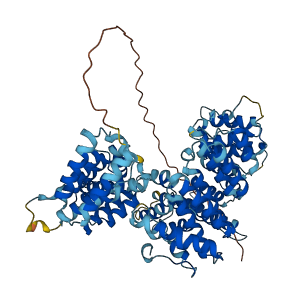
Descriptions
The autoinhibited protein was predicted that may have potential autoinhibitory elements via cis-regPred.
Autoinhibitory domains (AIDs)
Target domain |
|
Relief mechanism |
|
Assay |
cis-regPred |
Accessory elements
No accessory elements
Autoinhibited structure

Activated structure
1 structures for Q6CTF5
| Entry ID | Method | Resolution | Chain | Position | Source |
|---|---|---|---|---|---|
| AF-Q6CTF5-F1 | Predicted | AlphaFoldDB |
No variants for Q6CTF5
| Variant ID(s) | Position | Change | Description | Diseaes Association | Provenance |
|---|---|---|---|---|---|
| No variants for Q6CTF5 | |||||
No associated diseases with Q6CTF5
No regional properties for Q6CTF5
| Type | Name | Position | InterPro Accession |
|---|---|---|---|
| No domain, repeats, and functional sites for Q6CTF5 | |||
1 GO annotations of cellular component
| Name | Definition |
|---|---|
| mitochondrion | A semiautonomous, self replicating organelle that occurs in varying numbers, shapes, and sizes in the cytoplasm of virtually all eukaryotic cells. It is notably the site of tissue respiration. |
No GO annotations of molecular function
| Name | Definition |
|---|---|
| No GO annotations for molecular function |
2 GO annotations of biological process
| Name | Definition |
|---|---|
| DNA recombination | Any process in which a new genotype is formed by reassortment of genes resulting in gene combinations different from those that were present in the parents. In eukaryotes genetic recombination can occur by chromosome assortment, intrachromosomal recombination, or nonreciprocal interchromosomal recombination. Interchromosomal recombination occurs by crossing over. In bacteria it may occur by genetic transformation, conjugation, transduction, or F-duction. |
| meiotic cell cycle | Progression through the phases of the meiotic cell cycle, in which canonically a cell replicates to produce four offspring with half the chromosomal content of the progenitor cell via two nuclear divisions. |
No homologous proteins in AiPD
| UniProt AC | Gene Name | Protein Name | Species | Evidence Code |
|---|---|---|---|---|
| No homologous proteins | ||||
| 10 | 20 | 30 | 40 | 50 | 60 |
| MLSVRISARQ | CSVRGLATQA | NNVSQPAKDN | ATNGSDAATE | KKGTARYQRI | QPSVALNSLK |
| 70 | 80 | 90 | 100 | 110 | 120 |
| TKLSNDFQKQ | QPAQKIYSQF | QSDLQQLISE | QQVNPRHFVN | SSICNSVLAK | LILQSKSELD |
| 130 | 140 | 150 | 160 | 170 | 180 |
| GQSIGESASI | PPTPFEILET | YLKYNLARHQ | HFIIVLKQFL | IDLQPKEAIN | LWISFLEHAK |
| 190 | 200 | 210 | 220 | 230 | 240 |
| QMPLNNTGTS | QVQALTSIAY | LMLSKESNSA | PDVNVLTQLL | NITPSKVPFL | AIEQEIKSLG |
| 250 | 260 | 270 | 280 | 290 | 300 |
| LTATTKDELL | KSFDDLLLQW | FTADKDAFIN | EFLKNSNDLK | LITYLWKQYL | KLATKDFTTS |
| 310 | 320 | 330 | 340 | 350 | 360 |
| NQEIPGAFMI | KLAQLDRSLD | AVKIMTQLKE | ASADFKPSVS | LYNSLLQTVA | YIPAFGKEAQ |
| 370 | 380 | 390 | 400 | 410 | 420 |
| SIKLNRIQAI | WNSYIKSSGN | ITVASYKAML | EALIIAGHFK | TVESFWTLDV | PDDVKANSEI |
| 430 | 440 | 450 | 460 | 470 | 480 |
| SDIYLKNFFA | SVKKVHFSQL | KSKIPSKVHN | LELANTILLA | MVHSDASVGD | IDSFYSHTFQ |
| 490 | 500 | 510 | 520 | 530 | 540 |
| STEGIKPNDK | TLAIKLRANL | AAFGDSKNES | ILGTIGLSAN | SPTATLVIEE | FLKICENEES |
| 550 | 560 | 570 | 580 | 590 | 600 |
| ATALLKALNI | DNKSNDSAKK | VSNFLDYYLQ | HGNWEYAEEL | FKKYLTDNVK | SPSSVNYRLF |
| 610 | 620 | 630 | 640 | 650 | 660 |
| NSMFKGFSEL | SITRNDTGFV | SKQQVYWELC | QRIHNRIFNE | CVISTLKSVS | ALSRRNAEFS |
| 670 | 680 | 690 | 700 | ||
| ENELDFINNT | VLPYLVKLKI | ENSFKLQNPK | YLQNMKSNDK | IHIPKELL |