Q6CSZ5
Gene name |
SEC13 (KLLA0C16643g) |
Protein name |
Protein transport protein SEC13 |
Names |
|
Species |
Kluyveromyces lactis (strain ATCC 8585 / CBS 2359 / DSM 70799 / NBRC 1267 / NRRL Y-1140 / WM37) (Yeast) (Candida sphaerica) |
KEGG Pathway |
kla:KLLA0_C16643g |
EC number |
|
Protein Class |
|
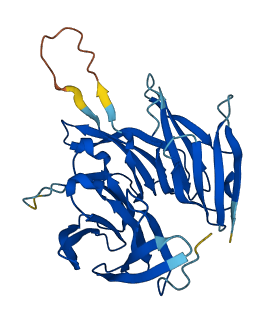
Descriptions
The autoinhibited protein was predicted that may have potential autoinhibitory elements via cis-regPred.
Autoinhibitory domains (AIDs)
Target domain |
|
Relief mechanism |
|
Assay |
cis-regPred |
Accessory elements
No accessory elements
Autoinhibited structure

Activated structure
1 structures for Q6CSZ5
| Entry ID | Method | Resolution | Chain | Position | Source |
|---|---|---|---|---|---|
| AF-Q6CSZ5-F1 | Predicted | AlphaFoldDB |
No variants for Q6CSZ5
| Variant ID(s) | Position | Change | Description | Diseaes Association | Provenance |
|---|---|---|---|---|---|
| No variants for Q6CSZ5 | |||||
No associated diseases with Q6CSZ5
6 regional properties for Q6CSZ5
| Type | Name | Position | InterPro Accession |
|---|---|---|---|
| repeat | WD40 repeat | 1 - 37 | IPR001680-1 |
| repeat | WD40 repeat | 42 - 83 | IPR001680-2 |
| repeat | WD40 repeat | 88 - 129 | IPR001680-3 |
| repeat | WD40 repeat | 134 - 191 | IPR001680-4 |
| repeat | WD40 repeat | 198 - 240 | IPR001680-5 |
| repeat | WD40 repeat | 249 - 287 | IPR001680-6 |
Functions
4 GO annotations of cellular component
| Name | Definition |
|---|---|
| COPII vesicle coat | One of two multimeric complexes that forms a membrane vesicle coat. COPII is best characterized in S. cerevisiae, where the subunits are called Sar1p, Sec13p, Sec31p, Sec23p, and Sec24p. Vesicles with COPII coats are found associated with endoplasmic reticulum (ER) membranes at steady state. |
| endoplasmic reticulum membrane | The lipid bilayer surrounding the endoplasmic reticulum. |
| GATOR2 complex | A multiprotein subcomplex of the GATOR complex that regulates TORC1 signaling by interacting with the Rag GTPase. In human, this complex consists of WDR24, WDR59, MIOS, SEH1L, and SEC13. In S. cerevisiae, this complex is referred to as SEACAT and contains the Sea2p, Sea3p, Sea4p, Seh1p, Sec13p proteins. |
| nuclear pore outer ring | A subcomplex of the nuclear pore complex (NPC) that forms the outer rings of the core scaffold, a lattice-like structure that gives the NPC its shape and strength. In S. cerevisiae, the two outer rings each contain multiple copies of the following proteins: Nup133p, Nup120p, Nup145Cp, Nup85p, Nup84p, Seh1p, and Sec13p. In vertebrates, the two outer rings each contain multiple copies of the following proteins: Nup133, Nup160, Nup96, Nup75, Nup107, Seh1, Sec13, Nup43, Nup37, and ALADIN. Components are arranged in 8-fold symmetrical 'spokes' around the central transport channel. A single 'spoke', can be isolated and is sometimes referred to as the Nup84 complex (S. cerevisiae) or the Nup107-160 complex (vertebrates). |
1 GO annotations of molecular function
| Name | Definition |
|---|---|
| structural molecule activity | The action of a molecule that contributes to the structural integrity of a complex or its assembly within or outside a cell. |
10 GO annotations of biological process
| Name | Definition |
|---|---|
| COPII-coated vesicle budding | The evagination of an endoplasmic reticulum membrane, resulting in formation of a COPII-coated vesicle. |
| mRNA transport | The directed movement of mRNA, messenger ribonucleic acid, into, out of or within a cell, or between cells, by means of some agent such as a transporter or pore. |
| nuclear pore localization | Any process in which nuclear pores are transported to, or maintained in, a specific location. |
| positive regulation of DNA-templated transcription | Any process that activates or increases the frequency, rate or extent of cellular DNA-templated transcription. |
| positive regulation of ER to Golgi vesicle-mediated transport | Any process that activates or increases the frequency, rate or extent of ER to Golgi vesicle-mediated transport. |
| positive regulation of GTPase activity | Any process that activates or increases the activity of a GTPase. |
| positive regulation of protein exit from endoplasmic reticulum | Any process that activates or increases the frequency, rate or extent of directed movement of proteins from the endoplasmic reticulum. |
| positive regulation of TORC1 signaling | Any process that activates or increases the frequency, rate or extent of TORC1 signaling. |
| protein transport | The directed movement of proteins into, out of or within a cell, or between cells, by means of some agent such as a transporter or pore. |
| ubiquitin-dependent ERAD pathway | The series of steps necessary to target endoplasmic reticulum (ER)-resident proteins for degradation by the cytoplasmic proteasome. Begins with recognition of the ER-resident protein, includes retrotranslocation (dislocation) of the protein from the ER to the cytosol, protein ubiquitination necessary for correct substrate transfer, transport of the protein to the proteasome, and ends with degradation of the protein by the cytoplasmic proteasome. |
No homologous proteins in AiPD
| UniProt AC | Gene Name | Protein Name | Species | Evidence Code |
|---|---|---|---|---|
| No homologous proteins | ||||
| 10 | 20 | 30 | 40 | 50 | 60 |
| MVTINNAHSE | LIHDAVLDYY | GKRLATCSSD | HTVKIFEVEG | ETHKLVDTLQ | GHEGPVWQVD |
| 70 | 80 | 90 | 100 | 110 | 120 |
| WAHPKFGVIL | ASCSYDGKVL | IWKEVNGRWS | QIAAHEVHSA | SVNSIQWAPH | EYGPLLLAAS |
| 130 | 140 | 150 | 160 | 170 | 180 |
| SDGKVSVVEF | KENGTTSPII | IDAHSIGANT | ACWAPATLQQ | QSNQGTSGSA | SPQQVRRFVT |
| 190 | 200 | 210 | 220 | 230 | 240 |
| GGADNLVKIW | KYNSDAATYL | LEHTLEGHSD | WVRDVAWSPT | VLSRSYLASV | SQDRTCIIWT |
| 250 | 260 | 270 | 280 | 290 | 300 |
| QDSKEDTWKK | TLLKEDKFPD | VLWRASWSLS | GNILALSCGD | NTVTLWKENL | EGKWEPAGQV |
| TE |