Q6CS27
Gene name |
MCR1 (KLLA0D04488g) |
Protein name |
NADH-cytochrome b5 reductase 2 |
Names |
Mitochondrial cytochrome b reductase |
Species |
Kluyveromyces lactis (strain ATCC 8585 / CBS 2359 / DSM 70799 / NBRC 1267 / NRRL Y-1140 / WM37) (Yeast) (Candida sphaerica) |
KEGG Pathway |
kla:KLLA0_D04488g |
EC number |
1.6.2.2: With a heme protein as acceptor |
Protein Class |
|
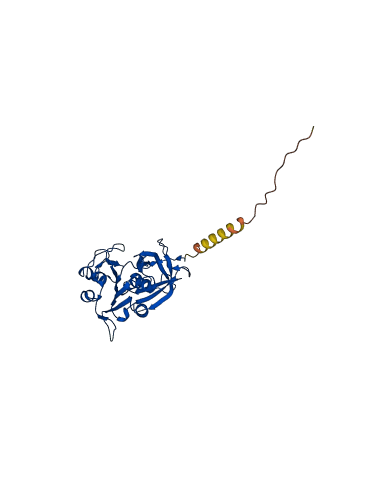
Descriptions
The autoinhibited protein was predicted that may have potential autoinhibitory elements via cis-regPred.
Autoinhibitory domains (AIDs)
Target domain |
|
Relief mechanism |
|
Assay |
cis-regPred |
Accessory elements
No accessory elements
Autoinhibited structure

Activated structure
1 structures for Q6CS27
| Entry ID | Method | Resolution | Chain | Position | Source |
|---|---|---|---|---|---|
| AF-Q6CS27-F1 | Predicted | AlphaFoldDB |
No variants for Q6CS27
| Variant ID(s) | Position | Change | Description | Diseaes Association | Provenance |
|---|---|---|---|---|---|
| No variants for Q6CS27 | |||||
No associated diseases with Q6CS27
8 regional properties for Q6CS27
| Type | Name | Position | InterPro Accession |
|---|---|---|---|
| domain | Oxidoreductase FAD/NAD(P)-binding | 160 - 266 | IPR001433 |
| domain | Flavoprotein pyridine nucleotide cytochrome reductase | 100 - 107 | IPR001709-1 |
| domain | Flavoprotein pyridine nucleotide cytochrome reductase | 159 - 178 | IPR001709-2 |
| domain | Flavoprotein pyridine nucleotide cytochrome reductase | 185 - 194 | IPR001709-3 |
| domain | Flavoprotein pyridine nucleotide cytochrome reductase | 197 - 208 | IPR001709-4 |
| domain | Flavoprotein pyridine nucleotide cytochrome reductase | 253 - 261 | IPR001709-5 |
| domain | Flavoprotein pyridine nucleotide cytochrome reductase-like, FAD-binding domain | 52 - 150 | IPR008333 |
| domain | FAD-binding domain, ferredoxin reductase-type | 47 - 151 | IPR017927 |
Functions
| Description | ||
|---|---|---|
| EC Number | 1.6.2.2 | With a heme protein as acceptor |
| Subcellular Localization |
|
|
| PANTHER Family | ||
| PANTHER Subfamily | ||
| PANTHER Protein Class | ||
| PANTHER Pathway Category | No pathway information available | |
2 GO annotations of cellular component
| Name | Definition |
|---|---|
| integral component of mitochondrial outer membrane | The component of the mitochondrial outer membrane consisting of the gene products having at least some part of their peptide sequence embedded in the hydrophobic region of the membrane. |
| mitochondrial intermembrane space | The region between the inner and outer lipid bilayers of the mitochondrial envelope. |
2 GO annotations of molecular function
| Name | Definition |
|---|---|
| cytochrome-b5 reductase activity, acting on NAD(P)H | Catalysis of the reaction: NAD(P)H + H+ + 2 ferricytochrome b(5) = NAD(P)+ + 2 ferrocytochrome b(5). |
| NADH dehydrogenase activity | Catalysis of the reaction: NADH + H+ + acceptor = NAD+ + reduced acceptor. |
2 GO annotations of biological process
| Name | Definition |
|---|---|
| cellular response to oxidative stress | Any process that results in a change in state or activity of a cell (in terms of movement, secretion, enzyme production, gene expression, etc.) as a result of oxidative stress, a state often resulting from exposure to high levels of reactive oxygen species, e.g. superoxide anions, hydrogen peroxide (H2O2), and hydroxyl radicals. |
| ergosterol biosynthetic process | The chemical reactions and pathways resulting in the formation of ergosterol, (22E)-ergosta-5,7,22-trien-3-beta-ol, a sterol found in ergot, yeast and moulds. |
No homologous proteins in AiPD
| UniProt AC | Gene Name | Protein Name | Species | Evidence Code |
|---|---|---|---|---|
| No homologous proteins | ||||
| 10 | 20 | 30 | 40 | 50 | 60 |
| MFARLSRSNK | FLPIALGVGA | ASIATAIILQ | RNYSIMNDTS | KAFLGDNEWI | DLPIIKIEKL |
| 70 | 80 | 90 | 100 | 110 | 120 |
| SHDTKRFTFA | LPKKDQVSGL | ITASCILAKF | VTPKGSNVIR | PYTPVSDNGT | KGKMELVVKH |
| 130 | 140 | 150 | 160 | 170 | 180 |
| YENGKFTSHL | FGLKENDTVS | FKGPITKWEW | KPNSYDSITL | LGAGTGINPL | YQLVHHIAEN |
| 190 | 200 | 210 | 220 | 230 | 240 |
| PEDNTKIHLY | YGNKTPEDIL | LKSELDNLQK | KYPDQVKITY | FVDKAEGNFE | GETGFITKDY |
| 250 | 260 | 270 | 280 | 290 | |
| LSHQAPKPSE | KNQVFVCGPP | PFMKAYSGPK | VSPQDQGELT | GILAELGYSK | SNVFKF |