Q6CR51
Gene name |
SSN3 (CDK8, SRB10, KLLA0D11814g) |
Protein name |
Serine/threonine-protein kinase SSN3 |
Names |
Cyclin-dependent kinase 8, KlSRB10 |
Species |
Kluyveromyces lactis (strain ATCC 8585 / CBS 2359 / DSM 70799 / NBRC 1267 / NRRL Y-1140 / WM37) (Yeast) (Candida sphaerica) |
KEGG Pathway |
kla:KLLA0_D11814g |
EC number |
2.7.11.22: Protein-serine/threonine kinases |
Protein Class |
|
Descriptions
The autoinhibited protein was predicted that may have potential autoinhibitory elements via cis-regPred.
Autoinhibitory domains (AIDs)
Target domain |
|
Relief mechanism |
|
Assay |
cis-regPred |
Accessory elements
329-355 (Activation loop from InterPro)
Target domain |
90-489 (Protein kinase domain) |
Relief mechanism |
|
Assay |
|
Autoinhibited structure

Activated structure
1 structures for Q6CR51
| Entry ID | Method | Resolution | Chain | Position | Source |
|---|---|---|---|---|---|
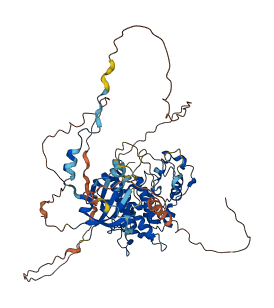
| AF-Q6CR51-F1 | Predicted | AlphaFoldDB |
No variants for Q6CR51
| Variant ID(s) | Position | Change | Description | Diseaes Association | Provenance |
|---|---|---|---|---|---|
| No variants for Q6CR51 | |||||
No associated diseases with Q6CR51
Functions
| Description | ||
|---|---|---|
| EC Number | 2.7.11.22 | Protein-serine/threonine kinases |
| Subcellular Localization |
|
|
| PANTHER Family | ||
| PANTHER Subfamily | ||
| PANTHER Protein Class | ||
| PANTHER Pathway Category | No pathway information available | |
2 GO annotations of cellular component
| Name | Definition |
|---|---|
| CKM complex | Cyclin-dependent kinase complex which reversibly associates with the Mediator complex. In Saccharomyces cerevisiae it consists of SSN2, SSN3, SSN8 and SRB8. |
| mediator complex | A protein complex that interacts with the carboxy-terminal domain of the largest subunit of RNA polymerase II and plays an active role in transducing the signal from a transcription factor to the transcriptional machinery. The mediator complex is required for activation of transcription of most protein-coding genes, but can also act as a transcriptional corepressor. The Saccharomyces complex contains several identifiable subcomplexes: a head domain comprising Srb2, -4, and -5, Med6, -8, and -11, and Rox3 proteins; a middle domain comprising Med1, -4, and -7, Nut1 and -2, Cse2, Rgr1, Soh1, and Srb7 proteins; a tail consisting of Gal11p, Med2p, Pgd1p, and Sin4p; and a regulatory subcomplex comprising Ssn2, -3, and -8, and Srb8 proteins. Metazoan mediator complexes have similar modular structures and include homologs of yeast Srb and Med proteins. |
5 GO annotations of molecular function
| Name | Definition |
|---|---|
| ATP binding | Binding to ATP, adenosine 5'-triphosphate, a universally important coenzyme and enzyme regulator. |
| cyclin-dependent protein serine/threonine kinase activity | Cyclin-dependent catalysis of the reactions: ATP + protein serine = ADP + protein serine phosphate, and ATP + protein threonine = ADP + protein threonine phosphate. |
| metal ion binding | Binding to a metal ion. |
| protein serine kinase activity | Catalysis of the reactions: ATP + protein serine = ADP + protein serine phosphate. |
| RNA polymerase II CTD heptapeptide repeat kinase activity | Catalysis of the reaction: ATP + RNA polymerase II large subunit CTD heptapeptide repeat (YSPTSPS) = ADP + H+ + phosphorylated RNA polymerase II. |
7 GO annotations of biological process
| Name | Definition |
|---|---|
| negative regulation of filamentous growth | Any process that decreases the frequency, rate or extent of the process in which a multicellular organism or a group of unicellular organisms grow in a threadlike, filamentous shape. |
| negative regulation of transcription by RNA polymerase II | Any process that stops, prevents, or reduces the frequency, rate or extent of transcription mediated by RNA polymerase II. |
| nuclear-transcribed mRNA catabolic process, non-stop decay | The chemical reactions and pathways resulting in the breakdown of the transcript body of a nuclear-transcribed mRNA that is lacking a stop codon. |
| phosphorylation of RNA polymerase II C-terminal domain | The process of introducing a phosphate group on to an amino acid residue in the C-terminal domain of RNA polymerase II. Typically, this occurs during the transcription cycle and results in production of an RNA polymerase II enzyme where the carboxy-terminal domain (CTD) of the largest subunit is extensively phosphorylated, often referred to as hyperphosphorylated or the II(0) form. Specific types of phosphorylation within the CTD are usually associated with specific regions of genes, though there are exceptions. The phosphorylation state regulates the association of specific complexes such as the capping enzyme or 3'-RNA processing machinery to the elongating RNA polymerase complex. |
| positive regulation of transcription from RNA polymerase II promoter by galactose | Any process involving galactose that activates or increases the rate of transcription from an RNA polymerase II promoter. |
| protein destabilization | Any process that decreases the stability of a protein, making it more vulnerable to degradative processes or aggregation. |
| response to oxidative stress | Any process that results in a change in state or activity of a cell or an organism (in terms of movement, secretion, enzyme production, gene expression, etc.) as a result of oxidative stress, a state often resulting from exposure to high levels of reactive oxygen species, e.g. superoxide anions, hydrogen peroxide (H2O2), and hydroxyl radicals. |
No homologous proteins in AiPD
| UniProt AC | Gene Name | Protein Name | Species | Evidence Code |
|---|---|---|---|---|
| No homologous proteins | ||||
| 10 | 20 | 30 | 40 | 50 | 60 |
| MYGNQQNNSN | PYQMSYYRMN | NGQGQGTNRW | PQQLSHQEML | AGHSQQILNN | NKPAGNQSKP |
| 70 | 80 | 90 | 100 | 110 | 120 |
| PIVMASNNVF | SIGPYRQRKD | SSRISVLQKY | EIIGYIAAGT | YGKVYKAKAR | DYQNGMNRDN |
| 130 | 140 | 150 | 160 | 170 | 180 |
| VIILDSPDSV | SADSNLDINS | INRSTRQQEA | NDNLTTMDFR | KPSHKRFTPP | NNSNSTQIRS |
| 190 | 200 | 210 | 220 | 230 | 240 |
| NSGSETNVRI | NSSSITNNSR | KPSQIQFYAI | KKFKTEREGV | EHYTGISQSA | CREMSLCREL |
| 250 | 260 | 270 | 280 | 290 | 300 |
| DNNHLTKLVE | IFLEKKSIYM | VSEFAEHDLL | QIIHFHSHPE | KRLIPPRMLK | SIMWQILDGV |
| 310 | 320 | 330 | 340 | 350 | 360 |
| SYLHQNWILH | RDLKPANIMV | TVDGCVKIGD | LGLARKFNNM | VQTLYTGDKV | IVTIWYRAPE |
| 370 | 380 | 390 | 400 | 410 | 420 |
| LILGARHYTP | AIDLWAVGCI | FAELIGLRPI | FKGEEAKMES | KKSVLFQANQ | FQKILEVMGS |
| 430 | 440 | 450 | 460 | 470 | 480 |
| PDHKIWPNID | SYPEYLQLAK | MPKYRDNLTA | WYQTAGGKDK | TALDILYRLL | QYDPIKRIDA |
| 490 | 500 | 510 | 520 | 530 | 540 |
| IDALDHVYFT | NGDPPVCENV | FEGLNYKYPP | RRIHTNDNDI | TNVGNDNNQA | NHSQKQPMHG |
| 550 | 560 | 570 | 580 | 590 | |
| NNNNKNGNMN | GLGVNKRILA | AAAAAAAAAA | VSGNGNNPTS | NTATGGSARK | KRK |