Q6CNI6
Gene name |
HEK2 (KHD1, KLLA0E12321g) |
Protein name |
Heterogeneous nuclear rnp K-like protein 2 |
Names |
KH domain-containing protein 1 |
Species |
Kluyveromyces lactis (strain ATCC 8585 / CBS 2359 / DSM 70799 / NBRC 1267 / NRRL Y-1140 / WM37) (Yeast) (Candida sphaerica) |
KEGG Pathway |
kla:KLLA0_E12321g |
EC number |
|
Protein Class |
|
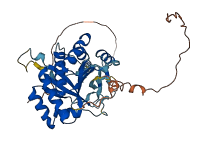
Descriptions
The autoinhibited protein was predicted that may have potential autoinhibitory elements via cis-regPred.
Autoinhibitory domains (AIDs)
Target domain |
|
Relief mechanism |
|
Assay |
cis-regPred |
Accessory elements
No accessory elements
Autoinhibited structure

Activated structure
1 structures for Q6CNI6
| Entry ID | Method | Resolution | Chain | Position | Source |
|---|---|---|---|---|---|
| AF-Q6CNI6-F1 | Predicted | AlphaFoldDB |
No variants for Q6CNI6
| Variant ID(s) | Position | Change | Description | Diseaes Association | Provenance |
|---|---|---|---|---|---|
| No variants for Q6CNI6 | |||||
No associated diseases with Q6CNI6
6 regional properties for Q6CNI6
| Type | Name | Position | InterPro Accession |
|---|---|---|---|
| domain | K Homology domain | 57 - 127 | IPR004087-1 |
| domain | K Homology domain | 160 - 231 | IPR004087-2 |
| domain | K Homology domain | 255 - 326 | IPR004087-3 |
| domain | K Homology domain, type 1 | 62 - 120 | IPR004088-1 |
| domain | K Homology domain, type 1 | 165 - 228 | IPR004088-2 |
| domain | K Homology domain, type 1 | 259 - 322 | IPR004088-3 |
3 GO annotations of cellular component
| Name | Definition |
|---|---|
| chromosome, telomeric region | The end of a linear chromosome, required for the integrity and maintenance of the end. A chromosome telomere usually includes a region of telomerase-encoded repeats the length of which rarely exceeds 20 bp each and that permits the formation of a telomeric loop (T-loop). The telomeric repeat region is usually preceded by a sub-telomeric region that is gene-poor but rich in repetitive elements. Some telomeres only consist of the latter part (for eg. D. melanogaster telomeres). |
| nucleus | A membrane-bounded organelle of eukaryotic cells in which chromosomes are housed and replicated. In most cells, the nucleus contains all of the cell's chromosomes except the organellar chromosomes, and is the site of RNA synthesis and processing. In some species, or in specialized cell types, RNA metabolism or DNA replication may be absent. |
| P-body | A focus in the cytoplasm where mRNAs may become inactivated by decapping or some other mechanism. Protein and RNA localized to these foci are involved in mRNA degradation, nonsense-mediated mRNA decay (NMD), translational repression, and RNA-mediated gene silencing. |
1 GO annotations of molecular function
| Name | Definition |
|---|---|
| mRNA binding | Binding to messenger RNA (mRNA), an intermediate molecule between DNA and protein. mRNA includes UTR and coding sequences, but does not contain introns. |
6 GO annotations of biological process
| Name | Definition |
|---|---|
| chromatin organization | The assembly or remodeling of chromatin composed of DNA complexed with histones, other associated proteins, and sometimes RNA. |
| intracellular mRNA localization | Any process in which mRNA is transported to, or maintained in, a specific location within the cell. |
| mRNA stabilization | Prevention of degradation of mRNA molecules. In the absence of compensating changes in other processes, the slowing of mRNA degradation can result in an overall increase in the population of active mRNA molecules. |
| mRNA transport | The directed movement of mRNA, messenger ribonucleic acid, into, out of or within a cell, or between cells, by means of some agent such as a transporter or pore. |
| regulation of translation | Any process that modulates the frequency, rate or extent of the chemical reactions and pathways resulting in the formation of proteins by the translation of mRNA or circRNA. |
| telomere maintenance via telomerase | The maintenance of proper telomeric length by the addition of telomeric repeats by telomerase. |
No homologous proteins in AiPD
| UniProt AC | Gene Name | Protein Name | Species | Evidence Code |
|---|---|---|---|---|
| No homologous proteins | ||||
| 10 | 20 | 30 | 40 | 50 | 60 |
| MSSSADNSNN | SSSRFPAAVD | SINNNSNSIN | DASQFHNSYN | EVNEINNDTN | SQVNNGNNIT |
| 70 | 80 | 90 | 100 | 110 | 120 |
| FHVLVSLKEA | AKIIGPQGNT | IETIRRENDI | KIGISPREKS | CSDRLLNVSG | PPRQVANSLG |
| 130 | 140 | 150 | 160 | 170 | 180 |
| QVLRVLTTDY | EPEEHVFKHL | RFMLPPASKE | EIEDPEKWKQ | IGNLRLICTN | PQISSVIGQQ |
| 190 | 200 | 210 | 220 | 230 | 240 |
| GAKIKKLIET | HTVKLVASKH | FLPDSKDRVL | EIQGFPTSVA | NCINEIAELF | IQDDVHVPPR |
| 250 | 260 | 270 | 280 | 290 | 300 |
| TLPRYYPHSK | HTKEIQVSQT | LAIPKEFVGA | LLGVGGNRIA | NLRKFTKTKI | VIGQDPTENG |
| 310 | 320 | 330 | 340 | 350 | 360 |
| DRIFTVWGND | QKSVKLAQTM | LLKNLEVEKK | RREEHEASLK | DGSSVPAAAA | ASAATSISAS |
| 370 | 380 | ||||
| GANQNDSIHT | PVSDNESPVV | FTE |