Q6CM99
Gene name |
HIR2 (KLLA0E21945g) |
Protein name |
Protein HIR2 |
Names |
|
Species |
Kluyveromyces lactis (strain ATCC 8585 / CBS 2359 / DSM 70799 / NBRC 1267 / NRRL Y-1140 / WM37) (Yeast) (Candida sphaerica) |
KEGG Pathway |
kla:KLLA0_E21847g |
EC number |
|
Protein Class |
|
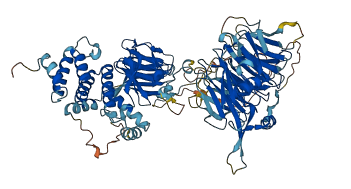
Descriptions
The autoinhibited protein was predicted that may have potential autoinhibitory elements via cis-regPred.
Autoinhibitory domains (AIDs)
Target domain |
|
Relief mechanism |
|
Assay |
cis-regPred |
Accessory elements
No accessory elements
Autoinhibited structure

Activated structure
1 structures for Q6CM99
| Entry ID | Method | Resolution | Chain | Position | Source |
|---|---|---|---|---|---|
| AF-Q6CM99-F1 | Predicted | AlphaFoldDB |
No variants for Q6CM99
| Variant ID(s) | Position | Change | Description | Diseaes Association | Provenance |
|---|---|---|---|---|---|
| No variants for Q6CM99 | |||||
No associated diseases with Q6CM99
No regional properties for Q6CM99
| Type | Name | Position | InterPro Accession |
|---|---|---|---|
| No domain, repeats, and functional sites for Q6CM99 | |||
3 GO annotations of cellular component
| Name | Definition |
|---|---|
| cytosol | The part of the cytoplasm that does not contain organelles but which does contain other particulate matter, such as protein complexes. |
| HIR complex | A protein complex proposed to be involved in replication-independent nucleosome assembly, by promoting histone deposition onto DNA. For example, in Saccharomyces, the complex contains Hir1p, Hir2p, Hir3p, and Hpc2p. |
| nucleus | A membrane-bounded organelle of eukaryotic cells in which chromosomes are housed and replicated. In most cells, the nucleus contains all of the cell's chromosomes except the organellar chromosomes, and is the site of RNA synthesis and processing. In some species, or in specialized cell types, RNA metabolism or DNA replication may be absent. |
3 GO annotations of molecular function
| Name | Definition |
|---|---|
| DNA binding | Any molecular function by which a gene product interacts selectively and non-covalently with DNA (deoxyribonucleic acid). |
| nucleosome binding | Binding to a nucleosome, a complex comprised of DNA wound around a multisubunit core and associated proteins, which forms the primary packing unit of DNA into higher order structures. |
| transcription corepressor activity | A transcription coregulator activity that represses or decreases the transcription of specific gene sets via binding to a DNA-bound DNA-binding transcription factor, either on its own or as part of a complex. Corepressors often act by altering chromatin structure and modifications. For example, one class of transcription corepressors modifies chromatin structure through covalent modification of histones. A second class remodels the conformation of chromatin in an ATP-dependent fashion. A third class modulates interactions of DNA-bound DNA-binding transcription factors with other transcription coregulators. |
5 GO annotations of biological process
| Name | Definition |
|---|---|
| negative regulation of chromatin organization | Any process that stops, prevents or reduces the frequency, rate or extent of chromatin organization. |
| negative regulation of transcription by RNA polymerase II | Any process that stops, prevents, or reduces the frequency, rate or extent of transcription mediated by RNA polymerase II. |
| negative regulation of transcription by RNA polymerase III | Any process that stops, prevents, or reduces the frequency, rate or extent of transcription mediated by RNA polymerase III. |
| nucleosome assembly | The aggregation, arrangement and bonding together of a nucleosome, the beadlike structural units of eukaryotic chromatin composed of histones and DNA. |
| transcription elongation by RNA polymerase II promoter | The extension of an RNA molecule after transcription initiation and promoter clearance at an RNA polymerase II promoter by the addition of ribonucleotides catalyzed by RNA polymerase II. |
No homologous proteins in AiPD
| UniProt AC | Gene Name | Protein Name | Species | Evidence Code |
|---|---|---|---|---|
| No homologous proteins | ||||
| 10 | 20 | 30 | 40 | 50 | 60 |
| MKLLKLPSKL | HDGQLTQCEV | DDNKLYIIGG | KYLSIWDSQT | LLNAATGKTD | VKEVKELEKM |
| 70 | 80 | 90 | 100 | 110 | 120 |
| SLDLLESNQE | DGRWLVVLDN | QRLVYGSDHL | LACLDLNKDS | NSEYKSREIG | IFKDNEAITD |
| 130 | 140 | 150 | 160 | 170 | 180 |
| LKYDKVNGLL | FVSLSKANSL | QIMDSKTWEL | KSSIELKSKP | ISIITDPLGQ | LLTVILQNRS |
| 190 | 200 | 210 | 220 | 230 | 240 |
| VQIYQYDSHG | TTKLHQSINQ | FVQTNPLPYR | MTMSPQGDVI | PMINSLHNNV | PTAVLLDRIQ |
| 250 | 260 | 270 | 280 | 290 | 300 |
| KFKIKLSLVG | YVADCKILKF | SPRIYSKTKS | PTSNDTQTFN | LLASSGNEDG | NVVVWNTNRI |
| 310 | 320 | 330 | 340 | 350 | 360 |
| KPLFDASKVV | NSYITDLEWD | NSGLGLFAIS | QDGQLVIFAF | QENELGDVMP | VEAVTEAAKE |
| 370 | 380 | 390 | 400 | 410 | 420 |
| IKLLDPLPFK | PKAEEPDTKL | PPNKTAQQTT | TNSKKQPKAA | EITTISSTNM | EFIQPSYMVP |
| 430 | 440 | 450 | 460 | 470 | 480 |
| KDLKRKPVTE | DPLLAQNKPA | NKKAKKELDQ | IDFLDTNLFL | PSVSFSKVRL | AHPKIRASFQ |
| 490 | 500 | 510 | 520 | 530 | 540 |
| YSSQGNFVLD | IKNGLGNDQK | PTSITLTRKD | NESSKQLFQT | FLPKFVTLCS | AGSSFWAWST |
| 550 | 560 | 570 | 580 | 590 | 600 |
| DTGMIYVTSI | SGQMLFPPML | LGVPVSFLEG | SGDYLLCITS | IGQMYCWNVN | TGKIAFPIND |
| 610 | 620 | 630 | 640 | 650 | 660 |
| VYSLLNPMLR | YSDDVLSRAE | NITMCAVTSQ | GIPIVTLSNG | DGYMFDSAME | AWMLINDSWW |
| 670 | 680 | 690 | 700 | 710 | 720 |
| PYGSQYWNFM | SSAGVDLTSN | DDEKKDKYWN | AEADILAKEV | KNNKNSIINY | LETKTNDELT |
| 730 | 740 | 750 | 760 | 770 | 780 |
| RKGRMKHLQR | FAKVLLMKEG | FENLEEMITL | AHLENKILVS | FRLKEVEEAI | RLLKIYCIRI |
| 790 | 800 | 810 | 820 | 830 | 840 |
| AEMGYTDRFS | QTLSWLYDPT | NTKFSPLDID | RRRNLIKDII | ISCANIRQVQ | RVTTSYANEL |
| GVISDSL |