Q6CKK7
Gene name |
POX1 (KLLA0F09933g) |
Protein name |
Acyl-coenzyme A oxidase |
Names |
Acyl-CoA oxidase |
Species |
Kluyveromyces lactis (strain ATCC 8585 / CBS 2359 / DSM 70799 / NBRC 1267 / NRRL Y-1140 / WM37) (Yeast) (Candida sphaerica) |
KEGG Pathway |
kla:KLLA0_F09933g |
EC number |
1.3.3.6: With oxygen as acceptor |
Protein Class |
|
Descriptions
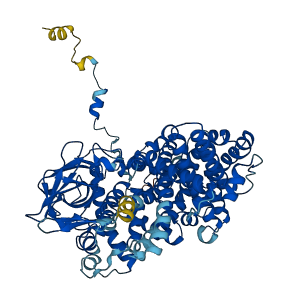
The autoinhibited protein was predicted that may have potential autoinhibitory elements via cis-regPred.
Autoinhibitory domains (AIDs)
Target domain |
|
Relief mechanism |
|
Assay |
cis-regPred |
Accessory elements
No accessory elements
Autoinhibited structure

Activated structure
1 structures for Q6CKK7
| Entry ID | Method | Resolution | Chain | Position | Source |
|---|---|---|---|---|---|
| AF-Q6CKK7-F1 | Predicted | AlphaFoldDB |
No variants for Q6CKK7
| Variant ID(s) | Position | Change | Description | Diseaes Association | Provenance |
|---|---|---|---|---|---|
| No variants for Q6CKK7 | |||||
No associated diseases with Q6CKK7
Functions
| Description | ||
|---|---|---|
| EC Number | 1.3.3.6 | With oxygen as acceptor |
| Subcellular Localization |
|
|
| PANTHER Family | ||
| PANTHER Subfamily | ||
| PANTHER Protein Class | ||
| PANTHER Pathway Category | No pathway information available | |
1 GO annotations of cellular component
| Name | Definition |
|---|---|
| peroxisomal matrix | The volume contained within the membranes of a peroxisome; in many cells the matrix contains a crystalloid core largely composed of urate oxidase. |
2 GO annotations of molecular function
| Name | Definition |
|---|---|
| acyl-CoA oxidase activity | Catalysis of the reaction: acyl-CoA + O2 = trans-2,3-dehydroacyl-CoA + hydrogen peroxide. |
| FAD binding | Binding to the oxidized form, FAD, of flavin-adenine dinucleotide, the coenzyme or the prosthetic group of various flavoprotein oxidoreductase enzymes. |
1 GO annotations of biological process
| Name | Definition |
|---|---|
| fatty acid beta-oxidation using acyl-CoA oxidase | A fatty acid beta-oxidation pathway in which the initial step, which converts an acyl-CoA to a trans-2-enoyl-CoA, is catalyzed by acyl-CoA oxidase; the electrons removed by oxidation pass directly to oxygen and produce hydrogen peroxide, which is cleaved by peroxisomal catalases. Fatty acid beta-oxidation begins with the addition of coenzyme A to a fatty acid, and ends when only two or three carbons remain (as acetyl-CoA or propionyl-CoA respectively). |
No homologous proteins in AiPD
| UniProt AC | Gene Name | Protein Name | Species | Evidence Code |
|---|---|---|---|---|
| No homologous proteins | ||||
| 10 | 20 | 30 | 40 | 50 | 60 |
| MTRQSTVDQN | QSTYNAKNFI | TKERQESKLD | IDQLNVFLEN | GEQEAKLTHD | LIEEIINDPI |
| 70 | 80 | 90 | 100 | 110 | 120 |
| LKTDTDHYDI | TKSQEREITA | RRIARLSLYM | EHDVKTKQRE | FKDDLVKNLE | RKDSKLLTNK |
| 130 | 140 | 150 | 160 | 170 | 180 |
| DLSIFDRRLS | LVANIDPGLS | TRIGVHLGLF | GNCIKGNGTD | EQIHYWLQEK | GALLLKGIYG |
| 190 | 200 | 210 | 220 | 230 | 240 |
| CFAMTELGHG | SNVAQLQTTA | TYDPSSDTFK | INTPDLLATK | WWIGGAAHSA | THTTAYARLI |
| 250 | 260 | 270 | 280 | 290 | 300 |
| VNGKDYGVKT | FVVPLRDEKT | LNLLPGIMIG | DIGAKMGRDG | IDNGWIQFKN | VVIPRQFMLQ |
| 310 | 320 | 330 | 340 | 350 | 360 |
| RFTKVIPGSP | PKVQTQPLLD | QISGYSALLS | GRVNMVMDSF | RFGSKFAIIA | TRYAVGRQQF |
| 370 | 380 | 390 | 400 | 410 | 420 |
| GPEGNETQLI | DYPLHQYRVL | PQLALCYLVA | PTAHKLMGTY | ISTLMELHQA | GADKAKLINV |
| 430 | 440 | 450 | 460 | 470 | 480 |
| SNKLKDLFID | SASLKATNTW | LVAKLIDDLR | QTCGGHGYSS | YNGFGKGYND | WVVQCTWEGD |
| 490 | 500 | 510 | 520 | 530 | 540 |
| NNILSLTSAK | SIVKKFADIS | RGKNTTVTTD | SLKYLTPQFI | GKSLSKDLTF | KFDNKKDFTE |
| 550 | 560 | 570 | 580 | 590 | 600 |
| IWAVMIIRLI | HHVVELISKG | TKIDSLSKTL | VQISKFHAIH | SMLLTYQDKL | NNESEASVKD |
| 610 | 620 | 630 | 640 | 650 | 660 |
| AYTKGYLWKL | YELFSLYFID | QHLGEFLLLK | VVTSDQMSQV | LQPRLLQLLP | EIRKECIALT |
| 670 | 680 | 690 | 700 | 710 | 720 |
| DAFKLPDAMI | NAPIGYYDGD | IYHNYFNEVT | NNNKLEPDGA | GRPPYYPLLT | SMLGRDDFQN |
| 730 | |||||
| RLGGSFESET | LDSLLK |