Q6CJA8
Gene name |
HOG1 (KLLA0F20053g) |
Protein name |
Mitogen-activated protein kinase HOG1 |
Names |
MAP kinase HOG1 |
Species |
Kluyveromyces lactis (strain ATCC 8585 / CBS 2359 / DSM 70799 / NBRC 1267 / NRRL Y-1140 / WM37) (Yeast) (Candida sphaerica) |
KEGG Pathway |
kla:KLLA0_F20053g |
EC number |
2.7.11.24: Protein-serine/threonine kinases |
Protein Class |
|
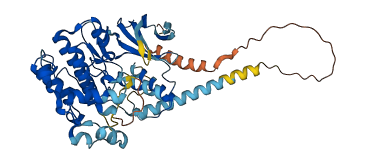
Descriptions
The autoinhibited protein was predicted that may have potential autoinhibitory elements via cis-regPred.
Autoinhibitory domains (AIDs)
Target domain |
|
Relief mechanism |
|
Assay |
cis-regPred |
Accessory elements
160-180 (Activation loop from InterPro)
Target domain |
22-301 (Protein kinase domain) |
Relief mechanism |
|
Assay |
|
Autoinhibited structure

Activated structure
1 structures for Q6CJA8
| Entry ID | Method | Resolution | Chain | Position | Source |
|---|---|---|---|---|---|
| AF-Q6CJA8-F1 | Predicted | AlphaFoldDB |
No variants for Q6CJA8
| Variant ID(s) | Position | Change | Description | Diseaes Association | Provenance |
|---|---|---|---|---|---|
| No variants for Q6CJA8 | |||||
No associated diseases with Q6CJA8
4 regional properties for Q6CJA8
| Type | Name | Position | InterPro Accession |
|---|---|---|---|
| domain | Protein kinase domain | 22 - 301 | IPR000719 |
| conserved_site | Mitogen-activated protein (MAP) kinase, conserved site | 57 - 155 | IPR003527 |
| active_site | Serine/threonine-protein kinase, active site | 139 - 151 | IPR008271 |
| binding_site | Protein kinase, ATP binding site | 28 - 52 | IPR017441 |
Functions
| Description | ||
|---|---|---|
| EC Number | 2.7.11.24 | Protein-serine/threonine kinases |
| Subcellular Localization |
|
|
| PANTHER Family | ||
| PANTHER Subfamily | ||
| PANTHER Protein Class | ||
| PANTHER Pathway Category | No pathway information available | |
4 GO annotations of cellular component
| Name | Definition |
|---|---|
| chromatin | The ordered and organized complex of DNA, protein, and sometimes RNA, that forms the chromosome. |
| mitochondrial inner membrane | The inner, i.e. lumen-facing, lipid bilayer of the mitochondrial envelope. It is highly folded to form cristae. |
| mitochondrial intermembrane space | The region between the inner and outer lipid bilayers of the mitochondrial envelope. |
| nucleus | A membrane-bounded organelle of eukaryotic cells in which chromosomes are housed and replicated. In most cells, the nucleus contains all of the cell's chromosomes except the organellar chromosomes, and is the site of RNA synthesis and processing. In some species, or in specialized cell types, RNA metabolism or DNA replication may be absent. |
6 GO annotations of molecular function
| Name | Definition |
|---|---|
| ATP binding | Binding to ATP, adenosine 5'-triphosphate, a universally important coenzyme and enzyme regulator. |
| calmodulin binding | Binding to calmodulin, a calcium-binding protein with many roles, both in the calcium-bound and calcium-free states. |
| chromatin binding | Binding to chromatin, the network of fibers of DNA, protein, and sometimes RNA, that make up the chromosomes of the eukaryotic nucleus during interphase. |
| MAP kinase activity | Catalysis of the reaction: protein + ATP = protein phosphate + ADP. This reaction is the phosphorylation of proteins. Mitogen-activated protein kinase; a family of protein kinases that perform a crucial step in relaying signals from the plasma membrane to the nucleus. They are activated by a wide range of proliferation- or differentiation-inducing signals; activation is strong with agonists such as polypeptide growth factors and tumor-promoting phorbol esters, but weak (in most cell backgrounds) by stress stimuli. |
| protein serine kinase activity | Catalysis of the reactions: ATP + protein serine = ADP + protein serine phosphate. |
| RNA polymerase II CTD heptapeptide repeat kinase activity | Catalysis of the reaction: ATP + RNA polymerase II large subunit CTD heptapeptide repeat (YSPTSPS) = ADP + H+ + phosphorylated RNA polymerase II. |
16 GO annotations of biological process
| Name | Definition |
|---|---|
| hyperosmotic response | Any process that results in a change in state or activity of a cell or an organism (in terms of movement, secretion, enzyme production, gene expression, etc.) as a result of detection of, or exposure to, a hyperosmotic environment, i.e. an environment with a higher concentration of solutes than the organism or cell. |
| negative regulation of cytoplasmic translational initiation in response to stress | Any process that stops, prevents or reduces the rate of cytoplasmic translation initiation as a result of a stimulus indicating the organism is under stress. |
| negative regulation of exit from mitosis | Any process involved in the inhibition of progression from anaphase/telophase (high mitotic CDK activity) to G1 (low mitotic CDK activity). |
| negative regulation of G2/M transition of mitotic cell cycle | Any signalling pathway that decreases or inhibits the activity of a cell cycle cyclin-dependent protein kinase to modulate the switch from G2 phase to M phase of the mitotic cell cycle. |
| negative regulation of induction of conjugation with cellular fusion | Any process that stops, prevents, or reduces the frequency or rate of initiation of conjugation with cellular fusion. |
| osmosensory signaling pathway | The series of molecular signals initiated in response to osmotic change. |
| p38MAPK cascade | An intracellular protein kinase cascade containing at least a p38 MAPK, a MAPKK and a MAP3K. The cascade can also contain an additional tier: the upstream MAP4K. The kinases in each tier phosphorylate and activate the kinases in the downstream tier to transmit a signal within a cell. |
| positive regulation of G2/M transition of mitotic cell cycle | Any signalling pathway that activates or increases the activity of a cell cycle cyclin-dependent protein kinase to modulate the switch from G2 phase to M phase of the mitotic cell cycle. |
| positive regulation of protein import into nucleus | Any process that activates or increases the frequency, rate or extent of movement of proteins from the cytoplasm into the nucleus. |
| positive regulation of transcription from RNA polymerase II promoter in response to oxidative stress | Any process that increases the frequency, rate or extent of transcription from an RNA polymerase II promoter as a result of a stimulus indicating the organism is under oxidative stress, a state often resulting from exposure to high levels of reactive oxygen species, e.g. superoxide anions, hydrogen peroxide (H2O2), and hydroxyl radicals. |
| protein phosphorylation | The process of introducing a phosphate group on to a protein. |
| regulation of aerobic respiration | Any process that modulates the frequency, rate or extent of aerobic respiration. |
| regulation of macroautophagy | Any process that modulates the frequency, rate or extent of macroautophagy. |
| regulation of meiotic cell cycle | Any process that modulates the rate or extent of progression through the meiotic cell cycle. |
| regulation of nuclear cell cycle DNA replication | Any process that modulates the frequency, rate or extent of The DNA-dependent DNA replication that occurs in the nucleus of eukaryotic organisms as part of the cell cycle. |
| regulation of reciprocal meiotic recombination | Any process that modulates the frequency, rate or extent of recombination during meiosis. Reciprocal meiotic recombination is the cell cycle process in which double strand breaks are formed and repaired through a double Holliday junction intermediate. |
No homologous proteins in AiPD
| UniProt AC | Gene Name | Protein Name | Species | Evidence Code |
|---|---|---|---|---|
| No homologous proteins | ||||
| 10 | 20 | 30 | 40 | 50 | 60 |
| MSNEEFIRTQ | IFGTVFEITN | RYTNLNPVGM | GAFGLVCSAT | DTLTSQPVAI | KKIMKPFSTS |
| 70 | 80 | 90 | 100 | 110 | 120 |
| VLAKRTYREL | KLLKHLRHEN | LICLEDIFLS | PLEDIYFVTE | LQGTDLHRLL | QTRPLEKQFV |
| 130 | 140 | 150 | 160 | 170 | 180 |
| QYFLYQILRG | LKYVHSAGVI | HRDLKPSNIL | INENCDLKIC | DFGLARIQDP | QMTGYVSTRY |
| 190 | 200 | 210 | 220 | 230 | 240 |
| YRAPEIMLTW | QKYNVEVDIW | SAGCIFAEMI | EGKPLFPGKD | HVHQFSIITD | LLGSPPKDVI |
| 250 | 260 | 270 | 280 | 290 | 300 |
| DTICSENTLK | FVTSLPHRDP | VPFSSRFQNL | EPDAIDLLEK | MLVFDPKKRI | TAADALAHPY |
| 310 | 320 | 330 | 340 | 350 | 360 |
| LSPYHDPTDE | PIAEAKFDWN | FNDADLPVDT | WRVMMYSEIL | DFHQIGDPQI | NTNATFDDQV |
| 370 | 380 | 390 | 400 | 410 | 420 |
| AAATVAAAEA | ASKQQQQQQH | QTEEQTQQTI | ASTPPQAQVT | PQQLESGANS | NSNSNPSFSI |
| 430 | 440 | ||||
| GPDPANETLT | NFANQADQYV | SKFK |