Q6CEE1
Gene name |
ARG2 (YALI0B16390g) |
Protein name |
Amino-acid acetyltransferase, mitochondrial |
Names |
Arginine-requiring protein 2, Glutamate N-acetyltransferase, N-acetylglutamate synthase, AGS, NAGS |
Species |
Yarrowia lipolytica (strain CLIB 122 / E 150) (Yeast) (Candida lipolytica) |
KEGG Pathway |
yli:YALI0B16390g |
EC number |
2.3.1.1: Transferring groups other than amino-acyl groups |
Protein Class |
|
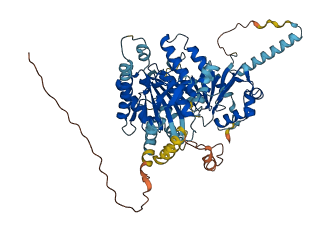
Descriptions
The autoinhibited protein was predicted that may have potential autoinhibitory elements via cis-regPred.
Autoinhibitory domains (AIDs)
Target domain |
|
Relief mechanism |
|
Assay |
cis-regPred |
Accessory elements
No accessory elements
Autoinhibited structure

Activated structure
1 structures for Q6CEE1
| Entry ID | Method | Resolution | Chain | Position | Source |
|---|---|---|---|---|---|
| AF-Q6CEE1-F1 | Predicted | AlphaFoldDB |
No variants for Q6CEE1
| Variant ID(s) | Position | Change | Description | Diseaes Association | Provenance |
|---|---|---|---|---|---|
| No variants for Q6CEE1 | |||||
No associated diseases with Q6CEE1
Functions
| Description | ||
|---|---|---|
| EC Number | 2.3.1.1 | Transferring groups other than amino-acyl groups |
| Subcellular Localization |
|
|
| PANTHER Family | ||
| PANTHER Subfamily | ||
| PANTHER Protein Class | ||
| PANTHER Pathway Category | No pathway information available | |
1 GO annotations of cellular component
| Name | Definition |
|---|---|
| mitochondrial matrix | The gel-like material, with considerable fine structure, that lies in the matrix space, or lumen, of a mitochondrion. It contains the enzymes of the tricarboxylic acid cycle and, in some organisms, the enzymes concerned with fatty acid oxidation. |
2 GO annotations of molecular function
| Name | Definition |
|---|---|
| acetyl-CoA:L-glutamate N-acetyltransferase activity | Catalysis of the reaction: L-glutamate + acetyl-CoA = N-acetyl-L-glutamate + CoA + H(+). |
| methione N-acyltransferase activity | Catalysis of the reaction: L-methionine + acetyl-CoA = N-acetyl-L-methionine + coenzyme A + H+. |
2 GO annotations of biological process
| Name | Definition |
|---|---|
| arginine biosynthetic process | The chemical reactions and pathways resulting in the formation of arginine, 2-amino-5-(carbamimidamido)pentanoic acid. |
| ornithine biosynthetic process | The chemical reactions and pathways resulting in the formation of ornithine, an amino acid only rarely found in proteins, but which is important in living organisms as an intermediate in the reactions of the urea cycle and in arginine biosynthesis. |
No homologous proteins in AiPD
| UniProt AC | Gene Name | Protein Name | Species | Evidence Code |
|---|---|---|---|---|
| No homologous proteins | ||||
| 10 | 20 | 30 | 40 | 50 | 60 |
| MLRSSRITAG | TCVSRGWHSY | TTKTPTKTAI | PPAAKSSNEA | KDLILSVLQS | AATKREAKTY |
| 70 | 80 | 90 | 100 | 110 | 120 |
| ISRYAPLTGV | ELQKKKEGLV | QRLLGVGKEQ | DNKEIENLTG | HAPEGLLGDS | EGTLRVAIIK |
| 130 | 140 | 150 | 160 | 170 | 180 |
| IRDIKSIEDD | LIAQMGETIA | RLSRLGVSPI | VVVDAGKARN | DFLKLDNKPF | RHYQKLILQK |
| 190 | 200 | 210 | 220 | 230 | 240 |
| VFKISDAIDA | ASPDVGARPI | EGLFSMNKKG | LRLAMPQMLM | HPLSHGKVPV | LAPLAYDDVT |
| 250 | 260 | 270 | 280 | 290 | 300 |
| SEEKLVMADD | VVHFLTQKLA | EVPANILSVE | KIIFVDPLGG | IPSVERSGAH | VFVNLKQELS |
| 310 | 320 | 330 | 340 | 350 | 360 |
| DIAAELHMGF | IPPAQREVHL | ANLKAMHKAL | KFLPPTASGL | ITTPAVAAIP | SVGRNPIIYN |
| 370 | 380 | 390 | 400 | 410 | 420 |
| VLTDRPVISP | SLPVELKKTP | TLETTLLREG | MPVITLKSDK | GLNLITEHEK | GNIDLDRLWH |
| 430 | 440 | 450 | 460 | 470 | 480 |
| LIEDSFGRRI | DKQHYLNRVN | GKIAGIIIAG | DYEGAAIITW | EDIDPVKAQE | DRDAADRAAA |
| 490 | 500 | 510 | 520 | 530 | 540 |
| EAAAAYAAGI | PLPSPPLYQK | LGDAVPLNPN | QVAYLDKFAV | LKRSQGSSSV | ADVVFKGMVM |
| 550 | 560 | 570 | 580 | 590 | 600 |
| SQFPNELLWR | SRKNNPVNKW | YFDRSKGSFK | IPGSEWCMFW | TGRKTREQYL | ERFVDICTRI |
| EPSLREEL |