Q6C4J0
Gene name |
POL2 (YALI0E26367g) |
Protein name |
DNA polymerase epsilon catalytic subunit A |
Names |
DNA polymerase II subunit A |
Species |
Yarrowia lipolytica (strain CLIB 122 / E 150) (Yeast) (Candida lipolytica) |
KEGG Pathway |
yli:YALI0E26367g |
EC number |
2.7.7.7: Nucleotidyltransferases |
Protein Class |
|
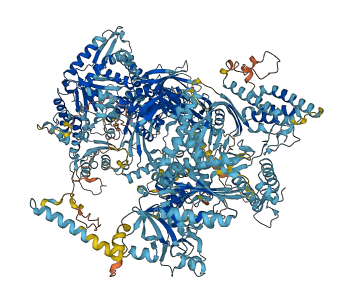
Descriptions
The autoinhibited protein was predicted that may have potential autoinhibitory elements via cis-regPred.
Autoinhibitory domains (AIDs)
Target domain |
|
Relief mechanism |
|
Assay |
cis-regPred |
Accessory elements
No accessory elements
Autoinhibited structure

Activated structure
1 structures for Q6C4J0
| Entry ID | Method | Resolution | Chain | Position | Source |
|---|---|---|---|---|---|
| AF-Q6C4J0-F1 | Predicted | AlphaFoldDB |
No variants for Q6C4J0
| Variant ID(s) | Position | Change | Description | Diseaes Association | Provenance |
|---|---|---|---|---|---|
| No variants for Q6C4J0 | |||||
No associated diseases with Q6C4J0
3 regional properties for Q6C4J0
Functions
| Description | ||
|---|---|---|
| EC Number | 2.7.7.7 | Nucleotidyltransferases |
| Subcellular Localization |
|
|
| PANTHER Family | ||
| PANTHER Subfamily | ||
| PANTHER Protein Class | ||
| PANTHER Pathway Category | No pathway information available | |
2 GO annotations of cellular component
| Name | Definition |
|---|---|
| epsilon DNA polymerase complex | A heterotetrameric DNA polymerase complex that catalyzes processive DNA synthesis in the absence of PCNA, but is further stimulated in the presence of PCNA. The complex contains a large catalytic subunit and three small subunits, and is best characterized in Saccharomyces, in which the subunits are named Pol2p, Dpb2p, Dpb3p, and Dpb4p. Some evidence suggests that DNA polymerase epsilon is the leading strand polymerase; it is also involved in nucleotide-excision repair and mismatch repair. |
| nuclear replication fork | The Y-shaped region of a nuclear replicating DNA molecule, resulting from the separation of the DNA strands and in which the synthesis of new strands takes place. Also includes associated protein complexes. |
9 GO annotations of molecular function
| Name | Definition |
|---|---|
| 4 iron, 4 sulfur cluster binding | Binding to a 4 iron, 4 sulfur (4Fe-4S) cluster; this cluster consists of four iron atoms, with the inorganic sulfur atoms found between the irons and acting as bridging ligands. |
| DNA binding | Any molecular function by which a gene product interacts selectively and non-covalently with DNA (deoxyribonucleic acid). |
| DNA-directed DNA polymerase activity | Catalysis of the reaction: deoxynucleoside triphosphate + DNA(n) = diphosphate + DNA(n+1); the synthesis of DNA from deoxyribonucleotide triphosphates in the presence of a DNA template and a 3'hydroxyl group. |
| double-stranded DNA binding | Binding to double-stranded DNA. |
| nucleotide binding | Binding to a nucleotide, any compound consisting of a nucleoside that is esterified with (ortho)phosphate or an oligophosphate at any hydroxyl group on the ribose or deoxyribose. |
| single-stranded DNA 3'-5' exodeoxyribonuclease activity | Catalysis of the sequential cleavage of mononucleotides from a free 3' terminus of a single-stranded DNA molecule. |
| single-stranded DNA binding | Binding to single-stranded DNA. |
| SUMO binding | Binding to the small ubiquitin-like protein SUMO. |
| zinc ion binding | Binding to a zinc ion (Zn). |
11 GO annotations of biological process
| Name | Definition |
|---|---|
| base-excision repair, gap-filling | Repair of the damaged strand by the combined action of an apurinic endouclease that degrades a few bases on the damaged strand and a polymerase that synthesizes a 'patch' in the 5' to 3' direction, using the undamaged strand as a template. |
| DNA replication proofreading | Correction of replication errors by DNA polymerase using a 3'-5' exonuclease activity. |
| double-strand break repair via nonhomologous end joining | The repair of a double-strand break in DNA in which the two broken ends are rejoined with little or no sequence complementarity. Information at the DNA ends may be lost due to the modification of broken DNA ends. This term covers instances of separate pathways, called classical (or canonical) and alternative nonhomologous end joining (C-NHEJ and A-NHEJ). These in turn may further branch into sub-pathways, but evidence is still unclear. |
| error-prone translesion synthesis | The conversion of DNA-damage induced single-stranded gaps into large molecular weight DNA after replication by using a specialized DNA polymerase or replication complex to insert a defined nucleotide across the lesion. This process does not remove the replication-blocking lesions and causes an increase in the endogenous mutation level. For example, in E. coli, a low fidelity DNA polymerase, pol V, copies lesions that block replication fork progress. This produces mutations specifically targeted to DNA template damage sites, but it can also produce mutations at undamaged sites. |
| gene conversion | A DNA recombination process that results in the unidirectional transfer of genetic material from a donor sequence to a highly homologous acceptor. The resulting acceptor sequence is identical to that of the donor. |
| leading strand elongation | The process in which an existing DNA strand is extended continuously in a 5' to 3' direction by activities including the addition of nucleotides to the 3' end of the strand, complementary to an existing template, as part of DNA replication. Leading strand elongation proceeds in the same direction as the replication fork. |
| mitotic cell cycle | Progression through the phases of the mitotic cell cycle, the most common eukaryotic cell cycle, which canonically comprises four successive phases called G1, S, G2, and M and includes replication of the genome and the subsequent segregation of chromosomes into daughter cells. In some variant cell cycles nuclear replication or nuclear division may not be followed by cell division, or G1 and G2 phases may be absent. |
| mitotic DNA replication checkpoint signaling | A signal transduction process that contributes to a mitotic DNA replication checkpoint. |
| mitotic intra-S DNA damage checkpoint signaling | A mitotic cell cycle checkpoint that slows DNA synthesis in response to DNA damage by the prevention of new origin firing and the stabilization of slow replication fork progression. |
| mitotic sister chromatid cohesion | The cell cycle process in which the sister chromatids of a replicated chromosome are joined along the entire length of the chromosome, from their formation in S phase through metaphase during a mitotic cell cycle. This cohesion cycle is critical for high fidelity chromosome transmission. |
| nucleotide-excision repair, DNA gap filling | Repair of the gap in the DNA helix by DNA polymerase and DNA ligase after the portion of the strand containing the lesion has been removed by pyrimidine-dimer repair enzymes. |
No homologous proteins in AiPD
| UniProt AC | Gene Name | Protein Name | Species | Evidence Code |
|---|---|---|---|---|
| No homologous proteins | ||||
| 10 | 20 | 30 | 40 | 50 | 60 |
| MGRPFNGNNT | HVVKQRSDEF | ERRRLERIEQ | LGQKFAAVER | RDAIDDRMGF | TRFSGDEKRV |
| 70 | 80 | 90 | 100 | 110 | 120 |
| GWLVNMHETL | LQSETAERGL | AAVDYYFYDE | EGGNFKSTVV | FRPYFFVICK | PHTEHAVKDL |
| 130 | 140 | 150 | 160 | 170 | 180 |
| MEKMFERVLA | STEIVTKEDL | NLTNHLTGKK | RKAVKLEFHN | SEDLSSTRFT | LSKIVDRQTQ |
| 190 | 200 | 210 | 220 | 230 | 240 |
| QTEQHLNIYE | LEGDVDTSTD | VESSITGIKE | FDVPFETRVA | IDLDIRVGNW | YEVTKENDTA |
| 250 | 260 | 270 | 280 | 290 | 300 |
| VLKHMVEREY | RADPVVMAYD | IETEKAPLRF | PDSAVDRIMM | ISYMIDGEGF | LITNREMVSE |
| 310 | 320 | 330 | 340 | 350 | 360 |
| DIEDFEYTPK | PEFPGNFTIF | NEPNEKAVLE | KWFEHIRDVC | PTVMTSYNGD | FFDFPFIDKR |
| 370 | 380 | 390 | 400 | 410 | 420 |
| TAFHGMNLYD | EIGWKKVEEE | RYECSYCVHM | DCLNWVKRDS | YLPQGSQGLK | AVTKVKLSYD |
| 430 | 440 | 450 | 460 | 470 | 480 |
| PKELDPEKMT | PYARDHPQIL | AEYSVSDAVA | TYYLYMKYVH | PFIFSLCCII | PLNPDAVLRK |
| 490 | 500 | 510 | 520 | 530 | 540 |
| GTGTLCEMLL | MVKAYEGRII | LPDKHKPALE | RHYKGHLVDN | ETYTGGHVES | LAAGVFRSDI |
| 550 | 560 | 570 | 580 | 590 | 600 |
| MVDFDIDTNS | IDELLVNLDE | TLEFCVTVEA | GKKSSDFENL | DEVRDQIIEQ | LQELKSNPKR |
| 610 | 620 | 630 | 640 | 650 | 660 |
| SDYPLIYHVD | VASMYPNIMT | TNRLQPDSMV | DEKDCAVCDY | NRPDKTCARE | LEWARRVDYY |
| 670 | 680 | 690 | 700 | 710 | 720 |
| PVSKGDVNNL | KQGLVEEYSG | GRFGNGSSVE | ISYDEGMTER | EKFQKRKGWA | GLSGQEQANK |
| 730 | 740 | 750 | 760 | 770 | 780 |
| LKERVAAFSL | KTKARKTDSE | TTVQKTIVCQ | RENPFYVDVV | QEFKQRRIDY | KTKAKRWNKE |
| 790 | 800 | 810 | 820 | 830 | 840 |
| AASASDPASR | EEAKKMAITN | DSMQLAHKVI | LNSFYGYVMR | KGSRWYSMEM | AGVTCYTGAK |
| 850 | 860 | 870 | 880 | 890 | 900 |
| IIKIARQTME | GLGIPLELDT | DGIWCMLPKT | FPEKFKCKFK | DGSSYELEYP | CSIMNYLVHR |
| 910 | 920 | 930 | 940 | 950 | 960 |
| DFTNHQYQKL | NPETGKYDTH | SENSIFFELD | GPYKCMMMPT | STDKGKGLKK | RYVVFDDRNK |
| 970 | 980 | 990 | 1000 | 1010 | 1020 |
| IVELKGFEVK | RRGELSLIKK | FQSQLWDTFL | EGSNLVECYA | AQARVAEAWL | AVIDSRGKNL |
| 1030 | 1040 | 1050 | 1060 | 1070 | 1080 |
| SDEELIDLVC | ENKSMSKPVH | EYGSQKSTAL | TTARRLAEIM | GDSILTGGKL | STKYIIAVRT |
| 1090 | 1100 | 1110 | 1120 | 1130 | 1140 |
| KNSMPVPEAK | KGSDEDSSTA | DRAIPTLVFE | TESLDEKLRF | LKRWMGPRWE | STDPRDVIDW |
| 1150 | 1160 | 1170 | 1180 | 1190 | 1200 |
| MYYRERLATT | INKLVVIPAI | LLGLKNPVRG | CDPPEWASDI | IKQRDNPIKQ | STLSSYFVKG |
| 1210 | 1220 | 1230 | 1240 | 1250 | 1260 |
| KLPTPEPILS | EEDEVMEIQV | GDIESIGTTP | SPSRPPGVPA | RVVVSKRVRK | TVEETDKSTP |
| 1270 | 1280 | 1290 | 1300 | 1310 | 1320 |
| SLPHKAPDPF | ADYAAYIKYA | KVKWKHQKAQ | RDRRAHLFGE | SDNGIASSWV | SKNAHLAQDA |
| 1330 | 1340 | 1350 | 1360 | 1370 | 1380 |
| WHLVSIHAAE | KPGQVEASVI | IGDKMQRVQI | NVPRKVYVGS | REPLKWDKFT | DVTNAMAVAE |
| 1390 | 1400 | 1410 | 1420 | 1430 | 1440 |
| EEQPKYLYRA | VMSEDMYQTE | MTNPESPLKD | PHVTKIYEAD | VSPDSRALIE | LGSTFHLDAS |
| 1450 | 1460 | 1470 | 1480 | 1490 | 1500 |
| TPGILSKGFT | HGFEAKWFKS | GDSRSYLQNS | GLSYAHIVHV | VSSAVEIFVI | TPTWDAPALV |
| 1510 | 1520 | 1530 | 1540 | 1550 | 1560 |
| FVHQSSSSEK | LPDISKEYAR | LRRGERYKQN | MDDCTVFSFP | DTMQYEVEYC | SNHRRMLQKV |
| 1570 | 1580 | 1590 | 1600 | 1610 | 1620 |
| SKACDSLSGS | RNGQLVFALH | SPDRNVDEKV | AALARIPCIR | LRPVPPSTAA | VGWQRDLVRR |
| 1630 | 1640 | 1650 | 1660 | 1670 | 1680 |
| LIASFLSHGA | NISYLVEMAR | YAKMPLCHVQ | DTRDVIDVSY | ARRLIQNSVV | LWWSAALSTG |
| 1690 | 1700 | 1710 | 1720 | 1730 | 1740 |
| GALTDQAEVP | VANNPGLYTN | ICFEIKIEHL | VLNALLQSAV | IQDTEGDIHN | ELLSNAFNPH |
| 1750 | 1760 | 1770 | 1780 | 1790 | 1800 |
| ALKTLKMVVK | EWWEHGDKKR | PPQDLLDNFT | VWVYAPESRL | FSPQLLYHTQ | NLTKKTFLYL |
| 1810 | 1820 | 1830 | 1840 | 1850 | 1860 |
| AQECRKHQAQ | LVYADQHKLV | LQTEKTELQL | VYSYSNYIVR | QIRTHPILKY | VSVDITRYWD |
| 1870 | 1880 | 1890 | 1900 | 1910 | 1920 |
| TFLWMDKWNY | GGYSSDVIVD | PSKQSESLLM | HWHIANFLPE | TLQQEFSKWV | QEYIHLLRLR |
| 1930 | 1940 | 1950 | 1960 | 1970 | 1980 |
| KYPENRTTDV | DDMPSDTPML | TDGDKDDAAL | LSDKFFGKGV | VSYLHPKLVR | RVKLLAQKLS |
| 1990 | 2000 | 2010 | 2020 | 2030 | 2040 |
| DVLSSGDSID | AFKFPVLPGS | MIQPETNPVV | EFAKYVCHIY | GINAKANFEV | QILLRDLLNI |
| 2050 | 2060 | 2070 | 2080 | 2090 | 2100 |
| FDINEFSEEG | TFRDPSMSLK | LTNMMCFKCK | NPCDLDLCKD | SCCTKSGFRC | PLCNSLYDMV |
| 2110 | 2120 | 2130 | 2140 | 2150 | 2160 |
| IVEQRLVGQL | QRMILEYETQ | DFRCDKCRRV | KEYELTEFCP | CSGSWVTIMS | AEDVHKELSI |
| 2170 | 2180 | ||||
| YDRCARWFEL | KMLGSFLRQL | GYV |