Q6C3X7
Gene name |
DBP5 (YALI0E31427g) |
Protein name |
ATP-dependent RNA helicase DBP5 |
Names |
|
Species |
Yarrowia lipolytica (strain CLIB 122 / E 150) (Yeast) (Candida lipolytica) |
KEGG Pathway |
yli:YALI0E31427g |
EC number |
3.6.4.13: Acting on ATP; involved in cellular and subcellular movement |
Protein Class |
|
Descriptions
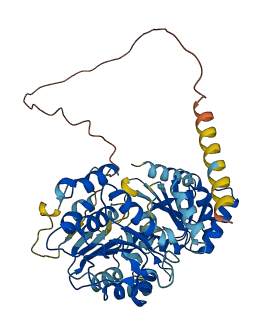
The autoinhibited protein was predicted that may have potential autoinhibitory elements via cis-regPred.
Autoinhibitory domains (AIDs)
Target domain |
|
Relief mechanism |
|
Assay |
cis-regPred |
Accessory elements
No accessory elements
Autoinhibited structure

Activated structure
1 structures for Q6C3X7
| Entry ID | Method | Resolution | Chain | Position | Source |
|---|---|---|---|---|---|
| AF-Q6C3X7-F1 | Predicted | AlphaFoldDB |
No variants for Q6C3X7
| Variant ID(s) | Position | Change | Description | Diseaes Association | Provenance |
|---|---|---|---|---|---|
| No variants for Q6C3X7 | |||||
No associated diseases with Q6C3X7
5 regional properties for Q6C3X7
| Type | Name | Position | InterPro Accession |
|---|---|---|---|
| conserved_site | ATP-dependent RNA helicase DEAD-box, conserved site | 244 - 252 | IPR000629 |
| domain | Helicase, C-terminal | 325 - 477 | IPR001650 |
| domain | DEAD/DEAH box helicase domain | 124 - 285 | IPR011545 |
| domain | Helicase superfamily 1/2, ATP-binding domain | 118 - 313 | IPR014001 |
| domain | RNA helicase, DEAD-box type, Q motif | 99 - 127 | IPR014014 |
Functions
| Description | ||
|---|---|---|
| EC Number | 3.6.4.13 | Acting on ATP; involved in cellular and subcellular movement |
| Subcellular Localization |
|
|
| PANTHER Family | ||
| PANTHER Subfamily | ||
| PANTHER Protein Class | ||
| PANTHER Pathway Category | No pathway information available | |
6 GO annotations of cellular component
| Name | Definition |
|---|---|
| cellular bud tip | The end of a cellular bud distal to the site of attachment to the mother cell. |
| cytoplasmic stress granule | A dense aggregation in the cytosol composed of proteins and RNAs that appear when the cell is under stress. |
| nuclear membrane | Either of the lipid bilayers that surround the nucleus and form the nuclear envelope; excludes the intermembrane space. |
| nuclear pore cytoplasmic filaments | Filamentous extensions on cytoplasmic face of the nuclear pore complex (NPC). In S. cerevisiae, Nup159p, Nup82p, and Nup42p contribute to the cytoplasmic filaments. In vertebrates, Nup358 is a major component. |
| nucleus | A membrane-bounded organelle of eukaryotic cells in which chromosomes are housed and replicated. In most cells, the nucleus contains all of the cell's chromosomes except the organellar chromosomes, and is the site of RNA synthesis and processing. In some species, or in specialized cell types, RNA metabolism or DNA replication may be absent. |
| polysome | A multiribosomal structure representing a linear array of ribosomes held together by messenger RNA. They represent the active complexes in cellular protein synthesis and are able to incorporate amino acids into polypeptides both in vivo and in vitro. |
5 GO annotations of molecular function
| Name | Definition |
|---|---|
| ATP binding | Binding to ATP, adenosine 5'-triphosphate, a universally important coenzyme and enzyme regulator. |
| ATP hydrolysis activity | Catalysis of the reaction: ATP + H2O = ADP + H+ phosphate. ATP hydrolysis is used in some reactions as an energy source, for example to catalyze a reaction or drive transport against a concentration gradient. |
| inositol hexakisphosphate binding | Binding to inositol hexakisphosphate. |
| RNA binding | Binding to an RNA molecule or a portion thereof. |
| RNA helicase activity | Unwinding of an RNA helix, driven by ATP hydrolysis. |
4 GO annotations of biological process
| Name | Definition |
|---|---|
| poly(A)+ mRNA export from nucleus | The directed movement of poly(A)+ mRNA out of the nucleus into the cytoplasm. |
| protein transport | The directed movement of proteins into, out of or within a cell, or between cells, by means of some agent such as a transporter or pore. |
| translational termination | The process resulting in the release of a polypeptide chain from the ribosome, usually in response to a termination codon (UAA, UAG, or UGA in the universal genetic code). |
| tRNA export from nucleus | The directed movement of tRNA from the nucleus to the cytoplasm. |
No homologous proteins in AiPD
| UniProt AC | Gene Name | Protein Name | Species | Evidence Code |
|---|---|---|---|---|
| No homologous proteins | ||||
| 10 | 20 | 30 | 40 | 50 | 60 |
| MSDQVSDMLE | KLELQKEKNQ | AAATEAKVEE | VKEDDKKDVK | EELNEDDKKV | AKEDDKKEDA |
| 70 | 80 | 90 | 100 | 110 | 120 |
| KEESKEDAEE | NNLIQTEYEV | RVKLADLQAD | PNSPLYSAKR | FEDLGLDENL | LKGLYAMKFN |
| 130 | 140 | 150 | 160 | 170 | 180 |
| KPSKIQEKAL | PLLLSDPPHN | MIGQSQSGTG | KTGAFSLTML | SRVDPNLKAV | QCICLAPSRE |
| 190 | 200 | 210 | 220 | 230 | 240 |
| LARQTLDVVD | EMKKFTDITT | HLIVPESTER | GQKVTSQILV | GTPGSVAGLL | QKKQIDAKHV |
| 250 | 260 | 270 | 280 | 290 | 300 |
| KVFVLDEADN | MVDSSMGSTC | ARIKKYLPSS | TQVVLFSATF | PESVLDLAGK | MCPNPNEIRL |
| 310 | 320 | 330 | 340 | 350 | 360 |
| KANELNVDAI | TQLYMDCEDG | EEKFKMLEEL | YSMLTIASSV | IFVAQRSTAN | ALYQRMSKNG |
| 370 | 380 | 390 | 400 | 410 | 420 |
| HKVSLLHSDL | SVDERDRLMD | DFRFGRSKVL | ISTNVIARGI | DIATVSMVVN | YDLPTDKNGK |
| 430 | 440 | 450 | 460 | 470 | 480 |
| PDPETYLHRI | GRTGRFGRSG | VSISFVHDEA | SFEVLDSIQQ | SLGMTLTQVP | TDDIDEVEEI |
| IKKAIKGK |