Q6C3J2
Gene name |
IPL1 (YALI0E34375g) |
Protein name |
Spindle assembly checkpoint kinase |
Names |
Aurora kinase |
Species |
Yarrowia lipolytica (strain CLIB 122 / E 150) (Yeast) (Candida lipolytica) |
KEGG Pathway |
yli:YALI0E34375g |
EC number |
2.7.11.1: Protein-serine/threonine kinases |
Protein Class |
|
Descriptions
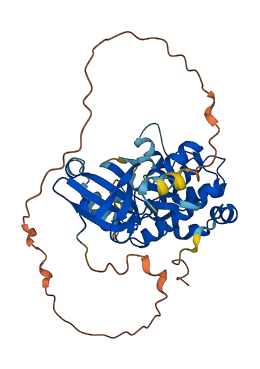
The autoinhibited protein was predicted that may have potential autoinhibitory elements via cis-regPred.
Autoinhibitory domains (AIDs)
Target domain |
|
Relief mechanism |
|
Assay |
cis-regPred |
Accessory elements
239-260 (Activation loop from InterPro)
Target domain |
99-350 (Protein kinase domain) |
Relief mechanism |
|
Assay |
|
Autoinhibited structure

Activated structure
1 structures for Q6C3J2
| Entry ID | Method | Resolution | Chain | Position | Source |
|---|---|---|---|---|---|
| AF-Q6C3J2-F1 | Predicted | AlphaFoldDB |
No variants for Q6C3J2
| Variant ID(s) | Position | Change | Description | Diseaes Association | Provenance |
|---|---|---|---|---|---|
| No variants for Q6C3J2 | |||||
No associated diseases with Q6C3J2
Functions
| Description | ||
|---|---|---|
| EC Number | 2.7.11.1 | Protein-serine/threonine kinases |
| Subcellular Localization |
|
|
| PANTHER Family | ||
| PANTHER Subfamily | ||
| PANTHER Protein Class | ||
| PANTHER Pathway Category | No pathway information available | |
6 GO annotations of cellular component
| Name | Definition |
|---|---|
| chromosome passenger complex | A eukaryotically conserved protein complex that localizes to kinetochores in early mitosis, the spindle mid-zone in anaphase B and to the telophase midbody. It has been proposed that the passenger complex coordinates various events based on its location to different structures during the course of mitosis. Complex members include the BIR-domain-containing protein Survivin, Aurora kinase, INCENP and Borealin. |
| cytoplasm | The contents of a cell excluding the plasma membrane and nucleus, but including other subcellular structures. |
| kinetochore | A multisubunit complex that is located at the centromeric region of DNA and provides an attachment point for the spindle microtubules. |
| nucleus | A membrane-bounded organelle of eukaryotic cells in which chromosomes are housed and replicated. In most cells, the nucleus contains all of the cell's chromosomes except the organellar chromosomes, and is the site of RNA synthesis and processing. In some species, or in specialized cell types, RNA metabolism or DNA replication may be absent. |
| spindle microtubule | Any microtubule that is part of a mitotic or meiotic spindle; anchored at one spindle pole. |
| spindle midzone | The area in the center of the spindle where the spindle microtubules from opposite poles overlap. |
3 GO annotations of molecular function
| Name | Definition |
|---|---|
| ATP binding | Binding to ATP, adenosine 5'-triphosphate, a universally important coenzyme and enzyme regulator. |
| histone serine kinase activity | Catalysis of the transfer of a phosphate group to a serine residue of a histone. |
| protein serine kinase activity | Catalysis of the reactions: ATP + protein serine = ADP + protein serine phosphate. |
4 GO annotations of biological process
| Name | Definition |
|---|---|
| chromosome segregation | The process in which genetic material, in the form of chromosomes, is organized into specific structures and then physically separated and apportioned to two or more sets. In eukaryotes, chromosome segregation begins with the condensation of chromosomes, includes chromosome separation, and ends when chromosomes have completed movement to the spindle poles. |
| mitotic spindle organization | A process that is carried out at the cellular level which results in the assembly, arrangement of constituent parts, or disassembly of the microtubule spindle during a mitotic cell cycle. |
| protein phosphorylation | The process of introducing a phosphate group on to a protein. |
| regulation of cytokinesis | Any process that modulates the frequency, rate or extent of the division of the cytoplasm of a cell and its separation into two daughter cells. |
No homologous proteins in AiPD
| UniProt AC | Gene Name | Protein Name | Species | Evidence Code |
|---|---|---|---|---|
| No homologous proteins | ||||
| 10 | 20 | 30 | 40 | 50 | 60 |
| MSMKQLETSM | SSVSLQEKKP | TRIKIALHPQ | SKSEQNETDR | ASKIPTGRIS | TTQPQTYYRP |
| 70 | 80 | 90 | 100 | 110 | 120 |
| TNLTKTPASQ | VSRRSSYTTD | PPSPLTGITG | FRNYSLDDFE | IGKALGKGKF | GKVYLVKDKK |
| 130 | 140 | 150 | 160 | 170 | 180 |
| TGFVSALKCM | EKKELVEGNV | EKQFRREVEI | QSNLRHTNVL | RLFGHFHDKD | RVYLILEYVV |
| 190 | 200 | 210 | 220 | 230 | 240 |
| HGELYKLLRN | QKRFTESTAS | SYIYQMSEAL | LYLHGKNIIH | RDIKPENILL | HFNDTIKISD |
| 250 | 260 | 270 | 280 | 290 | 300 |
| FGWSVHAPSN | RRSTLCGTMD | YLPPEIVQSR | PYDKNVDVWS | LGILMYEFLC | GAPPFEEPGG |
| 310 | 320 | 330 | 340 | 350 | 360 |
| AQATYRRIVK | LDLRIPPYVS | ADAADLIKRM | LTLDPAKRFK | LKDMHKHPWI | VRLRPTWKYK |
| 370 | |||||
| VPKTASHERS | A |