Q6C0W7
Gene name |
SLX1 |
Protein name |
Structure-specific endonuclease subunit SLX1 |
Names |
|
Species |
Yarrowia lipolytica (strain CLIB 122 / E 150) (Yeast) (Candida lipolytica) |
KEGG Pathway |
yli:YALI0F21131g |
EC number |
|
Protein Class |
|
Descriptions
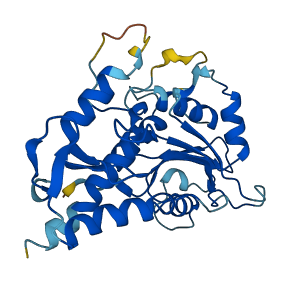
The autoinhibited protein was predicted that may have potential autoinhibitory elements via cis-regPred.
Autoinhibitory domains (AIDs)
Target domain |
|
Relief mechanism |
|
Assay |
cis-regPred |
Accessory elements
No accessory elements
Autoinhibited structure

Activated structure
1 structures for Q6C0W7
| Entry ID | Method | Resolution | Chain | Position | Source |
|---|---|---|---|---|---|
| AF-Q6C0W7-F1 | Predicted | AlphaFoldDB |
No variants for Q6C0W7
| Variant ID(s) | Position | Change | Description | Diseaes Association | Provenance |
|---|---|---|---|---|---|
| No variants for Q6C0W7 | |||||
No associated diseases with Q6C0W7
1 regional properties for Q6C0W7
| Type | Name | Position | InterPro Accession |
|---|---|---|---|
| domain | GIY-YIG endonuclease | 7 - 90 | IPR000305 |
1 GO annotations of cellular component
| Name | Definition |
|---|---|
| Slx1-Slx4 complex | A heterodimeric protein complex that possesses an endonuclease activity that specifically cleaves certain types of branched DNA structures; because such structures often form during the replication ribosomal DNA (rDNA) repeats, the complex plays a role in the maintenance of rDNA. The subunits are known as Slx1 and Slx 4 in budding and fission yeasts, and are conserved in eukaryotes. |
2 GO annotations of molecular function
| Name | Definition |
|---|---|
| 5'-flap endonuclease activity | Catalysis of the cleavage of a 5' flap structure in DNA, but not other DNA structures; processes the 5' ends of Okazaki fragments in lagging strand DNA synthesis. |
| crossover junction endodeoxyribonuclease activity | Catalysis of the endonucleolytic cleavage at a junction such as a reciprocal single-stranded crossover between two homologous DNA duplexes (Holliday junction). |
2 GO annotations of biological process
| Name | Definition |
|---|---|
| DNA-templated DNA replication | A DNA replication process that uses parental DNA as a template for the DNA-dependent DNA polymerases that synthesize the new strands. |
| double-strand break repair via homologous recombination | The error-free repair of a double-strand break in DNA in which the broken DNA molecule is repaired using homologous sequences. A strand in the broken DNA searches for a homologous region in an intact chromosome to serve as the template for DNA synthesis. The restoration of two intact DNA molecules results in the exchange, reciprocal or nonreciprocal, of genetic material between the intact DNA molecule and the broken DNA molecule. |
No homologous proteins in AiPD
| UniProt AC | Gene Name | Protein Name | Species | Evidence Code |
|---|---|---|---|---|
| No homologous proteins | ||||
| 10 | 20 | 30 | 40 | 50 | 60 |
| MTHQYPPFYG | VYLLQSTKKP | LSCYVGSTPN | PFRRIRQHNG | DLKAGGAWRT | KRAHLRPWSM |
| 70 | 80 | 90 | 100 | 110 | 120 |
| VLIVNGFPSK | ISALKFEHAL | QHPNMTRLIT | TKDIKRKVPQ | KARALGTHLA | FIRLLVRCSY |
| 130 | 140 | 150 | 160 | 170 | 180 |
| FRRMHLRITF | FRSHAHEAWE | KNDYDVGSLP | PQFQVETDYP | SDEAEAPPST | VGSGELDINN |
| 190 | 200 | 210 | 220 | 230 | 240 |
| RSIEEYLQKC | RDAVSNDKQL | TCYLSEKTLN | ISEGNVALCH | NCDGAFDVAE | LAERFLNEEI |
| 250 | 260 | 270 | 280 | ||
| PEELPFTTPS | RHIIPIGGDC | PSCLARMEWS | NVIKGVLAMR | PVLEDNKE |