Q6C0U8
Gene name |
CYM1 (YALI0F21615g) |
Protein name |
Mitochondrial presequence protease |
Names |
|
Species |
Yarrowia lipolytica (strain CLIB 122 / E 150) (Yeast) (Candida lipolytica) |
KEGG Pathway |
yli:YALI0F21615g |
EC number |
|
Protein Class |
|
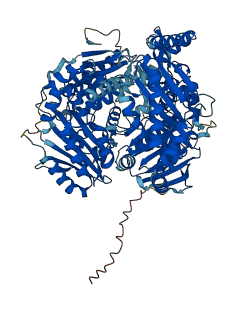
Descriptions
The autoinhibited protein was predicted that may have potential autoinhibitory elements via cis-regPred.
Autoinhibitory domains (AIDs)
Target domain |
|
Relief mechanism |
|
Assay |
cis-regPred |
Accessory elements
No accessory elements
Autoinhibited structure

Activated structure
1 structures for Q6C0U8
| Entry ID | Method | Resolution | Chain | Position | Source |
|---|---|---|---|---|---|
| AF-Q6C0U8-F1 | Predicted | AlphaFoldDB |
No variants for Q6C0U8
| Variant ID(s) | Position | Change | Description | Diseaes Association | Provenance |
|---|---|---|---|---|---|
| No variants for Q6C0U8 | |||||
No associated diseases with Q6C0U8
4 regional properties for Q6C0U8
| Type | Name | Position | InterPro Accession |
|---|---|---|---|
| domain | Peptidase M16, C-terminal | 227 - 410 | IPR007863-1 |
| domain | Peptidase M16, C-terminal | 804 - 911 | IPR007863-2 |
| domain | Peptidase M16, N-terminal | 76 - 166 | IPR011765 |
| domain | Peptidase M16C associated | 487 - 733 | IPR013578 |
1 GO annotations of cellular component
| Name | Definition |
|---|---|
| mitochondrial matrix | The gel-like material, with considerable fine structure, that lies in the matrix space, or lumen, of a mitochondrion. It contains the enzymes of the tricarboxylic acid cycle and, in some organisms, the enzymes concerned with fatty acid oxidation. |
2 GO annotations of molecular function
| Name | Definition |
|---|---|
| metal ion binding | Binding to a metal ion. |
| metalloendopeptidase activity | Catalysis of the hydrolysis of internal, alpha-peptide bonds in a polypeptide chain by a mechanism in which water acts as a nucleophile, one or two metal ions hold the water molecule in place, and charged amino acid side chains are ligands for the metal ions. |
1 GO annotations of biological process
| Name | Definition |
|---|---|
| protein processing | Any protein maturation process achieved by the cleavage of a peptide bond or bonds within a protein. Protein maturation is the process leading to the attainment of the full functional capacity of a protein. |
No homologous proteins in AiPD
| UniProt AC | Gene Name | Protein Name | Species | Evidence Code |
|---|---|---|---|---|
| No homologous proteins | ||||
| 10 | 20 | 30 | 40 | 50 | 60 |
| MLRLKSLKKP | VQAVVRRFAT | TSAPTLSVGD | NIHGFNVLRT | KEIPEFDLQA | TLLEHSTGAQ |
| 70 | 80 | 90 | 100 | 110 | 120 |
| HLHIARDDSN | NVFSIGFKTN | PPDRTGVPHI | LEHTTLCGSE | KYQVRDPFFK | MLNRSLANFM |
| 130 | 140 | 150 | 160 | 170 | 180 |
| NAMTAQDYTF | YPFATTNATD | MKNLRDVYLD | ATLKPLLREL | DFSQEGWRLE | NEDSKDKTSP |
| 190 | 200 | 210 | 220 | 230 | 240 |
| IILKGVVFNE | MKGQMSNAAY | AFYIRYLEKI | YPSLNNSGGD | PLVIPELTYE | GLKKFHADHY |
| 250 | 260 | 270 | 280 | 290 | 300 |
| NPSNAKTFSY | GDISVADHLE | ALNAKFENCE | ISKTPGNTER | LPLEFSSAAE | NTRIVEEGPI |
| 310 | 320 | 330 | 340 | 350 | 360 |
| DTLLDTSKQH | KMSMSWLMGS | PKDIYESFCV | KIISSLLIDG | HSSPLHQKLI | DSGLGSSYSP |
| 370 | 380 | 390 | 400 | 410 | 420 |
| NTGLDSAPGA | NIFSVGLQGV | TESDLTKVET | VILDTIKTTV | AEGFDKGRID | GLLHQTELAR |
| 430 | 440 | 450 | 460 | 470 | 480 |
| KDQNAKFGMA | LMNGVLPGWF | NQVDPLEALE | WNSVLDRFNK | DMEADPEFLQ | KVMKKYLLDN |
| 490 | 500 | 510 | 520 | 530 | 540 |
| KYFHFQMNPN | PDYEKNVQEK | EDEILTDKLA | KLTESDKEEI | FETGANLEKM | QEEPENLDCL |
| 550 | 560 | 570 | 580 | 590 | 600 |
| PTLHVSDIPR | SKPRVALEHT | KNPYPIQWRL | APTNGLTYFH | SISSLEGLPH | EYYPFLPLFT |
| 610 | 620 | 630 | 640 | 650 | 660 |
| SSLTFLGTKD | KTMGQLEDEI | KLNTGGLDFS | VSCSSSPLSL | PSSQLNFAMD | GVALDKNVET |
| 670 | 680 | 690 | 700 | 710 | 720 |
| MFGLFQELLR | NTDFTNVEKL | KTMIAASTAN | LSNALAQSGH | SFAMLRAASD | ISPVKKIDDI |
| 730 | 740 | 750 | 760 | 770 | 780 |
| LGGVAQVRFL | SELAAKSEQQ | LVDEVIPKLQ | EIAKFALTRE | QRFAVTCGQD | MQTKNDELVR |
| 790 | 800 | 810 | 820 | 830 | 840 |
| KFAESFETNE | SPFNISSLSI | PMTTPTSTLF | KLPFQVNYAG | IAIPGVPYTH | ADGAPLQVLA |
| 850 | 860 | 870 | 880 | 890 | 900 |
| NMLTHKHLHR | EIREKGGAYG | GGASYNPTDG | FFSYYSYRDP | NLERTLQTCQ | EAGEWSVKKD |
| 910 | 920 | 930 | 940 | 950 | 960 |
| WSSSDLQEAK | LSLFQRIDAP | ISVKSEGMAL | YANGLTYEQR | EKRRRQLLDV | AVDDVKRVAK |
| 970 | 980 | ||||
| QYLVNPSGYS | VAALGPGYET | MDKKKWTVLE |