Q6C061
Gene name |
ARP4 (YALI0F27533g) |
Protein name |
Actin-related protein 4 |
Names |
Actin-like protein ARP4, Actin-like protein 4 |
Species |
Yarrowia lipolytica (strain CLIB 122 / E 150) (Yeast) (Candida lipolytica) |
KEGG Pathway |
yli:YALI0F27533g |
EC number |
|
Protein Class |
|
Descriptions
The autoinhibited protein was predicted that may have potential autoinhibitory elements via cis-regPred.
Autoinhibitory domains (AIDs)
Target domain |
|
Relief mechanism |
|
Assay |
cis-regPred |
Accessory elements
No accessory elements
Autoinhibited structure

Activated structure
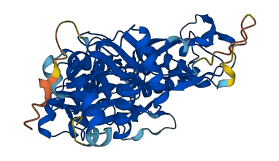
1 structures for Q6C061
| Entry ID | Method | Resolution | Chain | Position | Source |
|---|---|---|---|---|---|
| AF-Q6C061-F1 | Predicted | AlphaFoldDB |
No variants for Q6C061
| Variant ID(s) | Position | Change | Description | Diseaes Association | Provenance |
|---|---|---|---|---|---|
| No variants for Q6C061 | |||||
No associated diseases with Q6C061
2 GO annotations of cellular component
| Name | Definition |
|---|---|
| NuA4 histone acetyltransferase complex | A complex having histone acetylase activity on chromatin, as well as ATPase, DNA helicase and structural DNA binding activities. The complex is thought to be involved in double-strand DNA break repair. Subunits of the human complex include HTATIP/TIP60, TRRAP, RUVBL1, BUVBL2, beta-actin and BAF53/ACTL6A. In yeast, the complex has 13 subunits, including the catalytic subunit Esa1 (homologous to human Tip60). |
| SWI/SNF complex | A SWI/SNF-type complex that contains 8 to 14 proteins, including both conserved (core) and nonconserved components; contains the ATPase product of the yeast SNF2 or mammalian SMARCA4/BAF190A/BRG1 gene, or an ortholog thereof. |
1 GO annotations of molecular function
| Name | Definition |
|---|---|
| chromatin binding | Binding to chromatin, the network of fibers of DNA, protein, and sometimes RNA, that make up the chromosomes of the eukaryotic nucleus during interphase. |
4 GO annotations of biological process
| Name | Definition |
|---|---|
| chromatin organization | The assembly or remodeling of chromatin composed of DNA complexed with histones, other associated proteins, and sometimes RNA. |
| DNA repair | The process of restoring DNA after damage. Genomes are subject to damage by chemical and physical agents in the environment (e.g. UV and ionizing radiations, chemical mutagens, fungal and bacterial toxins, etc.) and by free radicals or alkylating agents endogenously generated in metabolism. DNA is also damaged because of errors during its replication. A variety of different DNA repair pathways have been reported that include direct reversal, base excision repair, nucleotide excision repair, photoreactivation, bypass, double-strand break repair pathway, and mismatch repair pathway. |
| histone H4 acetylation | The modification of histone H4 by the addition of an acetyl group. |
| regulation of transcription by RNA polymerase II | Any process that modulates the frequency, rate or extent of transcription mediated by RNA polymerase II. |
No homologous proteins in AiPD
| UniProt AC | Gene Name | Protein Name | Species | Evidence Code |
|---|---|---|---|---|
| No homologous proteins | ||||
| 10 | 20 | 30 | 40 | 50 | 60 |
| MTTTAPAPQV | YGGDEVATLV | IDTGSSYTRV | GYAGEDTPKL | VVSTECGLMA | DEDVEMEDDT |
| 70 | 80 | 90 | 100 | 110 | 120 |
| SNTTKKLNKY | KVGDSANLPL | PNMEVLHPLT | DGIVADWDAV | QNIWEYSLAR | LNADTKTHPL |
| 130 | 140 | 150 | 160 | 170 | 180 |
| MLTEPCWNTQ | ANKLKALEIA | FESLEVPASY | LVKDAVASAF | AAGKGNALVL | DVGSEVASVT |
| 190 | 200 | 210 | 220 | 230 | 240 |
| PVIDGLVLYK | PARRSQYAGD | YLDRQIKKVL | VSRGIDLTPR | FEIKNKKAVE | MGEPPVFTKR |
| 250 | 260 | 270 | 280 | 290 | 300 |
| ELPNVTHSFT | DLQVSRILSE | FKDSMCQVND | VPLTPEISGE | AADRVFEFPT | GYSTTFGADR |
| 310 | 320 | 330 | 340 | 350 | 360 |
| LSTSESLFKP | SEYPFDGETV | PDTARGLSEM | VVDTINASNV | DVRAHLANNI | VITGGGSLVQ |
| 370 | 380 | 390 | 400 | 410 | 420 |
| GLSDRVSKDV | TQALSGLKVR | VAAASNQEER | RHGAWIGGSV | LGSLGSFHQL | WVSKQEWQEK |
| 430 | |||||
| GGDYLVEKKR | FK |