Q6C030
Gene name |
DPB2 (YALI0F28215g) |
Protein name |
DNA polymerase epsilon subunit B |
Names |
DNA polymerase II subunit 2 |
Species |
Yarrowia lipolytica (strain CLIB 122 / E 150) (Yeast) (Candida lipolytica) |
KEGG Pathway |
yli:YALI0F28215g |
EC number |
|
Protein Class |
|
Descriptions
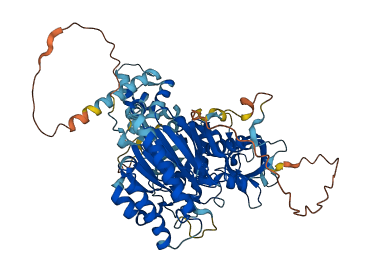
The autoinhibited protein was predicted that may have potential autoinhibitory elements via cis-regPred.
Autoinhibitory domains (AIDs)
Target domain |
|
Relief mechanism |
|
Assay |
cis-regPred |
Accessory elements
No accessory elements
Autoinhibited structure

Activated structure
1 structures for Q6C030
| Entry ID | Method | Resolution | Chain | Position | Source |
|---|---|---|---|---|---|
| AF-Q6C030-F1 | Predicted | AlphaFoldDB |
No variants for Q6C030
| Variant ID(s) | Position | Change | Description | Diseaes Association | Provenance |
|---|---|---|---|---|---|
| No variants for Q6C030 | |||||
No associated diseases with Q6C030
8 regional properties for Q6C030
| Type | Name | Position | InterPro Accession |
|---|---|---|---|
| domain | SH3 domain | 8 - 69 | IPR001452 |
| domain | Dedicator of cytokinesis protein 2, DHR2 domain | 1200 - 1620 | IPR026799 |
| domain | C2 DOCK-type domain | 419 - 615 | IPR027007 |
| domain | DOCKER domain | 1211 - 1622 | IPR027357 |
| domain | Dedicator of cytokinesis, N-terminal domain | 72 - 414 | IPR032376 |
| domain | DOCKER, Lobe A | 1205 - 1334 | IPR046769 |
| domain | DOCKER, Lobe B | 1395 - 1474 | IPR046770 |
| domain | DOCKER, Lobe C | 1516 - 1615 | IPR046773 |
3 GO annotations of cellular component
| Name | Definition |
|---|---|
| cytoplasm | The contents of a cell excluding the plasma membrane and nucleus, but including other subcellular structures. |
| epsilon DNA polymerase complex | A heterotetrameric DNA polymerase complex that catalyzes processive DNA synthesis in the absence of PCNA, but is further stimulated in the presence of PCNA. The complex contains a large catalytic subunit and three small subunits, and is best characterized in Saccharomyces, in which the subunits are named Pol2p, Dpb2p, Dpb3p, and Dpb4p. Some evidence suggests that DNA polymerase epsilon is the leading strand polymerase; it is also involved in nucleotide-excision repair and mismatch repair. |
| nuclear replication fork | The Y-shaped region of a nuclear replicating DNA molecule, resulting from the separation of the DNA strands and in which the synthesis of new strands takes place. Also includes associated protein complexes. |
4 GO annotations of molecular function
| Name | Definition |
|---|---|
| DNA polymerase processivity factor activity | An enzyme regulator activity that increases the processivity of polymerization by DNA polymerase, by allowing the polymerase to move rapidly along DNA while remaining topologically bound to it. |
| DNA-directed DNA polymerase activity | Catalysis of the reaction: deoxynucleoside triphosphate + DNA(n) = diphosphate + DNA(n+1); the synthesis of DNA from deoxyribonucleotide triphosphates in the presence of a DNA template and a 3'hydroxyl group. |
| double-stranded DNA binding | Binding to double-stranded DNA. |
| single-stranded DNA binding | Binding to single-stranded DNA. |
3 GO annotations of biological process
| Name | Definition |
|---|---|
| DNA-templated DNA replication | A DNA replication process that uses parental DNA as a template for the DNA-dependent DNA polymerases that synthesize the new strands. |
| DNA-templated DNA replication maintenance of fidelity | A DNA metabolic process that prevents or corrects errors to ensure that DNA is replicated accurately. Errors can be corrected either by intrinsic DNA polymerase proofreading activity or via mismatch repair. |
| error-prone translesion synthesis | The conversion of DNA-damage induced single-stranded gaps into large molecular weight DNA after replication by using a specialized DNA polymerase or replication complex to insert a defined nucleotide across the lesion. This process does not remove the replication-blocking lesions and causes an increase in the endogenous mutation level. For example, in E. coli, a low fidelity DNA polymerase, pol V, copies lesions that block replication fork progress. This produces mutations specifically targeted to DNA template damage sites, but it can also produce mutations at undamaged sites. |
No homologous proteins in AiPD
| UniProt AC | Gene Name | Protein Name | Species | Evidence Code |
|---|---|---|---|---|
| No homologous proteins | ||||
| 10 | 20 | 30 | 40 | 50 | 60 |
| MPAVLPIKLN | PSQMRPVAYR | IFSKKHGLNL | KSTGLETLTE | IIGKNYGTEW | RGAEAAKMME |
| 70 | 80 | 90 | 100 | 110 | 120 |
| EICRLWKEQE | MGVFVEGKPL | QELFDEITAS | KKAKEKARVQ | VVSKSVGLTG | VEEIEDREGE |
| 130 | 140 | 150 | 160 | 170 | 180 |
| PQVNVIREAA | PSVDVVWKEF | FKVISAFDQP | LFHYNARQQR | FEKRKTKPTL | FANAQSASNM |
| 190 | 200 | 210 | 220 | 230 | 240 |
| FLTRYHLVYN | RLLRNDDTTD | LKITSIRSLI | GRQGEFSIFG | MLSKNPEQKI | CLQDDTGRIL |
| 250 | 260 | 270 | 280 | 290 | 300 |
| LILAAGCKPD | PGVYYPEGSF | VICNGRYMKS | GDAEVFVVIT | MGPPVAEKRQ | ETITAYGNMD |
| 310 | 320 | 330 | 340 | 350 | 360 |
| YLGLHGNPHG | SVVRRIERQV | EASMLAEEKR | LVDQKVIVFG | GDMYLDNPLT | LKALQKVFST |
| 370 | 380 | 390 | 400 | 410 | 420 |
| IELEFQDSGT | KKPLAMVFSG | DFTSQYQPPH | LYKKGFDKLE | ELFKEFSSII | TGVKIIFVPG |
| 430 | 440 | 450 | 460 | 470 | 480 |
| QRDPWTNTFP | TQNAVVPLQP | LPTTMINRVA | RLCGEDVSMS | SNPCRMAYLT | QDMVFYRDGL |
| 490 | 500 | 510 | 520 | 530 | 540 |
| SERLRKCNLQ | LDSAKDDSDD | SDDDIEIDND | EVMINDVVVN | EPESSFDFGE | GLSNLTRPVD |
| 550 | 560 | 570 | 580 | 590 | 600 |
| ISTPMASQVG | PTNTLSAKEV | ESRKIVRTIC | DQGHLSPFNR | HDRPVAWDYD | ETLWLSPLPT |
| 610 | 620 | 630 | 640 | 650 | |
| ILFMVDTHAP | KFSLRYEECM | VVNPGPFLNR | KIASWVEYDP | SKKTVKERQL | HI |