Q6BZX4
Gene name |
TFB2 (YALI0F30173g) |
Protein name |
General transcription and DNA repair factor IIH subunit TFB2 |
Names |
TFIIH subunit TFB2, RNA polymerase II transcription factor B subunit 2 |
Species |
Yarrowia lipolytica (strain CLIB 122 / E 150) (Yeast) (Candida lipolytica) |
KEGG Pathway |
yli:YALI0F30173g |
EC number |
|
Protein Class |
|
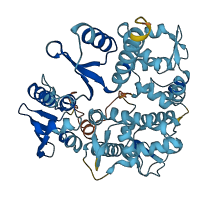
Descriptions
The autoinhibited protein was predicted that may have potential autoinhibitory elements via cis-regPred.
Autoinhibitory domains (AIDs)
Target domain |
|
Relief mechanism |
|
Assay |
cis-regPred |
Accessory elements
No accessory elements
Autoinhibited structure

Activated structure
1 structures for Q6BZX4
| Entry ID | Method | Resolution | Chain | Position | Source |
|---|---|---|---|---|---|
| AF-Q6BZX4-F1 | Predicted | AlphaFoldDB |
No variants for Q6BZX4
| Variant ID(s) | Position | Change | Description | Diseaes Association | Provenance |
|---|---|---|---|---|---|
| No variants for Q6BZX4 | |||||
No associated diseases with Q6BZX4
1 regional properties for Q6BZX4
| Type | Name | Position | InterPro Accession |
|---|---|---|---|
| domain | Transcription factor Tfb2, C-terminal domain | 389 - 456 | IPR040662 |
2 GO annotations of cellular component
| Name | Definition |
|---|---|
| transcription factor TFIIH core complex | The 7 subunit core of TFIIH that is a part of either the general transcription factor holo-TFIIH or the nucleotide-excision repair factor 3 complex. In S. cerevisiae/humans the complex is composed of: Ssl2/XPB, Tfb1/p62, Tfb2/p52, Ssl1/p44, Tfb4/p34, Tfb5/p8 and Rad3/XPD. |
| transcription factor TFIIH holo complex | A complex that is capable of kinase activity directed towards the C-terminal Domain (CTD) of the largest subunit of RNA polymerase II and is essential for initiation at RNA polymerase II promoters in vitro. It is composed of the core TFIIH complex and the TFIIK complex. |
2 GO annotations of molecular function
| Name | Definition |
|---|---|
| ATPase activator activity | Binds to and increases the activity of an ATP hydrolysis activity. |
| double-stranded DNA binding | Binding to double-stranded DNA. |
2 GO annotations of biological process
| Name | Definition |
|---|---|
| nucleotide-excision repair | A DNA repair process in which a small region of the strand surrounding the damage is removed from the DNA helix as an oligonucleotide. The small gap left in the DNA helix is filled in by the sequential action of DNA polymerase and DNA ligase. Nucleotide excision repair recognizes a wide range of substrates, including damage caused by UV irradiation (pyrimidine dimers and 6-4 photoproducts) and chemicals (intrastrand cross-links and bulky adducts). |
| phosphorylation of RNA polymerase II C-terminal domain | The process of introducing a phosphate group on to an amino acid residue in the C-terminal domain of RNA polymerase II. Typically, this occurs during the transcription cycle and results in production of an RNA polymerase II enzyme where the carboxy-terminal domain (CTD) of the largest subunit is extensively phosphorylated, often referred to as hyperphosphorylated or the II(0) form. Specific types of phosphorylation within the CTD are usually associated with specific regions of genes, though there are exceptions. The phosphorylation state regulates the association of specific complexes such as the capping enzyme or 3'-RNA processing machinery to the elongating RNA polymerase complex. |
No homologous proteins in AiPD
| UniProt AC | Gene Name | Protein Name | Species | Evidence Code |
|---|---|---|---|---|
| No homologous proteins | ||||
| 10 | 20 | 30 | 40 | 50 | 60 |
| MTSQFKNSIN | DYLEGLPEAV | LTRLYQSPAT | CLAVFRLLPA | LARTLIMGMI | FNPDPIAVAD |
| 70 | 80 | 90 | 100 | 110 | 120 |
| VDALVKPSSQ | RLKLETQKKL | RLLHIFTETQ | AHIIINPTFK | KNLRAALVGG | DQNISFGVPC |
| 130 | 140 | 150 | 160 | 170 | 180 |
| DTEDKHKVDV | AFLDAHAVSQ | WEMILHFMVG | TSIGRTPSDG | VLNLLKHSGL | MEPERGGLRI |
| 190 | 200 | 210 | 220 | 230 | 240 |
| TNAGFQFLLQ | DVNAQIWTLL | LQYLNMSEYL | QMDPVDVLNF | IFMLGSLELG | QDYSLSALSE |
| 250 | 260 | 270 | 280 | 290 | 300 |
| TQKHMLEDLR | DYGIVYQRKA | SSRRFYPTRL | ATTLTSETAA | LRTASQSMEA | ATQDTISSSV |
| 310 | 320 | 330 | 340 | 350 | 360 |
| AADSGFIILE | TNFRLYAYTE | SPLQIAVLNL | FVNLKTRFAN | MVTGQINRDS | VRFALSNGIT |
| 370 | 380 | 390 | 400 | 410 | 420 |
| AEQIITYLSV | HAHPRMKGME | HVLPPTVVDQ | IKLWQLEMDR | IRATDGYLFS | EFKNFDEYKD |
| 430 | 440 | 450 | 460 | ||
| VSTYAKELGV | LLYENPGKRK | FVSTLAGSQQ | IVEFVKRRNQ | KHRSSAN |