Q6BTT1
Gene name |
YTH1 (DEHA2C16126g) |
Protein name |
mRNA 3'-end-processing protein YTH1 |
Names |
|
Species |
Debaryomyces hansenii (strain ATCC 36239 / CBS 767 / BCRC 21394 / JCM 1990 / NBRC 0083 / IGC 2968) (Yeast) (Torulaspora hansenii) |
KEGG Pathway |
dha:DEHA2C16126g |
EC number |
|
Protein Class |
|
Descriptions
The autoinhibited protein was predicted that may have potential autoinhibitory elements via cis-regPred.
Autoinhibitory domains (AIDs)
Target domain |
|
Relief mechanism |
|
Assay |
cis-regPred |
Accessory elements
No accessory elements
Autoinhibited structure

Activated structure
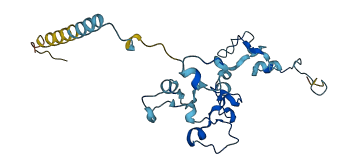
1 structures for Q6BTT1
| Entry ID | Method | Resolution | Chain | Position | Source |
|---|---|---|---|---|---|
| AF-Q6BTT1-F1 | Predicted | AlphaFoldDB |
No variants for Q6BTT1
| Variant ID(s) | Position | Change | Description | Diseaes Association | Provenance |
|---|---|---|---|---|---|
| No variants for Q6BTT1 | |||||
No associated diseases with Q6BTT1
5 regional properties for Q6BTT1
| Type | Name | Position | InterPro Accession |
|---|---|---|---|
| domain | Zinc finger, CCCH-type | 32 - 63 | IPR000571-1 |
| domain | Zinc finger, CCCH-type | 65 - 92 | IPR000571-2 |
| domain | Zinc finger, CCCH-type | 93 - 121 | IPR000571-3 |
| domain | Zinc finger, CCCH-type | 122 - 149 | IPR000571-4 |
| domain | Zinc finger, CCCH-type | 149 - 173 | IPR000571-5 |
1 GO annotations of cellular component
| Name | Definition |
|---|---|
| nucleus | A membrane-bounded organelle of eukaryotic cells in which chromosomes are housed and replicated. In most cells, the nucleus contains all of the cell's chromosomes except the organellar chromosomes, and is the site of RNA synthesis and processing. In some species, or in specialized cell types, RNA metabolism or DNA replication may be absent. |
2 GO annotations of molecular function
| Name | Definition |
|---|---|
| metal ion binding | Binding to a metal ion. |
| RNA binding | Binding to an RNA molecule or a portion thereof. |
1 GO annotations of biological process
| Name | Definition |
|---|---|
| pre-mRNA cleavage required for polyadenylation | The targeted, endonucleolytic cleavage of a pre-mRNA, required for polyadenylation of the 3' end. This cleavage is directed by binding sites near the 3' end of the mRNA and leaves a 3' hydoxyl end which then becomes a target for adenylation. |
No homologous proteins in AiPD
| UniProt AC | Gene Name | Protein Name | Species | Evidence Code |
|---|---|---|---|---|
| No homologous proteins | ||||
| 10 | 20 | 30 | 40 | 50 | 60 |
| MLQLNQVIHP | DTRNKRFKFE | PFLLKEYNFG | LDPDRPVCQF | YNPSNPNNSC | PNGSLCPHKH |
| 70 | 80 | 90 | 100 | 110 | 120 |
| VSSMYSNKIV | CKHWLRGLCK | KNDHCEFLHE | YNLRKMPECL | FYSKNGFCTQ | TPECLYLHVD |
| 130 | 140 | 150 | 160 | 170 | 180 |
| PQSKIPPCSS | YEKGFCPDGP | KCANRHIRKI | MCPLWLTGFC | PKGAECDYTH | PRFEAIIDRL |
| 190 | 200 | 210 | 220 | ||
| RIKPDEDAVE | EKEKVANGSD | KEDQNMADAT | SNGNTEEKDE | SGP |