Q6BMD0
Gene name |
ALG14 (DEHA2F06512g) |
Protein name |
UDP-N-acetylglucosamine transferase subunit ALG14 |
Names |
Asparagine-linked glycosylation protein 14 |
Species |
Debaryomyces hansenii (strain ATCC 36239 / CBS 767 / BCRC 21394 / JCM 1990 / NBRC 0083 / IGC 2968) (Yeast) (Torulaspora hansenii) |
KEGG Pathway |
dha:DEHA2F06512g |
EC number |
|
Protein Class |
|
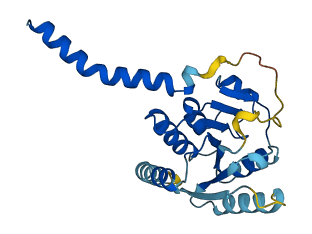
Descriptions
The autoinhibited protein was predicted that may have potential autoinhibitory elements via cis-regPred.
Autoinhibitory domains (AIDs)
Target domain |
|
Relief mechanism |
|
Assay |
cis-regPred |
Accessory elements
No accessory elements
Autoinhibited structure

Activated structure
1 structures for Q6BMD0
| Entry ID | Method | Resolution | Chain | Position | Source |
|---|---|---|---|---|---|
| AF-Q6BMD0-F1 | Predicted | AlphaFoldDB |
No variants for Q6BMD0
| Variant ID(s) | Position | Change | Description | Diseaes Association | Provenance |
|---|---|---|---|---|---|
| No variants for Q6BMD0 | |||||
1 associated diseases with Q6BMD0
[MIM: 613728]: Spinocerebellar ataxia, autosomal recessive, 10 (SCAR10)
A form of spinocerebellar ataxia, a clinically and genetically heterogeneous group of cerebellar disorders. Patients show progressive incoordination of gait and often poor coordination of hands, speech and eye movements, due to degeneration of the cerebellum with variable involvement of the brainstem and spinal cord. SCAR10 is characterized by onset in the teenage or young adult years of gait and limb ataxia, dysarthria, and nystagmus associated with marked cerebellar atrophy on brain imaging. {ECO:0000269|PubMed:21092923}. Note=The disease is caused by variants affecting the gene represented in this entry.
Without disease ID
- A form of spinocerebellar ataxia, a clinically and genetically heterogeneous group of cerebellar disorders. Patients show progressive incoordination of gait and often poor coordination of hands, speech and eye movements, due to degeneration of the cerebellum with variable involvement of the brainstem and spinal cord. SCAR10 is characterized by onset in the teenage or young adult years of gait and limb ataxia, dysarthria, and nystagmus associated with marked cerebellar atrophy on brain imaging. {ECO:0000269|PubMed:21092923}. Note=The disease is caused by variants affecting the gene represented in this entry.
No regional properties for Q6BMD0
| Type | Name | Position | InterPro Accession |
|---|---|---|---|
| No domain, repeats, and functional sites for Q6BMD0 | |||
3 GO annotations of cellular component
| Name | Definition |
|---|---|
| endoplasmic reticulum membrane | The lipid bilayer surrounding the endoplasmic reticulum. |
| integral component of membrane | The component of a membrane consisting of the gene products and protein complexes having at least some part of their peptide sequence embedded in the hydrophobic region of the membrane. |
| nuclear membrane | Either of the lipid bilayers that surround the nucleus and form the nuclear envelope; excludes the intermembrane space. |
No GO annotations of molecular function
| Name | Definition |
|---|---|
| No GO annotations for molecular function |
1 GO annotations of biological process
| Name | Definition |
|---|---|
| dolichol-linked oligosaccharide biosynthetic process | The chemical reactions and pathways resulting in the formation of dolichol-linked oligosaccharide, usually by a stepwise addition of glycosyl chains to endoplasmic reticulum membrane-bound dolichol-P. |
No homologous proteins in AiPD
| UniProt AC | Gene Name | Protein Name | Species | Evidence Code |
|---|---|---|---|---|
| No homologous proteins | ||||
| 10 | 20 | 30 | 40 | 50 | 60 |
| MDFESQLCIK | VVLLLLPFFI | IGIRLLWVLP | AVNSPAMGSE | KEKGLSQIPS | ELRGSNIMIF |
| 70 | 80 | 90 | 100 | 110 | 120 |
| LGSGGHTGEM | MRILANVDLN | NFNRTWVTSS | GDSTSILKCK | KYEDERLTSG | QNKSDYLVLH |
| 130 | 140 | 150 | 160 | 170 | 180 |
| RARTVGESII | SSVFSTVRSL | ISTIKHLYEL | PQFPSILLLN | GPGTSVPLAY | IIFLLKFLGL |
| 190 | 200 | 210 | 220 | 230 | |
| CKTRIIYIES | LARVKQLSVS | GLLILPITDR | FIVQWKQLAV | KYKRAEYYGI | LI |