Q6BKI8
Gene name |
EFM7 |
Protein name |
Protein N-terminal and lysine N-methyltransferase EFM7 |
Names |
Elongation factor methyltransferase 7 |
Species |
Debaryomyces hansenii (strain ATCC 36239 / CBS 767 / BCRC 21394 / JCM 1990 / NBRC 0083 / IGC 2968) (Yeast) (Torulaspora hansenii) |
KEGG Pathway |
dha:DEHA2F21604g |
EC number |
|
Protein Class |
|
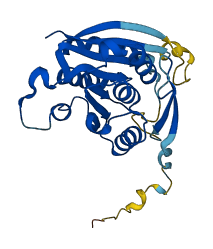
Descriptions
The autoinhibited protein was predicted that may have potential autoinhibitory elements via cis-regPred.
Autoinhibitory domains (AIDs)
Target domain |
|
Relief mechanism |
|
Assay |
cis-regPred |
Accessory elements
No accessory elements
Autoinhibited structure

Activated structure
1 structures for Q6BKI8
| Entry ID | Method | Resolution | Chain | Position | Source |
|---|---|---|---|---|---|
| AF-Q6BKI8-F1 | Predicted | AlphaFoldDB |
No variants for Q6BKI8
| Variant ID(s) | Position | Change | Description | Diseaes Association | Provenance |
|---|---|---|---|---|---|
| No variants for Q6BKI8 | |||||
No associated diseases with Q6BKI8
6 regional properties for Q6BKI8
| Type | Name | Position | InterPro Accession |
|---|---|---|---|
| repeat | WD40 repeat | 81 - 125 | IPR001680-1 |
| repeat | WD40 repeat | 131 - 176 | IPR001680-2 |
| repeat | WD40 repeat | 179 - 273 | IPR001680-3 |
| repeat | WD40 repeat | 295 - 332 | IPR001680-4 |
| repeat | WD40 repeat | 397 - 438 | IPR001680-5 |
| conserved_site | WD40 repeat, conserved site | 206 - 220 | IPR019775 |
1 GO annotations of cellular component
| Name | Definition |
|---|---|
| cytoplasm | The contents of a cell excluding the plasma membrane and nucleus, but including other subcellular structures. |
2 GO annotations of molecular function
| Name | Definition |
|---|---|
| N-terminal protein N-methyltransferase activity | Catalysis of the transfer of a methyl group from S-adenosyl-L-methionine (AdoMet) to the alpha-amino group of the N-terminal amino or imino acid residue of a protein substrate. For example, yeast Tae1p and mammalian family member METTL11A preferentially modify the N-terminal residue of substrates with the N-terminal sequence X-Pro-Lys, where X can be Pro, Ala, or Ser. |
| protein-lysine N-methyltransferase activity | Catalysis of the transfer of a methyl group from S-adenosyl-L-methionine to the epsilon-amino group of a lysine residue in a protein substrate. |
2 GO annotations of biological process
| Name | Definition |
|---|---|
| N-terminal peptidyl-glycine methylation | The methylation of the N-terminal glycine of proteins to form the derivative N-methylglycine. |
| peptidyl-lysine dimethylation | The methylation of peptidyl-lysine to form peptidyl-N6,N6-dimethyl-L-lysine. |
No homologous proteins in AiPD
| UniProt AC | Gene Name | Protein Name | Species | Evidence Code |
|---|---|---|---|---|
| No homologous proteins | ||||
| 10 | 20 | 30 | 40 | 50 | 60 |
| MSDDEFIDTG | LFAEPEGFTP | PPPPPHFAKY | QRKNKTDPAE | LNLRLVGKSP | LWGHLLWNAG |
| 70 | 80 | 90 | 100 | 110 | 120 |
| VFTADYLDKH | ADELVTGKDV | LELGAAAGLP | SLICGINKCN | RVVCTDYPDP | DLISNIQHNF |
| 130 | 140 | 150 | 160 | 170 | 180 |
| DHCQGLDLSK | TVVKGFIWGA | DAKPLMDDSE | KEIQNEDKFD | LVILSDLVFN | HTEHLKLLKT |
| 190 | 200 | 210 | 220 | 230 | 240 |
| CRDTVKKNGK | CLVVFSPHRP | KLLENDLEFF | RTCEDFQFKA | EKIDLVTWKP | MFEEDDESID |
| 250 | |||||
| IRARVYSFFL | VPQW |