Q6AYK9
Gene name |
Cdyl |
Protein name |
Chromodomain Y-like protein |
Names |
CDY-like, Crotonyl-CoA hydratase, Putative tubulin acetyltransferase Cdyl |
Species |
Rattus norvegicus (Rat) |
KEGG Pathway |
rno:361237 |
EC number |
|
Protein Class |
|
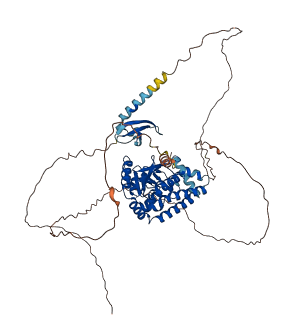
Descriptions
The autoinhibited protein was predicted that may have potential autoinhibitory elements via cis-regPred.
Autoinhibitory domains (AIDs)
Target domain |
|
Relief mechanism |
|
Assay |
cis-regPred |
Accessory elements
No accessory elements
Autoinhibited structure

Activated structure
1 structures for Q6AYK9
| Entry ID | Method | Resolution | Chain | Position | Source |
|---|---|---|---|---|---|
| AF-Q6AYK9-F1 | Predicted | AlphaFoldDB |
No variants for Q6AYK9
| Variant ID(s) | Position | Change | Description | Diseaes Association | Provenance |
|---|---|---|---|---|---|
| No variants for Q6AYK9 | |||||
1 associated diseases with Q6AYK9
[MIM: 613722]: Developmental and epileptic encephalopathy 12 (DEE12)
A form of epilepsy characterized by frequent tonic seizures or spasms beginning in infancy with a specific EEG finding of suppression-burst patterns, characterized by high-voltage bursts alternating with almost flat suppression phases. Patients may progress to West syndrome, which is characterized by tonic spasms with clustering, arrest of psychomotor development, and hypsarrhythmia on EEG. {ECO:0000269|PubMed:20833646}. Note=The disease is caused by variants affecting the gene represented in this entry.
Without disease ID
- A form of epilepsy characterized by frequent tonic seizures or spasms beginning in infancy with a specific EEG finding of suppression-burst patterns, characterized by high-voltage bursts alternating with almost flat suppression phases. Patients may progress to West syndrome, which is characterized by tonic spasms with clustering, arrest of psychomotor development, and hypsarrhythmia on EEG. {ECO:0000269|PubMed:20833646}. Note=The disease is caused by variants affecting the gene represented in this entry.
5 regional properties for Q6AYK9
| Type | Name | Position | InterPro Accession |
|---|---|---|---|
| conserved_site | ATP-dependent RNA helicase DEAD-box, conserved site | 150 - 158 | IPR000629 |
| domain | Helicase, C-terminal | 218 - 382 | IPR001650 |
| domain | DEAD/DEAH box helicase domain | 26 - 195 | IPR011545 |
| domain | Helicase superfamily 1/2, ATP-binding domain | 21 - 222 | IPR014001 |
| domain | RNA helicase, DEAD-box type, Q motif | 2 - 30 | IPR014014 |
Functions
4 GO annotations of cellular component
| Name | Definition |
|---|---|
| chromosome | A structure composed of a very long molecule of DNA and associated proteins (e.g. histones) that carries hereditary information. |
| cytoplasm | The contents of a cell excluding the plasma membrane and nucleus, but including other subcellular structures. |
| nuclear speck | A discrete extra-nucleolar subnuclear domain, 20-50 in number, in which splicing factors are seen to be localized by immunofluorescence microscopy. |
| nucleus | A membrane-bounded organelle of eukaryotic cells in which chromosomes are housed and replicated. In most cells, the nucleus contains all of the cell's chromosomes except the organellar chromosomes, and is the site of RNA synthesis and processing. In some species, or in specialized cell types, RNA metabolism or DNA replication may be absent. |
6 GO annotations of molecular function
| Name | Definition |
|---|---|
| acyltransferase activity | Catalysis of the transfer of an acyl group from one compound (donor) to another (acceptor). |
| chromatin binding | Binding to chromatin, the network of fibers of DNA, protein, and sometimes RNA, that make up the chromosomes of the eukaryotic nucleus during interphase. |
| crotonyl-CoA hydratase activity | Catalysis of the reaction: Acetyl-CoA + -N(6)-acetyl-L-lysine. |
| methylated histone binding | Binding to a histone in which a residue has been modified by methylation. |
| protein-macromolecule adaptor activity | The binding activity of a protein that brings together two or more macromolecules in contact, permitting those molecules to function in a coordinated way. The adaptor can bring together two proteins, or a protein and another macromolecule such as a lipid or a nucleic acid. |
| transcription corepressor activity | A transcription coregulator activity that represses or decreases the transcription of specific gene sets via binding to a DNA-bound DNA-binding transcription factor, either on its own or as part of a complex. Corepressors often act by altering chromatin structure and modifications. For example, one class of transcription corepressors modifies chromatin structure through covalent modification of histones. A second class remodels the conformation of chromatin in an ATP-dependent fashion. A third class modulates interactions of DNA-bound DNA-binding transcription factors with other transcription coregulators. |
3 GO annotations of biological process
| Name | Definition |
|---|---|
| negative regulation of peptidyl-lysine crotonylation | Any process that stops or reduces the rate of crotonylation of a lysine residue in a protein. |
| random inactivation of X chromosome | Compensating for the two-fold variation in X-chromosome:autosome ratios between sexes by a global inactivation of all, or most of, the genes on either the paternal or maternal X-chromosome in the XX sex. |
| spermatid development | The process whose specific outcome is the progression of a spermatid over time, from its formation to the mature structure. |
7 homologous proteins in AiPD
| UniProt AC | Gene Name | Protein Name | Species | Evidence Code |
|---|---|---|---|---|
| Q99549 | MPHOSPH8 | M-phase phosphoprotein 8 | Homo sapiens (Human) | PR |
| P83916 | CBX1 | Chromobox protein homolog 1 | Homo sapiens (Human) | PR |
| Q8N8U2 | CDYL2 | Chromodomain Y-like protein 2 | Homo sapiens (Human) | PR |
| Q9Y232 | CDYL | Chromodomain Y-like protein | Homo sapiens (Human) | PR |
| P83917 | Cbx1 | Chromobox protein homolog 1 | Mus musculus (Mouse) | PR |
| Q9D5D8 | Cdyl2 | Chromodomain Y-like protein 2 | Mus musculus (Mouse) | PR |
| Q9WTK2 | Cdyl | Chromodomain Y-like protein | Mus musculus (Mouse) | PR |
| 10 | 20 | 30 | 40 | 50 | 60 |
| MGLGSSQPST | KEAEPCTLQE | KEEHPVDDTR | QQNNAVPATV | SDPDQVSPAV | QDAETQVESI |
| 70 | 80 | 90 | 100 | 110 | 120 |
| VDKRKNKKGK | TEYLVRWKGY | DSEDDTWEPE | QHLVNCEEYI | HDFNRRHNER | QKEGTLARAN |
| 130 | 140 | 150 | 160 | 170 | 180 |
| RASPSNARKQ | ISRSTHSALS | KTNPKALVVG | KDHESKTNQL | LATSQKFRKN | TAPSLANRKN |
| 190 | 200 | 210 | 220 | 230 | 240 |
| MDLAKSGIKI | LVPKSPIKGR | TSIDGFHGES | PEKLDQGAED | TVTPEVTAEK | PTGALLGPGA |
| 250 | 260 | 270 | 280 | 290 | 300 |
| ERARMGSRPR | IHSLVPQVSG | PVTAAMATTL | AVNGKGTSPF | MDALTANGTV | TIQTSVTGVT |
| 310 | 320 | 330 | 340 | 350 | 360 |
| AGKRKFIDDR | RDQPFDKRLR | FSVRQTESAY | RYRDIVVRKQ | DGFTHILLST | KSSENNSLNP |
| 370 | 380 | 390 | 400 | 410 | 420 |
| EVMKEVQSAL | STAAADDSKL | VLLSAVGSVF | CCGLDFIYFI | RRLTDDRKRE | STKMAEAIRN |
| 430 | 440 | 450 | 460 | 470 | 480 |
| FVNTFIQFKK | PIIVAVNGPA | IGLGASILPL | CDVVWANEKA | WFQTPYTTFG | QSPDGCSTVM |
| 490 | 500 | 510 | 520 | 530 | 540 |
| FPKIMGGASA | NEMLLSGRKL | TAQEACGKGL | VSQVFWPGTF | TQEVMVRIKE | LASCNPIVLE |
| 550 | 560 | 570 | 580 | ||
| ESKALVRCNM | KMELEQANER | ECDALKKIWG | SAQGMDSMLK | YLQRKIDEF |