Q6AYK5
Gene name |
Lyar |
Protein name |
Cell growth-regulating nucleolar protein |
Names |
|
Species |
Rattus norvegicus (Rat) |
KEGG Pathway |
rno:289707 |
EC number |
|
Protein Class |
|
Descriptions
The autoinhibited protein was predicted that may have potential autoinhibitory elements via cis-regPred.
Autoinhibitory domains (AIDs)
Target domain |
|
Relief mechanism |
|
Assay |
cis-regPred |
Accessory elements
No accessory elements
Autoinhibited structure

Activated structure
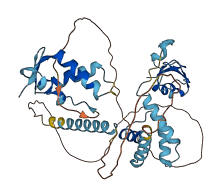
1 structures for Q6AYK5
| Entry ID | Method | Resolution | Chain | Position | Source |
|---|---|---|---|---|---|
| AF-Q6AYK5-F1 | Predicted | AlphaFoldDB |
No variants for Q6AYK5
| Variant ID(s) | Position | Change | Description | Diseaes Association | Provenance |
|---|---|---|---|---|---|
| No variants for Q6AYK5 | |||||
No associated diseases with Q6AYK5
Functions
5 GO annotations of cellular component
| Name | Definition |
|---|---|
| cytoplasm | The contents of a cell excluding the plasma membrane and nucleus, but including other subcellular structures. |
| nucleolus | A small, dense body one or more of which are present in the nucleus of eukaryotic cells. It is rich in RNA and protein, is not bounded by a limiting membrane, and is not seen during mitosis. Its prime function is the transcription of the nucleolar DNA into 45S ribosomal-precursor RNA, the processing of this RNA into 5.8S, 18S, and 28S components of ribosomal RNA, and the association of these components with 5S RNA and proteins synthesized outside the nucleolus. This association results in the formation of ribonucleoprotein precursors; these pass into the cytoplasm and mature into the 40S and 60S subunits of the ribosome. |
| nucleoplasm | That part of the nuclear content other than the chromosomes or the nucleolus. |
| nucleus | A membrane-bounded organelle of eukaryotic cells in which chromosomes are housed and replicated. In most cells, the nucleus contains all of the cell's chromosomes except the organellar chromosomes, and is the site of RNA synthesis and processing. In some species, or in specialized cell types, RNA metabolism or DNA replication may be absent. |
| photoreceptor outer segment | The outer segment of a vertebrate photoreceptor that contains a stack of membrane discs embedded with photoreceptor proteins. |
5 GO annotations of molecular function
| Name | Definition |
|---|---|
| DNA binding | Any molecular function by which a gene product interacts selectively and non-covalently with DNA (deoxyribonucleic acid). |
| DNA-binding transcription factor binding | Binding to a DNA-binding transcription factor, a protein that interacts with a specific DNA sequence (sometimes referred to as a motif) within the regulatory region of a gene to modulate transcription. |
| identical protein binding | Binding to an identical protein or proteins. |
| metal ion binding | Binding to a metal ion. |
| transcription regulator inhibitor activity | A molecular function regulator that inhibits the activity of a transcription regulator via direct binding and/or post-translational modification. |
7 GO annotations of biological process
| Name | Definition |
|---|---|
| erythrocyte development | The process whose specific outcome is the progression of an erythrocyte over time, from its formation to the mature structure. |
| innate immune response | Innate immune responses are defense responses mediated by germline encoded components that directly recognize components of potential pathogens. |
| negative regulation of innate immune response | Any process that stops, prevents, or reduces the frequency, rate or extent of the innate immune response. |
| negative regulation of transcription by RNA polymerase II | Any process that stops, prevents, or reduces the frequency, rate or extent of transcription mediated by RNA polymerase II. |
| positive regulation of phagocytosis | Any process that activates or increases the frequency, rate or extent of phagocytosis. |
| positive regulation of transcription by RNA polymerase I | Any process that activates or increases the frequency, rate or extent of transcription mediated by RNA polymerase I. |
| rRNA processing | Any process involved in the conversion of a primary ribosomal RNA (rRNA) transcript into one or more mature rRNA molecules. |
1 homologous proteins in AiPD
| UniProt AC | Gene Name | Protein Name | Species | Evidence Code |
|---|---|---|---|---|
| Q9NX58 | LYAR | Cell growth-regulating nucleolar protein | Homo sapiens (Human) | PR |
| 10 | 20 | 30 | 40 | 50 | 60 |
| MVFFTCNACG | ESVKKIQVEK | HVSICRNCEC | LSCIDCGKDF | WGDDYKNHVK | CISEDQKYGG |
| 70 | 80 | 90 | 100 | 110 | 120 |
| KGYEAKTHKG | DVKQQAWIQK | INELIKKPNV | SPKVRELLQQ | ISAFDNVPRK | KAKFQNWMRN |
| 130 | 140 | 150 | 160 | 170 | 180 |
| SLKVHSDSVL | EQVWNIFSEA | ASSEQDQQPP | SHMAKPNTEV | PTKVPSTKTN | GTTEEQTEAK |
| 190 | 200 | 210 | 220 | 230 | 240 |
| KNKRERKEER | QKSRKKEKKE | LKLENHQENL | KGQKPKKRKK | GQEAGHEAGG | EDAAEANGAP |
| 250 | 260 | 270 | 280 | 290 | 300 |
| EKKRARDAQA | SEEGADRNGG | PAEDADEGPT | KTAAGKRKRQ | KHSEVESDNK | KKKMKLPGQP |
| 310 | 320 | 330 | 340 | 350 | 360 |
| EEGEPEDHEA | PSKGKFNWKG | TIKAVLKQAP | DNEISVKKLK | KKVIAQYHAV | MSDHHTSEEE |
| 370 | 380 | ||||
| LLAIFNKKIS | RNPTFKVLKD | KVKLLK |