Q6AYJ5
Gene name |
Cluap1 |
Protein name |
Clusterin-associated protein 1 |
Names |
|
Species |
Rattus norvegicus (Rat) |
KEGG Pathway |
rno:363544 |
EC number |
|
Protein Class |
|
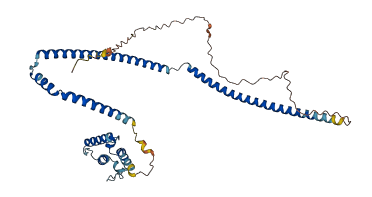
Descriptions
The autoinhibited protein was predicted that may have potential autoinhibitory elements via cis-regPred.
Autoinhibitory domains (AIDs)
Target domain |
|
Relief mechanism |
|
Assay |
cis-regPred |
Accessory elements
No accessory elements
Autoinhibited structure

Activated structure
1 structures for Q6AYJ5
| Entry ID | Method | Resolution | Chain | Position | Source |
|---|---|---|---|---|---|
| AF-Q6AYJ5-F1 | Predicted | AlphaFoldDB |
1 variants for Q6AYJ5
| Variant ID(s) | Position | Change | Description | Diseaes Association | Provenance |
|---|---|---|---|---|---|
| rs8163070 | 362 | N>D | No | EVA |
No associated diseases with Q6AYJ5
No regional properties for Q6AYJ5
| Type | Name | Position | InterPro Accession |
|---|---|---|---|
| No domain, repeats, and functional sites for Q6AYJ5 | |||
7 GO annotations of cellular component
| Name | Definition |
|---|---|
| centrosome | A structure comprised of a core structure (in most organisms, a pair of centrioles) and peripheral material from which a microtubule-based structure, such as a spindle apparatus, is organized. Centrosomes occur close to the nucleus during interphase in many eukaryotic cells, though in animal cells it changes continually during the cell-division cycle. |
| ciliary base | Area of the cilium (also called flagellum) where the basal body and the axoneme are anchored to the plasma membrane. The ciliary base encompasses the distal part of the basal body, transition fibers and transition zone and is structurally and functionally very distinct from the rest of the cilium. In this area proteins are sorted and filtered before entering the cilium, and many ciliary proteins localize specifically to this area. |
| ciliary tip | Part of the cilium where the axoneme ends. The ciliary tip has been implicated in ciliary assembly and disassembly, as well as signal transduction. |
| cilium | A specialized eukaryotic organelle that consists of a filiform extrusion of the cell surface and of some cytoplasmic parts. Each cilium is largely bounded by an extrusion of the cytoplasmic (plasma) membrane, and contains a regular longitudinal array of microtubules, anchored to a basal body. |
| intraciliary transport particle A | The smaller subcomplex of the intraciliary transport particle; characterized complexes have molecular weights of 710-760 kDa. |
| intraciliary transport particle B | The larger subcomplex of the intraciliary transport particle; characterized complexes have molecular weights around 550 kDa. |
| nucleus | A membrane-bounded organelle of eukaryotic cells in which chromosomes are housed and replicated. In most cells, the nucleus contains all of the cell's chromosomes except the organellar chromosomes, and is the site of RNA synthesis and processing. In some species, or in specialized cell types, RNA metabolism or DNA replication may be absent. |
No GO annotations of molecular function
| Name | Definition |
|---|---|
| No GO annotations for molecular function |
7 GO annotations of biological process
| Name | Definition |
|---|---|
| axoneme assembly | The assembly and organization of an axoneme, the bundle of microtubules and associated proteins that forms the core of cilia (also called flagella) in eukaryotic cells and is responsible for their movements. |
| cilium assembly | The assembly of a cilium, a specialized eukaryotic organelle that consists of a filiform extrusion of the cell surface. Each cilium is bounded by an extrusion of the cytoplasmic membrane, and contains a regular longitudinal array of microtubules, anchored basally in a centriole. |
| floor plate formation | The formation of a ventral region of glial cells in the neural tube that provides inductive signals for the specification of neuronal cell types. The floor plate is evident at the ventral midline by the neural fold stage. |
| heart looping | The tube morphogenesis process in which the primitive heart tube loops asymmetrically. This looping brings the primitive heart chambers into alignment preceding their future integration. Heart looping begins with dextral-looping and ends when the main regional divisions of the mature heart and primordium of the great arterial trunks become established preceeding septation. |
| left/right pattern formation | The pattern specification process that results in the subdivision of the left/right axis in space to define an area or volume in which specific patterns of cell differentiation will take place or in which cells interpret a specific environment. |
| neural tube closure | The last step in the formation of the neural tube, where the paired neural folds are brought together and fuse at the dorsal midline. |
| smoothened signaling pathway | The series of molecular signals generated as a consequence of activation of the transmembrane protein Smoothened. |
1 homologous proteins in AiPD
| UniProt AC | Gene Name | Protein Name | Species | Evidence Code |
|---|---|---|---|---|
| Q8R3P7 | Cluap1 | Clusterin-associated protein 1 | Mus musculus (Mouse) | PR |
| 10 | 20 | 30 | 40 | 50 | 60 |
| MMRALGYPRH | ISMENFRTPN | FGLVSEVLLW | LVKRYEPQTD | IPSDTETEQD | RVFFIKAIAQ |
| 70 | 80 | 90 | 100 | 110 | 120 |
| FMATKAHIKL | NTKKLYQADG | YAVKELLKIT | SVLYNAMKTK | GMEGSNVGEE | DISKFKFDLG |
| 130 | 140 | 150 | 160 | 170 | 180 |
| SKIADLKAAR | QLASEITAKG | ASLYDLLGKE | VELRELRTEA | IARPLEINET | EKVMRIAIKD |
| 190 | 200 | 210 | 220 | 230 | 240 |
| ILAQVQKTKD | LLNNVASDEA | NLEAKIEKRK | LELERNRKRL | QTLQSVRPAF | MDEYEKVEEE |
| 250 | 260 | 270 | 280 | 290 | 300 |
| LQKQYDVYLE | KFRNLAYLEQ | QLEDHHRMEQ | ERFEEAENTL | RLMQNKLKEE | EKRLLKSGSN |
| 310 | 320 | 330 | 340 | 350 | 360 |
| DDSDIDIQED | DESDSELEDR | RLSKPRTAME | VLMQGRPSKR | IVGTMQGGDS | DEDEDSEDSE |
| 370 | 380 | 390 | 400 | ||
| MNMEDDEEDD | DDLEDESIAL | SPAKPSRRVR | KPEPLDESDN | DF |