Q68XV9
Gene name |
aatA (RT0046) |
Protein name |
Probable aspartate/prephenate aminotransferase |
Names |
AspAT / PAT, Transaminase A |
Species |
Rickettsia typhi (strain ATCC VR-144 / Wilmington) |
KEGG Pathway |
rty:RT0046 |
EC number |
2.6.1.1: Transaminases |
Protein Class |
|
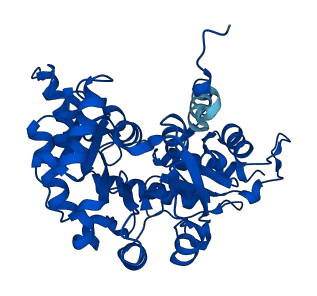
Descriptions
The autoinhibited protein was predicted that may have potential autoinhibitory elements via cis-regPred.
Autoinhibitory domains (AIDs)
Target domain |
|
Relief mechanism |
|
Assay |
cis-regPred |
Accessory elements
No accessory elements
Autoinhibited structure

Activated structure
1 structures for Q68XV9
| Entry ID | Method | Resolution | Chain | Position | Source |
|---|---|---|---|---|---|
| AF-Q68XV9-F1 | Predicted | AlphaFoldDB |
No variants for Q68XV9
| Variant ID(s) | Position | Change | Description | Diseaes Association | Provenance |
|---|---|---|---|---|---|
| No variants for Q68XV9 | |||||
No associated diseases with Q68XV9
Functions
| Description | ||
|---|---|---|
| EC Number | 2.6.1.1 | Transaminases |
| Subcellular Localization |
|
|
| PANTHER Family | ||
| PANTHER Subfamily | ||
| PANTHER Protein Class | ||
| PANTHER Pathway Category | No pathway information available | |
1 GO annotations of cellular component
| Name | Definition |
|---|---|
| cytoplasm | The contents of a cell excluding the plasma membrane and nucleus, but including other subcellular structures. |
3 GO annotations of molecular function
| Name | Definition |
|---|---|
| glutamate-prephenate aminotransferase activity | Catalysis of the reaction: 2-oxoglutarate + L-arogenate = L-glutamate + prephenate. |
| L-aspartate:2-oxoglutarate aminotransferase activity | Catalysis of the reaction: L-aspartate + 2-oxoglutarate = oxaloacetate + L-glutamate. |
| pyridoxal phosphate binding | Binding to pyridoxal 5' phosphate, 3-hydroxy-5-(hydroxymethyl)-2-methyl4-pyridine carboxaldehyde 5' phosphate, the biologically active form of vitamin B6. |
2 GO annotations of biological process
| Name | Definition |
|---|---|
| alpha-amino acid metabolic process | The chemical reactions and pathways involving an alpha-amino acid. |
| biosynthetic process | The chemical reactions and pathways resulting in the formation of substances; typically the energy-requiring part of metabolism in which simpler substances are transformed into more complex ones. |
No homologous proteins in AiPD
| UniProt AC | Gene Name | Protein Name | Species | Evidence Code |
|---|---|---|---|---|
| No homologous proteins | ||||
| 10 | 20 | 30 | 40 | 50 | 60 |
| MSIISTRLNS | IKPSPTLAVV | KKTLELKKAG | VNIIALGAGE | PDFDTPDNIK | EVAITSIKDG |
| 70 | 80 | 90 | 100 | 110 | 120 |
| FTKYTNVDGI | PLLKQAIKNK | FKRENNIDYE | LDEIIVSTGG | KQVIYNLFMA | SLDKGDEVII |
| 130 | 140 | 150 | 160 | 170 | 180 |
| PVPYWVSYPD | MVALSTGTPI | FVNCGIENNF | KLTVEALERS | ITDKTKWLII | NSPSNPTGAG |
| 190 | 200 | 210 | 220 | 230 | 240 |
| YNCKELENIA | KTLRKYPNVN | IMSDDIYEHI | TFDDFKFYTL | AQIAPDLKER | IFTVNGVSKA |
| 250 | 260 | 270 | 280 | 290 | 300 |
| YSMTGWRIGY | GAGSKALIKA | MTVIQSQSTS | NPCSISQMAA | IEALNGTQDY | IKPNALNFQK |
| 310 | 320 | 330 | 340 | 350 | 360 |
| KRDLALSILE | KVIYFECYKP | EGAFYLFVKC | DKIFGTKTKS | GKIIANSNHF | SEYLLEEAKV |
| 370 | 380 | 390 | |||
| AVVPGVAFGL | DGYFRISYAT | SMQELKEACI | RIKQACNTL |