Q66KH2
Gene name |
ergic3 |
Protein name |
Endoplasmic reticulum-Golgi intermediate compartment protein 3 |
Names |
|
Species |
Xenopus laevis (African clawed frog) |
KEGG Pathway |
xla:447415 |
EC number |
|
Protein Class |
|
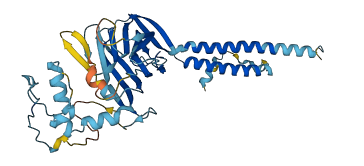
Descriptions
The autoinhibited protein was predicted that may have potential autoinhibitory elements via cis-regPred.
Autoinhibitory domains (AIDs)
Target domain |
|
Relief mechanism |
|
Assay |
cis-regPred |
Accessory elements
No accessory elements
Autoinhibited structure

Activated structure
1 structures for Q66KH2
| Entry ID | Method | Resolution | Chain | Position | Source |
|---|---|---|---|---|---|
| AF-Q66KH2-F1 | Predicted | AlphaFoldDB |
No variants for Q66KH2
| Variant ID(s) | Position | Change | Description | Diseaes Association | Provenance |
|---|---|---|---|---|---|
| No variants for Q66KH2 | |||||
No associated diseases with Q66KH2
Functions
4 GO annotations of cellular component
| Name | Definition |
|---|---|
| endoplasmic reticulum membrane | The lipid bilayer surrounding the endoplasmic reticulum. |
| endoplasmic reticulum-Golgi intermediate compartment membrane | The lipid bilayer surrounding any of the compartments of the endoplasmic reticulum (ER)-Golgi intermediate compartment system. |
| Golgi apparatus | A membrane-bound cytoplasmic organelle of the endomembrane system that further processes the core oligosaccharides (e.g. N-glycans) added to proteins in the endoplasmic reticulum and packages them into membrane-bound vesicles. The Golgi apparatus operates at the intersection of the secretory, lysosomal, and endocytic pathways. |
| integral component of membrane | The component of a membrane consisting of the gene products and protein complexes having at least some part of their peptide sequence embedded in the hydrophobic region of the membrane. |
No GO annotations of molecular function
| Name | Definition |
|---|---|
| No GO annotations for molecular function |
1 GO annotations of biological process
| Name | Definition |
|---|---|
| vesicle-mediated transport | A cellular transport process in which transported substances are moved in membrane-bounded vesicles; transported substances are enclosed in the vesicle lumen or located in the vesicle membrane. The process begins with a step that directs a substance to the forming vesicle, and includes vesicle budding and coating. Vesicles are then targeted to, and fuse with, an acceptor membrane. |
No homologous proteins in AiPD
| UniProt AC | Gene Name | Protein Name | Species | Evidence Code |
|---|---|---|---|---|
| No homologous proteins | ||||
| 10 | 20 | 30 | 40 | 50 | 60 |
| METLHRLRQF | DAYPKTLEDF | RVKTCGGAVV | TVISGLIMLI | LFFSELQYYL | TKEVYPELFV |
| 70 | 80 | 90 | 100 | 110 | 120 |
| DKSRGDKLKI | NIDVIFPHMP | CAYLSIDAMD | VAGEQQLDVE | HNLFKQRLDL | DKKPVTSEAD |
| 130 | 140 | 150 | 160 | 170 | 180 |
| RHELGKSEEQ | VVFDPKTLDP | NRCESCYGAE | TDDFSCCNSC | DDVREAYRRK | GWAFKTPDSI |
| 190 | 200 | 210 | 220 | 230 | 240 |
| EQCKREGFSQ | KMQEQKNEGC | QVYGFLEVNK | VAGNFHFAPG | KSFQQSHVHV | HAVEIHDLQS |
| 250 | 260 | 270 | 280 | 290 | 300 |
| FGLDNINMTH | EIKHLSFGKD | YPGLVNPLDG | TSIVAMQSSM | MFQYFVKIVP | TVYVKVDGEV |
| 310 | 320 | 330 | 340 | 350 | 360 |
| LRTNQFSVTR | HEKMTNGLIG | DQGLPGVFVL | YELSPMMVKF | TEKHRSFTHF | LTGVCAIIGG |
| 370 | 380 | ||||
| VFTVAGLIDS | LIYYSTRAIQ | KKIELGKAT |