Q66JX5
Gene name |
Cep43 |
Protein name |
Centrosomal protein 43 |
Names |
FGFR1 oncogene partner |
Species |
Mus musculus (Mouse) |
KEGG Pathway |
mmu:75296 |
EC number |
|
Protein Class |
|
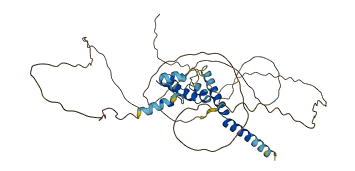
Descriptions
The autoinhibited protein was predicted that may have potential autoinhibitory elements via cis-regPred.
Autoinhibitory domains (AIDs)
Target domain |
|
Relief mechanism |
|
Assay |
cis-regPred |
Accessory elements
No accessory elements
Autoinhibited structure

Activated structure
1 structures for Q66JX5
| Entry ID | Method | Resolution | Chain | Position | Source |
|---|---|---|---|---|---|
| AF-Q66JX5-F1 | Predicted | AlphaFoldDB |
16 variants for Q66JX5
| Variant ID(s) | Position | Change | Description | Diseaes Association | Provenance |
|---|---|---|---|---|---|
| 20 | L>R | strain: C57BL/6J [UniProt] | No | ||
| rs224586042 | 61 | N>S | No | EVA | |
| rs257597205 | 112 | Q>R | No | EVA | |
| rs48213049 | 186 | I>S | No | EVA | |
| rs51715587 | 190 | P>S | No | EVA | |
| rs3389447455 | 216 | S>N | No | EVA | |
| rs3389447402 | 217 | L>Q | No | EVA | |
| rs3389391865 | 218 | H>N | No | EVA | |
| rs3389434921 | 222 | H>L | No | EVA | |
| rs215314707 | 274 | R>W | No | EVA | |
| rs51906200 | 277 | V>M | No | EVA | |
| rs3389430840 | 298 | G>* | No | EVA | |
| rs3389412057 | 352 | E>Q | No | EVA | |
| rs3389432187 | 354 | S>N | No | EVA | |
| rs3389412102 | 364 | S>P | No | EVA | |
| rs232891142 | 370 | G>V | No | EVA |
No associated diseases with Q66JX5
Functions
5 GO annotations of cellular component
| Name | Definition |
|---|---|
| cell projection | A prolongation or process extending from a cell, e.g. a flagellum or axon. |
| centriole | A cellular organelle, found close to the nucleus in many eukaryotic cells, consisting of a small cylinder with microtubular walls, 300-500 nm long and 150-250 nm in diameter. It contains nine short, parallel, peripheral microtubular fibrils, each fibril consisting of one complete microtubule fused to two incomplete microtubules. Cells usually have two centrioles, lying at right angles to each other. At division, each pair of centrioles generates another pair and the twin pairs form the pole of the mitotic spindle. |
| centrosome | A structure comprised of a core structure (in most organisms, a pair of centrioles) and peripheral material from which a microtubule-based structure, such as a spindle apparatus, is organized. Centrosomes occur close to the nucleus during interphase in many eukaryotic cells, though in animal cells it changes continually during the cell-division cycle. |
| nucleus | A membrane-bounded organelle of eukaryotic cells in which chromosomes are housed and replicated. In most cells, the nucleus contains all of the cell's chromosomes except the organellar chromosomes, and is the site of RNA synthesis and processing. In some species, or in specialized cell types, RNA metabolism or DNA replication may be absent. |
| perinuclear region of cytoplasm | Cytoplasm situated near, or occurring around, the nucleus. |
3 GO annotations of molecular function
| Name | Definition |
|---|---|
| protein homodimerization activity | Binding to an identical protein to form a homodimer. |
| protein kinase binding | Binding to a protein kinase, any enzyme that catalyzes the transfer of a phosphate group, usually from ATP, to a protein substrate. |
| protein tyrosine kinase inhibitor activity | Stops, prevents or reduces the activity of a protein tyrosine kinase. |
6 GO annotations of biological process
| Name | Definition |
|---|---|
| cell projection organization | A process that is carried out at the cellular level which results in the assembly, arrangement of constituent parts, or disassembly of a prolongation or process extending from a cell, e.g. a flagellum or axon. |
| microtubule anchoring | Any process in which a microtubule is maintained in a specific location in a cell. |
| negative regulation of protein kinase activity | Any process that stops, prevents, or reduces the frequency, rate or extent of protein kinase activity. |
| positive regulation of cell growth | Any process that activates or increases the frequency, rate, extent or direction of cell growth. |
| positive regulation of cell migration | Any process that activates or increases the frequency, rate or extent of cell migration. |
| positive regulation of cell population proliferation | Any process that activates or increases the rate or extent of cell proliferation. |
No homologous proteins in AiPD
| UniProt AC | Gene Name | Protein Name | Species | Evidence Code |
|---|---|---|---|---|
| No homologous proteins | ||||
| 10 | 20 | 30 | 40 | 50 | 60 |
| MAATTAAVVA | EEDTELRDLL | VQTLENSGVL | NRIKAELRAA | VFLALEEQEK | VENKTPLVNE |
| 70 | 80 | 90 | 100 | 110 | 120 |
| NLKKFLNTKD | GRLVASLVAE | FLQFFNLDFT | LAVFHPETST | IQGLEGRENL | AQDLGIIEAE |
| 130 | 140 | 150 | 160 | 170 | 180 |
| GTVGGPLLLE | VIRRCQQKEK | GPASVEGALD | LSDGHPPSKS | PEGKSSANST | PSKIPRYKGQ |
| 190 | 200 | 210 | 220 | 230 | 240 |
| GKKKTIGQKP | GDKKTSSETS | QSEPSVSLSE | SKSKSSLHSL | AHETRIASFL | SSSAVDARDS |
| 250 | 260 | 270 | 280 | 290 | 300 |
| SALCPDGDDV | EGDSFFDDPI | PKPEKTYGWR | AEPRKQVGGL | ASLSDKPHLR | SGLSSLAGAP |
| 310 | 320 | 330 | 340 | 350 | 360 |
| SLTDPESKRG | STVLKDLKLV | GEKIGSLGLG | TGEDEDYADD | FNSASHRSEK | SELSIGEEIE |
| 370 | 380 | 390 | |||
| EDLSMGVEDG | NTSDKLDDLT | QDLTVSQLSD | VADYLEDVA |