Q64350
Gene name |
Eif2b5 (Eif2be) |
Protein name |
Translation initiation factor eIF-2B subunit epsilon |
Names |
eIF-2B GDP-GTP exchange factor subunit epsilon |
Species |
Rattus norvegicus (Rat) |
KEGG Pathway |
rno:192234 |
EC number |
|
Protein Class |
|
Descriptions
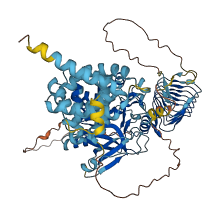
The autoinhibited protein was predicted that may have potential autoinhibitory elements via cis-regPred.
Autoinhibitory domains (AIDs)
Target domain |
|
Relief mechanism |
|
Assay |
cis-regPred |
Accessory elements
No accessory elements
Autoinhibited structure

Activated structure
1 structures for Q64350
| Entry ID | Method | Resolution | Chain | Position | Source |
|---|---|---|---|---|---|
| AF-Q64350-F1 | Predicted | AlphaFoldDB |
No variants for Q64350
| Variant ID(s) | Position | Change | Description | Diseaes Association | Provenance |
|---|---|---|---|---|---|
| No variants for Q64350 | |||||
No associated diseases with Q64350
4 GO annotations of cellular component
| Name | Definition |
|---|---|
| cytoplasm | The contents of a cell excluding the plasma membrane and nucleus, but including other subcellular structures. |
| cytosol | The part of the cytoplasm that does not contain organelles but which does contain other particulate matter, such as protein complexes. |
| eukaryotic translation initiation factor 2B complex | A multisubunit guanine nucleotide exchange factor which catalyzes the exchange of GDP bound to initiation factor eIF2 for GTP, generating active eIF2-GTP. In humans, it is composed of five subunits, alpha, beta, delta, gamma and epsilon. |
| nucleus | A membrane-bounded organelle of eukaryotic cells in which chromosomes are housed and replicated. In most cells, the nucleus contains all of the cell's chromosomes except the organellar chromosomes, and is the site of RNA synthesis and processing. In some species, or in specialized cell types, RNA metabolism or DNA replication may be absent. |
3 GO annotations of molecular function
| Name | Definition |
|---|---|
| guanyl-nucleotide exchange factor activity | Stimulates the exchange of GDP to GTP on a signaling GTPase, changing its conformation to its active form. Guanine nucleotide exchange factors (GEFs) act by stimulating the release of guanosine diphosphate (GDP) to allow binding of guanosine triphosphate (GTP), which is more abundant in the cell under normal cellular physiological conditions. |
| translation initiation factor activity | Functions in the initiation of ribosome-mediated translation of mRNA into a polypeptide. |
| translation initiation factor binding | Binding to a translation initiation factor, any polypeptide factor involved in the initiation of ribosome-mediated translation. |
17 GO annotations of biological process
| Name | Definition |
|---|---|
| aging | A developmental process that is a deterioration and loss of function over time. Aging includes loss of functions such as resistance to disease, homeostasis, and fertility, as well as wear and tear. Aging includes cellular senescence, but is more inclusive. May precede death and may succeed developmental maturation (GO:0021700). |
| astrocyte development | The process aimed at the progression of an astrocyte over time, from initial commitment of the cell to a specific fate, to the fully functional differentiated cell. An astrocyte is the most abundant type of glial cell. Astrocytes provide support for neurons and regulate the environment in which they function. |
| astrocyte differentiation | The process in which a relatively unspecialized cell acquires the specialized features of an astrocyte. An astrocyte is the most abundant type of glial cell. Astrocytes provide support for neurons and regulate the environment in which they function. |
| hippocampus development | The progression of the hippocampus over time from its initial formation until its mature state. |
| myelination | The process in which myelin sheaths are formed and maintained around neurons. Oligodendrocytes in the brain and spinal cord and Schwann cells in the peripheral nervous system wrap axons with compact layers of their plasma membrane. Adjacent myelin segments are separated by a non-myelinated stretch of axon called a node of Ranvier. |
| oligodendrocyte development | The process aimed at the progression of an oligodendrocyte over time, from initial commitment of the cell to a specific fate, to the fully functional differentiated cell. An oligodendrocyte is a type of glial cell involved in myelinating the axons in the central nervous system. |
| ovarian follicle development | The process whose specific outcome is the progression of the ovarian follicle over time, from its formation to the mature structure. |
| positive regulation of apoptotic process | Any process that activates or increases the frequency, rate or extent of cell death by apoptotic process. |
| positive regulation of translation | Any process that activates or increases the frequency, rate or extent of the chemical reactions and pathways resulting in the formation of proteins by the translation of mRNA or circRNA. |
| positive regulation of translational initiation | Any process that activates or increases the frequency, rate or extent of translational initiation. |
| response to endoplasmic reticulum stress | Any process that results in a change in state or activity of a cell (in terms of movement, secretion, enzyme production, gene expression, etc.) as a result of a stress acting at the endoplasmic reticulum. ER stress usually results from the accumulation of unfolded or misfolded proteins in the ER lumen. |
| response to glucose | Any process that results in a change in state or activity of a cell or an organism (in terms of movement, secretion, enzyme production, gene expression, etc.) as a result of a glucose stimulus. |
| response to heat | Any process that results in a change in state or activity of a cell or an organism (in terms of movement, secretion, enzyme production, gene expression, etc.) as a result of a heat stimulus, a temperature stimulus above the optimal temperature for that organism. |
| response to lithium ion | Any process that results in a change in state or activity of a cell or an organism (in terms of movement, secretion, enzyme production, gene expression, etc.) as a result of a lithium (Li+) ion stimulus. |
| response to peptide hormone | Any process that results in a change in state or activity of a cell or an organism (in terms of movement, secretion, enzyme production, gene expression, etc.) as a result of a peptide hormone stimulus. A peptide hormone is any of a class of peptides that are secreted into the blood stream and have endocrine functions in living animals. |
| T cell receptor signaling pathway | The series of molecular signals initiated by the cross-linking of an antigen receptor on a T cell. |
| translational initiation | The process preceding formation of the peptide bond between the first two amino acids of a protein. This includes the formation of a complex of the ribosome, mRNA or circRNA, and an initiation complex that contains the first aminoacyl-tRNA. |
| 10 | 20 | 30 | 40 | 50 | 60 |
| MAATAAVPSA | VGGRANKRGG | GSGGGGTQGA | EEEPPPPLQA | VLVADSFDRR | FFPISKDQPR |
| 70 | 80 | 90 | 100 | 110 | 120 |
| VLLPLANVAL | IDYTLEFLTA | TGVQETFVFC | CWKAAQIKEH | LQKSKWCHPT | SLNVVRIITS |
| 130 | 140 | 150 | 160 | 170 | 180 |
| DLYRSLGDVL | RDVDAKALVR | SDFLLIYGDV | VSNINISKAL | EEHRLRRKLE | KNVSVMTMVF |
| 190 | 200 | 210 | 220 | 230 | 240 |
| KESSPSHPTR | CHEDNVVLAV | DSTTNRILHF | QKTQGLRHFS | FPLGLFQGSL | DGVEIRYDLL |
| 250 | 260 | 270 | 280 | 290 | 300 |
| DCHISICSPQ | VAQLFTDNFD | YQTRDDFVRG | LLVNEEILGN | QIHLHVTSRE | YGARVSNLHM |
| 310 | 320 | 330 | 340 | 350 | 360 |
| YSAVCADVIR | RWVYPLTPEV | NFTDSSTQSY | THSRHNIYRG | PEVSLGHGSV | LEENVLLGAG |
| 370 | 380 | 390 | 400 | 410 | 420 |
| TVVGSNCSIT | NSVIGPNCHI | GDNVVLDQAY | LWQGVRVAAG | AQIHQSLLCD | RAEVKERVIL |
| 430 | 440 | 450 | 460 | 470 | 480 |
| KPHCVLTSQV | VVGPDIILPE | GSVISLHPPD | AEEDEDDGQF | SDDSGADQEK | EKVKLKGYNP |
| 490 | 500 | 510 | 520 | 530 | 540 |
| AEVGPEGQGY | LWKAEDVDEK | EDEELRQSLW | GLMINMEEES | ETESERSVDP | EELDSRAGSP |
| 550 | 560 | 570 | 580 | 590 | 600 |
| QLDDIRVFQN | EVLGTLQRGR | EENISCDNLV | LEINSLKYAY | NISLKEVMQV | LSHVVLEFPL |
| 610 | 620 | 630 | 640 | 650 | 660 |
| QQVDGVLDPN | RYCALLLPLL | KAWSPVFRNY | IKRAADHLEA | LAAIEDFFLE | HETLVPSLAK |
| 670 | 680 | 690 | 700 | 710 | |
| VLMAFYQLEI | LAEETILSWF | SQRDITDKGQ | QLRKNQQLQR | FIQWLREAEE | ESSDDD |