Q64277
Gene name |
Bst1 (Bp-3, Bp3, Ly65) |
Protein name |
ADP-ribosyl cyclase/cyclic ADP-ribose hydrolase 2 |
Names |
|
Species |
Mus musculus (Mouse) |
KEGG Pathway |
mmu:12182 |
EC number |
3.2.2.6: Hydrolyzing N-glycosyl compounds |
Protein Class |
|
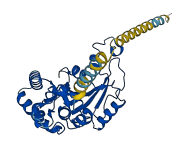
Descriptions
The autoinhibited protein was predicted that may have potential autoinhibitory elements via cis-regPred.
Autoinhibitory domains (AIDs)
Target domain |
|
Relief mechanism |
|
Assay |
cis-regPred |
Accessory elements
No accessory elements
Autoinhibited structure

Activated structure
1 structures for Q64277
| Entry ID | Method | Resolution | Chain | Position | Source |
|---|---|---|---|---|---|
| AF-Q64277-F1 | Predicted | AlphaFoldDB |
No variants for Q64277
| Variant ID(s) | Position | Change | Description | Diseaes Association | Provenance |
|---|---|---|---|---|---|
| No variants for Q64277 | |||||
No associated diseases with Q64277
No regional properties for Q64277
| Type | Name | Position | InterPro Accession |
|---|---|---|---|
| No domain, repeats, and functional sites for Q64277 | |||
Functions
| Description | ||
|---|---|---|
| EC Number | 3.2.2.6 | Hydrolyzing N-glycosyl compounds |
| Subcellular Localization |
|
|
| PANTHER Family | ||
| PANTHER Subfamily | ||
| PANTHER Protein Class | ||
| PANTHER Pathway Category | No pathway information available | |
4 GO annotations of cellular component
| Name | Definition |
|---|---|
| anchored component of membrane | The component of a membrane consisting of the gene products that are tethered to the membrane only by a covalently attached anchor, such as a lipid group that is embedded in the membrane. Gene products with peptide sequences that are embedded in the membrane are excluded from this grouping. |
| extrinsic component of membrane | The component of a membrane consisting of gene products and protein complexes that are loosely bound to one of its surfaces, but not integrated into the hydrophobic region. |
| plasma membrane | The membrane surrounding a cell that separates the cell from its external environment. It consists of a phospholipid bilayer and associated proteins. |
| uropod | A membrane projection with related cytoskeletal components at the trailing edge of a cell in the process of migrating or being activated, found on the opposite side of the cell from the leading edge or immunological synapse, respectively. |
7 GO annotations of molecular function
| Name | Definition |
|---|---|
| ADP-ribosyl cyclase activity | Catalysis of the reaction: NAD = cyclic ADP-ribose + nicotinamide. |
| cyclic ADP-ribose hydrolase | Catalysis of the reaction: cyclic ADP-ribose + H20 = ADP-ribose (ADPR). |
| NAD(P)+ nucleosidase activity | Catalysis of the reaction: NAD(P)+ + H2O = ADP-ribose(P) + nicotinamide. |
| NAD+ nucleosidase activity | Catalysis of the reaction: NAD+ + H2O = nicotinamide + ADP-ribose. |
| NAD+ nucleotidase, cyclic ADP-ribose generating | Catalysis of the reaction: NAD+ + H2O = nicotinamide + ADP-ribose that proceeds in a stepwise fashion by ADP-ribosyl cyclase activity followed by cyclic ADP-ribose hydrolase activity. |
| phosphorus-oxygen lyase activity | Catalysis of the cleavage of a phosphorus-oxygen bond by other means than by hydrolysis or oxidation, or conversely adding a group to a double bond. |
| transferase activity | Catalysis of the transfer of a group, e.g. a methyl group, glycosyl group, acyl group, phosphorus-containing, or other groups, from one compound (generally regarded as the donor) to another compound (generally regarded as the acceptor). Transferase is the systematic name for any enzyme of EC class 2. |
8 GO annotations of biological process
| Name | Definition |
|---|---|
| positive regulation of B cell proliferation | Any process that activates or increases the rate or extent of B cell proliferation. |
| positive regulation of cell population proliferation | Any process that activates or increases the rate or extent of cell proliferation. |
| regulation of actin cytoskeleton organization | Any process that modulates the frequency, rate or extent of the formation, arrangement of constituent parts, or disassembly of cytoskeletal structures comprising actin filaments and their associated proteins. |
| regulation of calcium-mediated signaling | Any process that modulates the frequency, rate or extent of calcium-mediated signaling, the process in which a cell uses calcium ions to convert an extracellular signal into a response. |
| regulation of cell-matrix adhesion | Any process that modulates the frequency, rate or extent of attachment of a cell to the extracellular matrix. |
| regulation of inflammatory response | Any process that modulates the frequency, rate or extent of the inflammatory response, the immediate defensive reaction (by vertebrate tissue) to infection or injury caused by chemical or physical agents. |
| regulation of neutrophil chemotaxis | Any process that modulates the frequency, rate, or extent of neutrophil chemotaxis. Neutrophil chemotaxis is the directed movement of a neutrophil cell, the most numerous polymorphonuclear leukocyte found in the blood, in response to an external stimulus, usually an infection or wounding. |
| regulation of peptidyl-tyrosine phosphorylation | Any process that modulates the frequency, rate or extent of the phosphorylation of peptidyl-tyrosine. |
No homologous proteins in AiPD
| UniProt AC | Gene Name | Protein Name | Species | Evidence Code |
|---|---|---|---|---|
| No homologous proteins | ||||
| 10 | 20 | 30 | 40 | 50 | 60 |
| MAVQGGLLSL | WLWLWLSLLT | VLLGARARWR | GEGTTPHLQS | IFLGRCAEYT | TLLSLGNKNC |
| 70 | 80 | 90 | 100 | 110 | 120 |
| TAIWEAFKGV | LDKDPCSVLP | SDYDLFINLS | RHPIPRDKSL | FWENNHLLVM | SYGENTRRLV |
| 130 | 140 | 150 | 160 | 170 | 180 |
| ALCDVLYGKV | GDFLSWCRQE | NASGLDYQSC | PTSEDCENNA | VDSYWKSASM | QYSRDSSGVI |
| 190 | 200 | 210 | 220 | 230 | 240 |
| NVMLNGSEPK | GAYPTRGFFA | DFEIPYLQKD | KVTRIEIWVM | HDVGGPNVES | CGEGSVKILE |
| 250 | 260 | 270 | 280 | 290 | 300 |
| DRLEALGFQH | SCINDYRPVK | FLMCVDHSTH | PDCIMNSASA | SMRRESASLH | AIGDASLLIS |
| 310 | |||||
| LLVALASSSQ | A |