Q62277
Gene name |
Syp |
Protein name |
Synaptophysin |
Names |
BM89 antigen, Major synaptic vesicle protein p38 |
Species |
Mus musculus (Mouse) |
KEGG Pathway |
mmu:20977 |
EC number |
|
Protein Class |
|
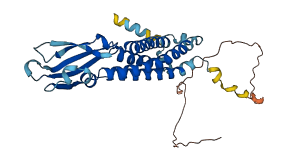
Descriptions
The autoinhibited protein was predicted that may have potential autoinhibitory elements via cis-regPred.
Autoinhibitory domains (AIDs)
Target domain |
|
Relief mechanism |
|
Assay |
cis-regPred |
Accessory elements
No accessory elements
Autoinhibited structure

Activated structure
1 structures for Q62277
| Entry ID | Method | Resolution | Chain | Position | Source |
|---|---|---|---|---|---|
| AF-Q62277-F1 | Predicted | AlphaFoldDB |
17 variants for Q62277
| Variant ID(s) | Position | Change | Description | Diseaes Association | Provenance |
|---|---|---|---|---|---|
| rs3389459713 | 38 | I>V | No | EVA | |
| rs3389554898 | 56 | E>K | No | EVA | |
| rs3389531380 | 79 | Q>* | No | EVA | |
| rs3389543876 | 80 | V>E | No | EVA | |
| rs3389518078 | 93 | T>I | No | EVA | |
| rs3389459662 | 117 | L>I | No | EVA | |
| rs3409327386 | 141 | M>I | No | EVA | |
| rs3407470617 | 152 | F>I | No | EVA | |
| rs3409327355 | 155 | L>P | No | EVA | |
| rs3409755469 | 160 | A>P | No | EVA | |
| rs3409594510 | 169 | K>M | No | EVA | |
| rs3408356990 | 186 | Q>* | No | EVA | |
| rs3409420588 | 187 | T>K | No | EVA | |
| rs3389566991 | 192 | K>M | No | EVA | |
| rs3408356926 | 211 | L>P | No | EVA | |
| rs3409327387 | 279 | Y>N | No | EVA | |
| rs3409415541 | 315 | M>Y | No | EVA |
No associated diseases with Q62277
1 regional properties for Q62277
| Type | Name | Position | InterPro Accession |
|---|---|---|---|
| conserved_site | Ribosome-binding factor A, conserved site | 77 - 98 | IPR020053 |
20 GO annotations of cellular component
| Name | Definition |
|---|---|
| anchoring junction | A cell junction that mechanically attaches a cell (and its cytoskeleton) to neighboring cells or to the extracellular matrix. |
| clathrin-sculpted glutamate transport vesicle membrane | The lipid bilayer surrounding a clathrin-sculpted glutamate transport vesicle. |
| excitatory synapse | A synapse in which an action potential in the presynaptic cell increases the probability of an action potential occurring in the postsynaptic cell. |
| integral component of synaptic vesicle membrane | The component of the synaptic vesicle membrane consisting of the gene products and protein complexes having at least some part of their peptide sequence embedded in the hydrophobic region of the membrane. |
| intracellular organelle | Organized structure of distinctive morphology and function, occurring within the cell. Includes the nucleus, mitochondria, plastids, vacuoles, vesicles, ribosomes and the cytoskeleton. Excludes the plasma membrane. |
| membrane | A lipid bilayer along with all the proteins and protein complexes embedded in it an attached to it. |
| neuromuscular junction | The junction between the axon of a motor neuron and a muscle fiber. In response to the arrival of action potentials, the presynaptic button releases molecules of neurotransmitters into the synaptic cleft. These diffuse across the cleft and transmit the signal to the postsynaptic membrane of the muscle fiber, leading to a change in post-synaptic potential. |
| neuron projection | A prolongation or process extending from a nerve cell, e.g. an axon or dendrite. |
| neuron projection terminus | The specialized, terminal region of a neuron projection such as an axon or a dendrite. |
| neuron spine | A small membranous protrusion, often ending in a bulbous head and attached to the neuron by a narrow stalk or neck. |
| perinuclear region of cytoplasm | Cytoplasm situated near, or occurring around, the nucleus. |
| postsynaptic density | An electron dense network of proteins within and adjacent to the postsynaptic membrane of an asymmetric, neuron-neuron synapse. Its major components include neurotransmitter receptors and the proteins that spatially and functionally organize them such as anchoring and scaffolding molecules, signaling enzymes and cytoskeletal components. |
| presynaptic active zone | A specialized region of the plasma membrane and cell cortex of a presynaptic neuron; encompasses a region of the plasma membrane where synaptic vesicles dock and fuse, and a specialized cortical cytoskeletal matrix. |
| presynaptic membrane | A specialized area of membrane of the axon terminal that faces the plasma membrane of the neuron or muscle fiber with which the axon terminal establishes a synaptic junction; many synaptic junctions exhibit structural presynaptic characteristics, such as conical, electron-dense internal protrusions, that distinguish it from the remainder of the axon plasma membrane. |
| protein-containing complex | A stable assembly of two or more macromolecules, i.e. proteins, nucleic acids, carbohydrates or lipids, in which at least one component is a protein and the constituent parts function together. |
| Schaffer collateral - CA1 synapse | A synapse between the Schaffer collateral axon of a CA3 pyramidal cell and a CA1 pyramidal cell. |
| synapse | The junction between an axon of one neuron and a dendrite of another neuron, a muscle fiber or a glial cell. As the axon approaches the synapse it enlarges into a specialized structure, the presynaptic terminal bouton, which contains mitochondria and synaptic vesicles. At the tip of the terminal bouton is the presynaptic membrane; facing it, and separated from it by a minute cleft (the synaptic cleft) is a specialized area of membrane on the receiving cell, known as the postsynaptic membrane. In response to the arrival of nerve impulses, the presynaptic terminal bouton secretes molecules of neurotransmitters into the synaptic cleft. These diffuse across the cleft and transmit the signal to the postsynaptic membrane. |
| synaptic vesicle | A secretory organelle, typically 50 nm in diameter, of presynaptic nerve terminals; accumulates in high concentrations of neurotransmitters and secretes these into the synaptic cleft by fusion with the 'active zone' of the presynaptic plasma membrane. |
| synaptic vesicle membrane | The lipid bilayer surrounding a synaptic vesicle. |
| terminal bouton | Terminal inflated portion of the axon, containing the specialized apparatus necessary to release neurotransmitters. The axon terminus is considered to be the whole region of thickening and the terminal bouton is a specialized region of it. |
7 GO annotations of molecular function
| Name | Definition |
|---|---|
| cholesterol binding | Binding to cholesterol (cholest-5-en-3-beta-ol); the principal sterol of vertebrates and the precursor of many steroids, including bile acids and steroid hormones. |
| identical protein binding | Binding to an identical protein or proteins. |
| protein domain specific binding | Binding to a specific domain of a protein. |
| protein-containing complex binding | Binding to a macromolecular complex. |
| SH2 domain binding | Binding to a SH2 domain (Src homology 2) of a protein, a protein domain of about 100 amino-acid residues and belonging to the alpha + beta domain class. |
| SNARE binding | Binding to a SNARE (soluble N-ethylmaleimide-sensitive factor attached protein receptor) protein. |
| syntaxin-1 binding | Binding to a syntaxin-1 SNAP receptor. |
9 GO annotations of biological process
| Name | Definition |
|---|---|
| cellular response to organic substance | Any process that results in a change in state or activity of a cell (in terms of movement, secretion, enzyme production, gene expression, etc.) as a result of an organic substance stimulus. |
| chemical synaptic transmission | The vesicular release of classical neurotransmitter molecules from a presynapse, across a chemical synapse, the subsequent activation of neurotransmitter receptors at the postsynapse of a target cell (neuron, muscle, or secretory cell) and the effects of this activation on the postsynaptic membrane potential and ionic composition of the postsynaptic cytosol. This process encompasses both spontaneous and evoked release of neurotransmitter and all parts of synaptic vesicle exocytosis. Evoked transmission starts with the arrival of an action potential at the presynapse. |
| endocytosis | A vesicle-mediated transport process in which cells take up external materials or membrane constituents by the invagination of a small region of the plasma membrane to form a new membrane-bounded vesicle. |
| regulation of long-term neuronal synaptic plasticity | A process that modulates long-term neuronal synaptic plasticity, the ability of neuronal synapses to change long-term as circumstances require. Long-term neuronal synaptic plasticity generally involves increase or decrease in actual synapse numbers. |
| regulation of neuronal synaptic plasticity | A process that modulates neuronal synaptic plasticity, the ability of neuronal synapses to change as circumstances require. They may alter function, such as increasing or decreasing their sensitivity, or they may increase or decrease in actual numbers. |
| regulation of opioid receptor signaling pathway | Any process that modulates the frequency, rate or extent of opioid receptor signaling pathway. |
| regulation of short-term neuronal synaptic plasticity | A process that modulates short-term neuronal synaptic plasticity, the ability of neuronal synapses to change in the short-term as circumstances require. Short-term neuronal synaptic plasticity generally involves increasing or decreasing synaptic sensitivity. |
| regulation of synaptic vesicle exocytosis | Any process that modulates the frequency, rate or extent of synaptic vesicle exocytosis. |
| synaptic vesicle endocytosis | A vesicle-mediated transport process, in which the synaptic vesicle membrane constituents are retrieved from the presynaptic membrane on the axon terminal after neurotransmitter secretion by exocytosis. Synaptic vesicle endocytosis can occur via clathrin-dependent and clathrin-independent mechanisms. |
No homologous proteins in AiPD
| UniProt AC | Gene Name | Protein Name | Species | Evidence Code |
|---|---|---|---|---|
| No homologous proteins | ||||
| 10 | 20 | 30 | 40 | 50 | 60 |
| MLLLADMDVV | NQLVAGGQFR | VVKEPLGFVK | VLQWVFAIFA | FATCGSYTGE | LRLSVECANK |
| 70 | 80 | 90 | 100 | 110 | 120 |
| TESALNIEVE | FEYPFRLHQV | YFDAPSCVKG | GTTKIFLVGD | YSSSAEFFVT | VAVFAFLYSM |
| 130 | 140 | 150 | 160 | 170 | 180 |
| GALATYIFLQ | NKYRENNKGP | MMDFLATAVF | AFMWLVSSSA | WAKGLSDVKM | ATDPENIIKE |
| 190 | 200 | 210 | 220 | 230 | 240 |
| MPMCRQTGNT | CKELRDPVTS | GLNTSVVFGF | LNLVLWVGNL | WFVFKETGWA | APFMRAPPGA |
| 250 | 260 | 270 | 280 | 290 | 300 |
| PEKQPAPGDA | YGDAGYGQGP | GGYGPQDSYG | PQGGYQPDYG | QPASGGGGGY | GPQGDYGQQG |
| 310 | |||||
| YGQQGAPTSF | SNQM |