Q61425
Gene name |
Hadh (Hadhsc, Mschad, Schad) |
Protein name |
Hydroxyacyl-coenzyme A dehydrogenase, mitochondrial |
Names |
HCDH, Medium and short-chain L-3-hydroxyacyl-coenzyme A dehydrogenase, Short-chain 3-hydroxyacyl-CoA dehydrogenase |
Species |
Mus musculus (Mouse) |
KEGG Pathway |
mmu:15107 |
EC number |
1.1.1.35: With NAD(+) or NADP(+) as acceptor |
Protein Class |
|
Descriptions
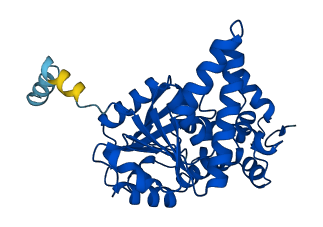
The autoinhibited protein was predicted that may have potential autoinhibitory elements via cis-regPred.
Autoinhibitory domains (AIDs)
Target domain |
|
Relief mechanism |
|
Assay |
cis-regPred |
Accessory elements
No accessory elements
Autoinhibited structure

Activated structure
1 structures for Q61425
| Entry ID | Method | Resolution | Chain | Position | Source |
|---|---|---|---|---|---|
| AF-Q61425-F1 | Predicted | AlphaFoldDB |
20 variants for Q61425
| Variant ID(s) | Position | Change | Description | Diseaes Association | Provenance |
|---|---|---|---|---|---|
| rs3388667897 | 23 | K>* | No | EVA | |
| rs3388659952 | 54 | V>I | No | EVA | |
| rs3388660985 | 56 | V>* | No | EVA | |
| rs3388651602 | 57 | D>E | No | EVA | |
| rs3388660988 | 58 | Q>* | No | EVA | |
| rs3388663221 | 58 | Q>R | No | EVA | |
| rs3388662650 | 60 | E>G | No | EVA | |
| rs3388657704 | 68 | K>* | No | EVA | |
| rs3388663284 | 105 | D>V | No | EVA | |
| rs3388668469 | 149 | S>T | No | EVA | |
| rs3388659497 | 153 | I>F | No | EVA | |
| rs3388667851 | 161 | T>I | No | EVA | |
| rs3388665058 | 171 | F>L | No | EVA | |
| rs3388660818 | 190 | S>N | No | EVA | |
| rs223933025 | 231 | V>I | No | EVA | |
| rs3393712655 | 234 | H>R* | No | EVA | |
| rs3388657738 | 237 | G>S | No | EVA | |
| rs3388653643 | 250 | L>M | No | EVA | |
| rs3388657675 | 281 | E>G | No | EVA | |
| rs3388651606 | 306 | T>I | No | EVA |
No associated diseases with Q61425
9 regional properties for Q61425
| Type | Name | Position | InterPro Accession |
|---|---|---|---|
| domain | Helicase, C-terminal | 415 - 577 | IPR001650 |
| conserved_site | SEC-C motif | 821 - 839 | IPR004027 |
| domain | SecA DEAD-like, N-terminal | 5 - 383 | IPR011115 |
| domain | SecA Wing/Scaffold | 571 - 779 | IPR011116 |
| domain | SecA, preprotein cross-linking domain | 227 - 339 | IPR011130 |
| domain | Helicase superfamily 1/2, ATP-binding domain | 87 - 245 | IPR014001 |
| domain | SecA motor DEAD | 1 - 571 | IPR014018 |
| conserved_site | SecA conserved site | 481 - 496 | IPR020937 |
| domain | SecA, C-terminal helicase domain | 401 - 541 | IPR044722 |
Functions
| Description | ||
|---|---|---|
| EC Number | 1.1.1.35 | With NAD(+) or NADP(+) as acceptor |
| Subcellular Localization |
|
|
| PANTHER Family | ||
| PANTHER Subfamily | ||
| PANTHER Protein Class | ||
| PANTHER Pathway Category | No pathway information available | |
5 GO annotations of cellular component
| Name | Definition |
|---|---|
| cytoplasm | The contents of a cell excluding the plasma membrane and nucleus, but including other subcellular structures. |
| mitochondrial inner membrane | The inner, i.e. lumen-facing, lipid bilayer of the mitochondrial envelope. It is highly folded to form cristae. |
| mitochondrial matrix | The gel-like material, with considerable fine structure, that lies in the matrix space, or lumen, of a mitochondrion. It contains the enzymes of the tricarboxylic acid cycle and, in some organisms, the enzymes concerned with fatty acid oxidation. |
| mitochondrion | A semiautonomous, self replicating organelle that occurs in varying numbers, shapes, and sizes in the cytoplasm of virtually all eukaryotic cells. It is notably the site of tissue respiration. |
| nucleoplasm | That part of the nuclear content other than the chromosomes or the nucleolus. |
3 GO annotations of molecular function
| Name | Definition |
|---|---|
| 3-hydroxyacyl-CoA dehydrogenase activity | Catalysis of the reaction: (S)-3-hydroxyacyl-CoA + NAD+ = 3-oxoacyl-CoA + NADH + H(+). |
| identical protein binding | Binding to an identical protein or proteins. |
| NAD+ binding | Binding to the oxidized form, NAD, of nicotinamide adenine dinucleotide, a coenzyme involved in many redox and biosynthetic reactions. |
7 GO annotations of biological process
| Name | Definition |
|---|---|
| fatty acid beta-oxidation | A fatty acid oxidation process that results in the complete oxidation of a long-chain fatty acid. Fatty acid beta-oxidation begins with the addition of coenzyme A to a fatty acid, and occurs by successive cycles of reactions during each of which the fatty acid is shortened by a two-carbon fragment removed as acetyl coenzyme A; the cycle continues until only two or three carbons remain (as acetyl-CoA or propionyl-CoA respectively). |
| negative regulation of insulin secretion | Any process that stops, prevents, or reduces the frequency, rate or extent of the regulated release of insulin. |
| positive regulation of cold-induced thermogenesis | Any process that activates or increases the frequency, rate or extent of cold-induced thermogenesis. |
| regulation of insulin secretion | Any process that modulates the frequency, rate or extent of the regulated release of insulin. |
| response to activity | Any process that results in a change in state or activity of a cell or an organism (in terms of movement, secretion, enzyme production, gene expression, etc.) as a result of an activity stimulus. |
| response to insulin | Any process that results in a change in state or activity of a cell or an organism (in terms of movement, secretion, enzyme production, gene expression, etc.) as a result of an insulin stimulus. Insulin is a polypeptide hormone produced by the islets of Langerhans of the pancreas in mammals, and by the homologous organs of other organisms. |
| response to xenobiotic stimulus | Any process that results in a change in state or activity of a cell or an organism (in terms of movement, secretion, enzyme production, gene expression, etc.) as a result of a stimulus from a xenobiotic, a compound foreign to the organim exposed to it. It may be synthesized by another organism (like ampicilin) or it can be a synthetic chemical. |
1 homologous proteins in AiPD
| UniProt AC | Gene Name | Protein Name | Species | Evidence Code |
|---|---|---|---|---|
| Q16836 | HADH | Hydroxyacyl-coenzyme A dehydrogenase, mitochondrial | Homo sapiens (Human) | PR |
| 10 | 20 | 30 | 40 | 50 | 60 |
| MAFVTRQFLR | SMSSSSSASA | AAKKILIKHV | TVIGGGLMGA | GIAQVAAATG | HTVVLVDQTE |
| 70 | 80 | 90 | 100 | 110 | 120 |
| DILAKSKKGI | EESLKRMAKK | KFTENPKAGD | EFVEKTLSCL | STSTDAASVV | HSTDLVVEAI |
| 130 | 140 | 150 | 160 | 170 | 180 |
| VENLKLKNEL | FQRLDKFAAE | HTIFASNTSS | LQITNIANAT | TRQDRFAGLH | FFNPVPMMKL |
| 190 | 200 | 210 | 220 | 230 | 240 |
| VEVIKTPMTS | QKTFESLVDF | CKTLGKHPVS | CKDTPGFIVN | RLLVPYLIEA | VRLHERGDAS |
| 250 | 260 | 270 | 280 | 290 | 300 |
| KEDIDTAMKL | GAGYPMGPFE | LLDYVGLDTT | KFILDGWHEM | EPENPLFQPS | PSMNNLVAQK |
| 310 | |||||
| KLGKKTGEGF | YKYK |