Q60V73
Gene name |
mel-32 |
Protein name |
Serine hydroxymethyltransferase |
Names |
SHMT, Glycine hydroxymethyltransferase, Maternal effect lethal protein 32, Serine methylase |
Species |
Caenorhabditis briggsae |
KEGG Pathway |
|
EC number |
2.1.2.1: Hydroxymethyl-, formyl- and related transferases |
Protein Class |
|
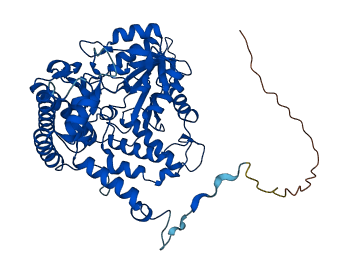
Descriptions
The autoinhibited protein was predicted that may have potential autoinhibitory elements via cis-regPred.
Autoinhibitory domains (AIDs)
Target domain |
|
Relief mechanism |
|
Assay |
cis-regPred |
Accessory elements
No accessory elements
Autoinhibited structure

Activated structure
1 structures for Q60V73
| Entry ID | Method | Resolution | Chain | Position | Source |
|---|---|---|---|---|---|
| AF-Q60V73-F1 | Predicted | AlphaFoldDB |
No variants for Q60V73
| Variant ID(s) | Position | Change | Description | Diseaes Association | Provenance |
|---|---|---|---|---|---|
| No variants for Q60V73 | |||||
No associated diseases with Q60V73
Functions
| Description | ||
|---|---|---|
| EC Number | 2.1.2.1 | Hydroxymethyl-, formyl- and related transferases |
| Subcellular Localization |
|
|
| PANTHER Family | ||
| PANTHER Subfamily | ||
| PANTHER Protein Class | ||
| PANTHER Pathway Category | No pathway information available | |
3 GO annotations of cellular component
| Name | Definition |
|---|---|
| cytoplasm | The contents of a cell excluding the plasma membrane and nucleus, but including other subcellular structures. |
| cytosol | The part of the cytoplasm that does not contain organelles but which does contain other particulate matter, such as protein complexes. |
| nucleus | A membrane-bounded organelle of eukaryotic cells in which chromosomes are housed and replicated. In most cells, the nucleus contains all of the cell's chromosomes except the organellar chromosomes, and is the site of RNA synthesis and processing. In some species, or in specialized cell types, RNA metabolism or DNA replication may be absent. |
7 GO annotations of molecular function
| Name | Definition |
|---|---|
| glycine hydroxymethyltransferase activity | Catalysis of the reaction: 5,10-methylenetetrahydrofolate + glycine + H2O = tetrahydrofolate + L-serine. |
| mRNA 5'-UTR binding | Binding to an mRNA molecule at its 5' untranslated region. |
| mRNA regulatory element binding translation repressor activity | Antagonizes the ribosome-mediated translation of mRNA into a polypeptide via direct binding (through a selective and non-covalent interaction) to nucleic acid. |
| protein homodimerization activity | Binding to an identical protein to form a homodimer. |
| pyridoxal phosphate binding | Binding to pyridoxal 5' phosphate, 3-hydroxy-5-(hydroxymethyl)-2-methyl4-pyridine carboxaldehyde 5' phosphate, the biologically active form of vitamin B6. |
| serine binding | Binding to 2-amino-3-hydroxypropanoic acid. |
| zinc ion binding | Binding to a zinc ion (Zn). |
10 GO annotations of biological process
| Name | Definition |
|---|---|
| embryo development ending in birth or egg hatching | The process whose specific outcome is the progression of an embryo over time, from zygote formation until the end of the embryonic life stage. The end of the embryonic life stage is organism-specific and may be somewhat arbitrary; for mammals it is usually considered to be birth, for insects the hatching of the first instar larva from the eggshell. |
| folic acid metabolic process | The chemical reactions and pathways involving folic acid, pteroylglutamic acid. Folic acid is widely distributed as a member of the vitamin B complex and is essential for the synthesis of purine and pyrimidines. |
| glycine biosynthetic process from serine | The chemical reactions and pathways resulting in the formation of glycine from other compounds, including serine. |
| L-serine catabolic process | The chemical reactions and pathways resulting in the breakdown of L-serine, the L-enantiomer of serine, i.e. (2S)-2-amino-3-hydroxypropanoic acid. |
| one-carbon metabolic process | The chemical reactions and pathways involving the transfer of one-carbon units in various oxidation states. |
| protein homotetramerization | The formation of a protein homotetramer, a macromolecular structure consisting of four noncovalently associated identical subunits. |
| purine nucleobase biosynthetic process | The chemical reactions and pathways resulting in the formation of purine nucleobases, one of the two classes of nitrogen-containing ring compounds found in DNA and RNA, which include adenine and guanine. |
| serine family amino acid metabolic process | The chemical reactions and pathways involving amino acids of the serine family, comprising cysteine, glycine, homoserine, selenocysteine and serine. |
| tetrahydrofolate interconversion | The chemical reactions and pathways by which one-carbon (C1) units are transferred between tetrahydrofolate molecules, to synthesise other tetrahydrofolate molecules. |
| tetrahydrofolate metabolic process | The chemical reactions and pathways involving tetrahydrofolate, 5,6,7,8-tetrahydrofolic acid, a folate derivative bearing additional hydrogens on the pterin group. |
No homologous proteins in AiPD
| UniProt AC | Gene Name | Protein Name | Species | Evidence Code |
|---|---|---|---|---|
| No homologous proteins | ||||
| 10 | 20 | 30 | 40 | 50 | 60 |
| MFARAVSRKT | MTGLLAGSRV | LLASQFTMAD | RQVHTPLEPV | QRQKYANNEN | LLKDHVEKID |
| 70 | 80 | 90 | 100 | 110 | 120 |
| PEVFNIMKNE | KSRQRRGLEL | IASENFTSKA | VMDALGSAMC | NKYSEGYPGA | RYYGGNEFID |
| 130 | 140 | 150 | 160 | 170 | 180 |
| QMEILCQKRA | LEVFGLDPAK | WGVNVQSLSG | SPANFAVYTA | LVGANGRIMG | LDLPDGGHLT |
| 190 | 200 | 210 | 220 | 230 | 240 |
| HGFFTPARKV | SATSEFFQSM | PYKVDAQSGL | IDYDKLEENA | MLFRPKVLIA | GVSCYARHLD |
| 250 | 260 | 270 | 280 | 290 | 300 |
| YERFRKIATK | AGAYLMSDMA | HISGLVAAGL | IPSPFEYSDV | VTTTTHKSLR | GPRGAMIFYR |
| 310 | 320 | 330 | 340 | 350 | 360 |
| KGVRSVNAKG | VETLYDLEEK | INSAVFPGLQ | GGPHNHTIAG | IAVALKQCLS | EDFVQYGEQI |
| 370 | 380 | 390 | 400 | 410 | 420 |
| LKNAKTLAER | LKKHGYSLAT | GGTDNHLLLV | DLRPIGVEGA | RAEHILDLAH | IACNKNTCPG |
| 430 | 440 | 450 | 460 | 470 | 480 |
| DVSALRPGGI | RLGTPALTSR | GFKEQDFEKV | GDFIHEGVQI | AKKYNAEAGK | TLKDFKAFTA |
| 490 | 500 | 510 | |||
| TNEQFKQEVA | ELAKRVEEFS | GKFEIPGNDL | F |