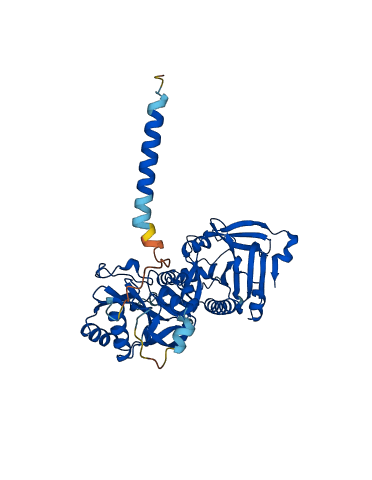
Descriptions
The autoinhibited protein was predicted that may have potential autoinhibitory elements via cis-regPred.
Autoinhibitory domains (AIDs)
Target domain |
|
Relief mechanism |
|
Assay |
cis-regPred |
Accessory elements
No accessory elements
Autoinhibited structure

Activated structure
1 structures for Q60HG0
| Entry ID | Method | Resolution | Chain | Position | Source |
|---|---|---|---|---|---|
| AF-Q60HG0-F1 | Predicted | AlphaFoldDB |
No variants for Q60HG0
| Variant ID(s) | Position | Change | Description | Diseaes Association | Provenance |
|---|---|---|---|---|---|
| No variants for Q60HG0 | |||||
No associated diseases with Q60HG0
1 regional properties for Q60HG0
| Type | Name | Position | InterPro Accession |
|---|---|---|---|
| domain | Ribitol-5-phosphate transferase FKTN, N-terminal | 1 - 278 | IPR045587 |
Functions
4 GO annotations of cellular component
| Name | Definition |
|---|---|
| cis-Golgi network | The network of interconnected tubular and cisternal structures located at the convex side of the Golgi apparatus, which abuts the endoplasmic reticulum. |
| Golgi apparatus | A membrane-bound cytoplasmic organelle of the endomembrane system that further processes the core oligosaccharides (e.g. N-glycans) added to proteins in the endoplasmic reticulum and packages them into membrane-bound vesicles. The Golgi apparatus operates at the intersection of the secretory, lysosomal, and endocytic pathways. |
| integral component of Golgi membrane | The component of the Golgi membrane consisting of the gene products and protein complexes having at least some part of their peptide sequence embedded in the hydrophobic region of the membrane. |
| nucleus | A membrane-bounded organelle of eukaryotic cells in which chromosomes are housed and replicated. In most cells, the nucleus contains all of the cell's chromosomes except the organellar chromosomes, and is the site of RNA synthesis and processing. In some species, or in specialized cell types, RNA metabolism or DNA replication may be absent. |
1 GO annotations of molecular function
| Name | Definition |
|---|---|
| phosphotransferase activity, for other substituted phosphate groups | Catalysis of the transfer of a substituted phosphate group, other than diphosphate or nucleotidyl residues, from one compound (donor) to a another (acceptor). |
2 GO annotations of biological process
| Name | Definition |
|---|---|
| protein O-linked glycosylation | A protein glycosylation process in which a carbohydrate or carbohydrate derivative unit is added to a protein via the hydroxyl group of peptidyl-serine, peptidyl-threonine, peptidyl-hydroxylysine, or peptidyl-hydroxyproline, or via the phenol group of peptidyl-tyrosine, forming an O-glycan. |
| protein O-linked mannosylation | The transfer of mannose from dolichyl activated mannose to the hydroxyl group of a seryl or threonyl residue of a protein acceptor molecule, to form an O-linked protein-sugar linkage. |
No homologous proteins in AiPD
| UniProt AC | Gene Name | Protein Name | Species | Evidence Code |
|---|---|---|---|---|
| No homologous proteins | ||||
| 10 | 20 | 30 | 40 | 50 | 60 |
| MSRINKNVVL | ALLTLTSSAF | LLFQLYYYKH | YLSTRNGAGL | SKSKGSRIGF | DSTQWRAVKK |
| 70 | 80 | 90 | 100 | 110 | 120 |
| FIMLTSNQNV | PVFLIDPLIL | ELINKNFEQV | KNTSQGSISQ | CTFFCVPRDF | TAFALQYHLW |
| 130 | 140 | 150 | 160 | 170 | 180 |
| KNEEGWFRIA | ENMGFQCLKI | ESKDPRLDGI | DSLSGTEIPL | HYICKLAAHA | IHLVVFHERS |
| 190 | 200 | 210 | 220 | 230 | 240 |
| SNYLWHGHLR | LKEHIDRKFV | PFRKLQFGRY | PGAFDRPELQ | QVTVDGLEVL | IPKDPMHFVE |
| 250 | 260 | 270 | 280 | 290 | 300 |
| EVPHSRFIEC | RYKEARAFFQ | QYLDDNTVEA | MAFRKSAKEL | LQLAAKTLNK | LGVPFWLSSG |
| 310 | 320 | 330 | 340 | 350 | 360 |
| TCLGWYRQCN | IIPYSKDVDL | GIFIQDYKSD | IILAFQDAGL | PLKHKFGKVE | DSLELSFQGK |
| 370 | 380 | 390 | 400 | 410 | 420 |
| DDVKLDIFFF | YEETDHMWNG | GTQAKTGKKF | KYLFPKFTLC | WTEFVDMKVH | VPCETLEYIE |
| 430 | 440 | 450 | 460 | ||
| ANYGKTWKIP | VKTWDWKRSP | PNVQPNGIWP | ISEWDEVIQL | Y |