Q60HC0
Gene name |
SYT1 (QnpA-13075) |
Protein name |
Synaptotagmin-1 |
Names |
Synaptotagmin I, SytI |
Species |
Macaca fascicularis (Crab-eating macaque) (Cynomolgus monkey) |
KEGG Pathway |
mcf:101865424 |
EC number |
|
Protein Class |
|
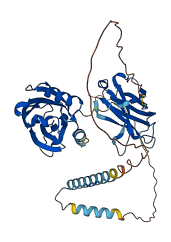
Descriptions
The autoinhibited protein was predicted that may have potential autoinhibitory elements via cis-regPred.
Autoinhibitory domains (AIDs)
Target domain |
|
Relief mechanism |
|
Assay |
cis-regPred |
Accessory elements
No accessory elements
Autoinhibited structure

Activated structure
1 structures for Q60HC0
| Entry ID | Method | Resolution | Chain | Position | Source |
|---|---|---|---|---|---|
| AF-Q60HC0-F1 | Predicted | AlphaFoldDB |
No variants for Q60HC0
| Variant ID(s) | Position | Change | Description | Diseaes Association | Provenance |
|---|---|---|---|---|---|
| No variants for Q60HC0 | |||||
No associated diseases with Q60HC0
6 regional properties for Q60HC0
| Type | Name | Position | InterPro Accession |
|---|---|---|---|
| domain | C2 domain | 139 - 260 | IPR000008-1 |
| domain | C2 domain | 270 - 403 | IPR000008-2 |
| domain | Synaptotagmin | 274 - 289 | IPR001565-1 |
| domain | Synaptotagmin | 289 - 302 | IPR001565-2 |
| domain | Synaptotagmin | 346 - 361 | IPR001565-3 |
| domain | Synaptotagmin | 366 - 376 | IPR001565-4 |
Functions
9 GO annotations of cellular component
| Name | Definition |
|---|---|
| anchoring junction | A cell junction that mechanically attaches a cell (and its cytoskeleton) to neighboring cells or to the extracellular matrix. |
| axon | The long process of a neuron that conducts nerve impulses, usually away from the cell body to the terminals and varicosities, which are sites of storage and release of neurotransmitter. |
| chromaffin granule membrane | The lipid bilayer surrounding a chromaffin granule, a specialized secretory vesicle found in the cells of adrenal glands and various other organs, which is concerned with the synthesis, storage, metabolism, and secretion of epinephrine and norepinephrine. |
| dense core granule | Electron-dense organelle with a granular internal matrix; contains proteins destined to be secreted. |
| glutamatergic synapse | A synapse that uses glutamate as a neurotransmitter. |
| Golgi apparatus | A membrane-bound cytoplasmic organelle of the endomembrane system that further processes the core oligosaccharides (e.g. N-glycans) added to proteins in the endoplasmic reticulum and packages them into membrane-bound vesicles. The Golgi apparatus operates at the intersection of the secretory, lysosomal, and endocytic pathways. |
| integral component of membrane | The component of a membrane consisting of the gene products and protein complexes having at least some part of their peptide sequence embedded in the hydrophobic region of the membrane. |
| presynaptic membrane | A specialized area of membrane of the axon terminal that faces the plasma membrane of the neuron or muscle fiber with which the axon terminal establishes a synaptic junction; many synaptic junctions exhibit structural presynaptic characteristics, such as conical, electron-dense internal protrusions, that distinguish it from the remainder of the axon plasma membrane. |
| synaptic vesicle membrane | The lipid bilayer surrounding a synaptic vesicle. |
5 GO annotations of molecular function
| Name | Definition |
|---|---|
| calcium ion sensor activity | Binding to and responding, e.g. by conformational change, to changes in the cellular level of calcium ions (Ca2+). |
| calcium-dependent phospholipid binding | Binding to a phospholipid, a class of lipids containing phosphoric acid as a mono- or diester, in the presence of calcium. |
| calcium-dependent protein binding | Binding to a protein or protein complex in the presence of calcium. |
| low-density lipoprotein particle receptor binding | Binding to a low-density lipoprotein receptor. |
| syntaxin-1 binding | Binding to a syntaxin-1 SNAP receptor. |
9 GO annotations of biological process
| Name | Definition |
|---|---|
| calcium-dependent activation of synaptic vesicle fusion | The regulatory process by which increased cytosolic calcium levels lead to the the fusion of synaptic vesicles with the presynaptic active zone membrane by bringing primed synaptic vesicle membrane into contact with membrane presynaptic active zone membrane. |
| cell differentiation | The process in which relatively unspecialized cells, e.g. embryonic or regenerative cells, acquire specialized structural and/or functional features that characterize the cells, tissues, or organs of the mature organism or some other relatively stable phase of the organism's life history. Differentiation includes the processes involved in commitment of a cell to a specific fate and its subsequent development to the mature state. |
| fast, calcium ion-dependent exocytosis of neurotransmitter | The fast, initial phase of calcium ion-induced neurotransmitter release, via exocytosis, into the synaptic cleft. This depends on low affinity calcium sensors and typically begins a fraction of a millisecond after Ca2+ influx, and decays rapidly (1-10ms) with a decay constant of around 5-10ms. The underlying molecular mechanisms of this process are distinct from those of the later, slow phase of release. |
| positive regulation of calcium ion-dependent exocytosis of neurotransmitter | Any process that activates or increases the frequency, rate or extent of calcium ion-dependent exocytosis of neurotransmitter. |
| positive regulation of dendrite extension | Any process that activates or increases the frequency, rate or extent of dendrite extension. |
| regulation of dopamine secretion | Any process that modulates the frequency, rate or extent of the regulated release of dopamine. |
| regulation of synaptic transmission, glutamatergic | Any process that modulates the frequency, rate or extent of glutamatergic synaptic transmission, the process of communication from a neuron to another neuron across a synapse using the neurotransmitter glutamate. |
| spontaneous neurotransmitter secretion | Neurotransmitter secretion that occurs in the absence of the action of a secretagogue or a presynaptic action potential. |
| synchronous neurotransmitter secretion | Release of neurotransmitter at the synapse that lasts for just a few milliseconds after action potential invasion. |
No homologous proteins in AiPD
| UniProt AC | Gene Name | Protein Name | Species | Evidence Code |
|---|---|---|---|---|
| No homologous proteins | ||||
| 10 | 20 | 30 | 40 | 50 | 60 |
| MVSESHHEAL | AAPPVTTVAT | VLPSNATEPA | SPGEGKEDAF | SKLKEKFMNE | LHKIPLPPWA |
| 70 | 80 | 90 | 100 | 110 | 120 |
| LIAIAIVAVL | LVLTCCFCIC | KKCLFKKKNK | KKGKEKGGKN | AINMKDVKDL | GKTMKDQDDD |
| 130 | 140 | 150 | 160 | 170 | 180 |
| AETGLTDGEE | KEEPKEEEKL | GKLQYSLDYD | FQNNQLLVGI | IQAAELPALD | MGGTSDPYVK |
| 190 | 200 | 210 | 220 | 230 | 240 |
| VFLLPDKKKK | FETKVHRKTL | NPVFNEQFTF | KVPYSELGGK | TLVMAVYDFD | RFSKHDIIGE |
| 250 | 260 | 270 | 280 | 290 | 300 |
| FKVPMNTVDF | GHVTEEWRDL | QSAEKEEQEK | LGDICFSLRY | VPTAGKLTVV | ILEAKNLKKM |
| 310 | 320 | 330 | 340 | 350 | 360 |
| DVGGLSDPYV | KIHLMQNGKR | LKKKKTTIKK | NTLNPYYNES | FSFEVPFEQI | QKVQVVVTVL |
| 370 | 380 | 390 | 400 | 410 | |
| DYDKIGKNDA | IGKVFVGYNS | TGAELRHWSD | MLANPRRPIA | QWHTLQVEEE | VDAMLAVKK |