Descriptions
The autoinhibited protein was predicted that may have potential autoinhibitory elements via cis-regPred.
Autoinhibitory domains (AIDs)
Target domain |
|
Relief mechanism |
|
Assay |
cis-regPred |
Accessory elements
No accessory elements
Autoinhibited structure

Activated structure
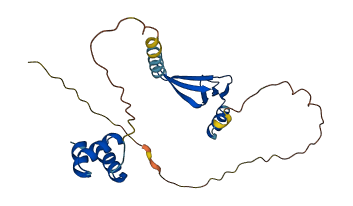
1 structures for Q60817
| Entry ID | Method | Resolution | Chain | Position | Source |
|---|---|---|---|---|---|
| AF-Q60817-F1 | Predicted | AlphaFoldDB |
9 variants for Q60817
| Variant ID(s) | Position | Change | Description | Diseaes Association | Provenance |
|---|---|---|---|---|---|
| rs3389121862 | 32 | D>V | No | EVA | |
| rs3389142971 | 68 | K>N | No | EVA | |
| rs3389072956 | 96 | I>N | No | EVA | |
| rs3389130132 | 101 | N>I | No | EVA | |
| rs3389098958 | 145 | V>L | No | EVA | |
| rs3389133310 | 162 | V>D | No | EVA | |
| rs3389133076 | 176 | V>M | No | EVA | |
| rs3389145295 | 201 | N>K | No | EVA | |
| rs3389127418 | 206 | I>T | No | EVA |
No associated diseases with Q60817
3 GO annotations of cellular component
| Name | Definition |
|---|---|
| cytoplasm | The contents of a cell excluding the plasma membrane and nucleus, but including other subcellular structures. |
| nascent polypeptide-associated complex | A heterodimeric protein complex that can reversibly bind to ribosomes, and is located in direct proximity to newly synthesized polypeptide chains as they emerge from the ribosome. |
| nucleus | A membrane-bounded organelle of eukaryotic cells in which chromosomes are housed and replicated. In most cells, the nucleus contains all of the cell's chromosomes except the organellar chromosomes, and is the site of RNA synthesis and processing. In some species, or in specialized cell types, RNA metabolism or DNA replication may be absent. |
4 GO annotations of molecular function
| Name | Definition |
|---|---|
| DNA binding | Any molecular function by which a gene product interacts selectively and non-covalently with DNA (deoxyribonucleic acid). |
| TBP-class protein binding | Binding to a member of the class of TATA-binding proteins (TBP), including any of the TBP-related factors (TRFs). |
| transcription coactivator activity | A transcription coregulator activity that activates or increases the transcription of specific gene sets via binding to a DNA-bound DNA-binding transcription factor, either on its own or as part of a complex. Coactivators often act by altering chromatin structure and modifications. For example, one class of transcription coactivators modifies chromatin structure through covalent modification of histones. A second class remodels the conformation of chromatin in an ATP-dependent fashion. A third class modulates interactions of DNA-bound DNA-binding transcription factors with other transcription coregulators. A fourth class of coactivator activity is the bridging of a DNA-binding transcription factor to the general (basal) transcription machinery. The Mediator complex, which bridges sequence-specific DNA binding transcription factors and RNA polymerase, is also a transcription coactivator. |
| unfolded protein binding | Binding to an unfolded protein. |
14 GO annotations of biological process
| Name | Definition |
|---|---|
| cardiac ventricle development | The process whose specific outcome is the progression of a cardiac ventricle over time, from its formation to the mature structure. A cardiac ventricle receives blood from a cardiac atrium and pumps it out of the heart. |
| heart development | The process whose specific outcome is the progression of the heart over time, from its formation to the mature structure. The heart is a hollow, muscular organ, which, by contracting rhythmically, keeps up the circulation of the blood. |
| heart trabecula morphogenesis | The process of shaping a trabecula in the heart. A trabecula is a small, often microscopic, tissue element in the form of a small beam, strut or rod, which generally has a mechanical function. Trabecula are usually but not necessarily, composed of dense collagenous tissue. |
| myoblast migration | The orderly movement of a myoblast from one site to another, often during the development of a multicellular organism. A myoblast is a cell type that, by fusion with other myoblasts, gives rise to the myotubes that eventually develop into skeletal muscle fibers. |
| negative regulation of protein localization to endoplasmic reticulum | Any process that stops, prevents or reduces the frequency, rate or extent of protein localization to endoplasmic reticulum. |
| negative regulation of striated muscle cell apoptotic process | Any process that decreases the rate or extent of striated muscle cell apoptotic process, a form of programmed cell death induced by external or internal signals that trigger the activity of proteolytic caspases whose actions dismantle a striated muscle cell and result in its death. |
| negative regulation of transcription by RNA polymerase II | Any process that stops, prevents, or reduces the frequency, rate or extent of transcription mediated by RNA polymerase II. |
| positive regulation of cell proliferation involved in heart morphogenesis | Any process that activates or increases the frequency, rate or extent of cell proliferation involved in heart morphogenesis. |
| positive regulation of skeletal muscle tissue growth | Any process that activates, maintains or increases the rate of skeletal muscle growth. |
| positive regulation of transcription by RNA polymerase II | Any process that activates or increases the frequency, rate or extent of transcription from an RNA polymerase II promoter. |
| protein targeting to membrane | The process of directing proteins towards a membrane, usually using signals contained within the protein. |
| regulation of skeletal muscle fiber development | Any process that modulates the frequency, rate or extent of skeletal muscle fiber development. Muscle fibers are formed by the maturation of myotubes. They can be classed as slow, intermediate/fast or fast. |
| skeletal muscle tissue regeneration | The regrowth of skeletal muscle tissue to repair injured or damaged muscle fibers in the postnatal stage. |
| wound healing | The series of events that restore integrity to a damaged tissue, following an injury. |
No homologous proteins in AiPD
| UniProt AC | Gene Name | Protein Name | Species | Evidence Code |
|---|---|---|---|---|
| No homologous proteins | ||||
| 10 | 20 | 30 | 40 | 50 | 60 |
| MPGEATETVP | ATEQELPQPQ | AETGSGTESD | SDESVPELEE | QDSTQTATQQ | AQLAAAAEID |
| 70 | 80 | 90 | 100 | 110 | 120 |
| EEPVSKAKQS | RSEKKARKAM | SKLGLRQVTG | VTRVTIRKSK | NILFVITKPD | VYKSPASDTY |
| 130 | 140 | 150 | 160 | 170 | 180 |
| IVFGEAKIED | LSQQAQLAAA | EKFKVQGEAV | SNIQENTQTP | TVQEESEEEE | VDETGVEVKD |
| 190 | 200 | 210 | |||
| IELVMSQANV | SRAKAVRALK | NNSNDIVNAI | MELTM |