Q60749
Gene name |
Khdrbs1 |
Protein name |
KH domain-containing, RNA-binding, signal transduction-associated protein 1 |
Names |
GAP-associated tyrosine phosphoprotein p62, Src-associated in mitosis 68 kDa protein, Sam68, p21 Ras GTPase-activating protein-associated p62, p68 |
Species |
Mus musculus (Mouse) |
KEGG Pathway |
mmu:20218 |
EC number |
|
Protein Class |
|
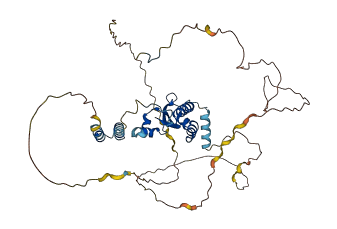
Descriptions
The autoinhibited protein was predicted that may have potential autoinhibitory elements via cis-regPred.
Autoinhibitory domains (AIDs)
Target domain |
|
Relief mechanism |
|
Assay |
cis-regPred |
Accessory elements
No accessory elements
Autoinhibited structure

Activated structure
1 structures for Q60749
| Entry ID | Method | Resolution | Chain | Position | Source |
|---|---|---|---|---|---|
| AF-Q60749-F1 | Predicted | AlphaFoldDB |
14 variants for Q60749
| Variant ID(s) | Position | Change | Description | Diseaes Association | Provenance |
|---|---|---|---|---|---|
| rs3388701679 | 112 | D>E | No | EVA | |
| rs3388716033 | 259 | M>K | No | EVA | |
| rs3388703652 | 261 | D>Y | No | EVA | |
| rs3394906735 | 289 | R>S | No | EVA | |
| rs3394835293 | 293 | A>G | No | EVA | |
| rs3394695107 | 295 | P>A | No | EVA | |
| rs3388703642 | 324 | T>A | No | EVA | |
| rs3388721941 | 326 | G>C | No | EVA | |
| rs3388712328 | 342 | A>P | No | EVA | |
| rs3388716014 | 353 | Q>* | No | EVA | |
| rs3388710326 | 380 | Y>* | No | EVA | |
| rs3388716725 | 387 | Y>C | No | EVA | |
| rs3388716086 | 409 | E>G | No | EVA | |
| rs3388712347 | 415 | D>E | No | EVA |
No associated diseases with Q60749
6 GO annotations of cellular component
| Name | Definition |
|---|---|
| cytoplasm | The contents of a cell excluding the plasma membrane and nucleus, but including other subcellular structures. |
| Grb2-Sos complex | A protein complex that contains Grb2 and the guanine nucleotide exchange factor Sos (or an ortholog thereof, such as mSos1), and is involved in linking EGFR activation to the p21-Ras pathway. |
| membrane | A lipid bilayer along with all the proteins and protein complexes embedded in it an attached to it. |
| nucleoplasm | That part of the nuclear content other than the chromosomes or the nucleolus. |
| nucleus | A membrane-bounded organelle of eukaryotic cells in which chromosomes are housed and replicated. In most cells, the nucleus contains all of the cell's chromosomes except the organellar chromosomes, and is the site of RNA synthesis and processing. In some species, or in specialized cell types, RNA metabolism or DNA replication may be absent. |
| protein-containing complex | A stable assembly of two or more macromolecules, i.e. proteins, nucleic acids, carbohydrates or lipids, in which at least one component is a protein and the constituent parts function together. |
11 GO annotations of molecular function
| Name | Definition |
|---|---|
| identical protein binding | Binding to an identical protein or proteins. |
| mRNA binding | Binding to messenger RNA (mRNA), an intermediate molecule between DNA and protein. mRNA includes UTR and coding sequences, but does not contain introns. |
| poly(A) binding | Binding to a sequence of adenylyl residues in an RNA molecule, such as the poly(A) tail, a sequence of adenylyl residues at the 3' end of eukaryotic mRNA. |
| poly(U) RNA binding | Binding to a sequence of uracil residues in an RNA molecule. |
| protein domain specific binding | Binding to a specific domain of a protein. |
| protein tyrosine kinase binding | Binding to protein tyrosine kinase. |
| protein-containing complex binding | Binding to a macromolecular complex. |
| RNA binding | Binding to an RNA molecule or a portion thereof. |
| SH2 domain binding | Binding to a SH2 domain (Src homology 2) of a protein, a protein domain of about 100 amino-acid residues and belonging to the alpha + beta domain class. |
| SH3 domain binding | Binding to a SH3 domain (Src homology 3) of a protein, small protein modules containing approximately 50 amino acid residues found in a great variety of intracellular or membrane-associated proteins. |
| signaling adaptor activity | The binding activity of a molecule that brings together two or more molecules in a signaling pathway, permitting those molecules to function in a coordinated way. Adaptor molecules themselves do not have catalytic activity. |
11 GO annotations of biological process
| Name | Definition |
|---|---|
| cell cycle | The progression of biochemical and morphological phases and events that occur in a cell during successive cell replication or nuclear replication events. Canonically, the cell cycle comprises the replication and segregation of genetic material followed by the division of the cell, but in endocycles or syncytial cells nuclear replication or nuclear division may not be followed by cell division. |
| cell surface receptor signaling pathway | The series of molecular signals initiated by activation of a receptor on the surface of a cell. The pathway begins with binding of an extracellular ligand to a cell surface receptor, or for receptors that signal in the absence of a ligand, by ligand-withdrawal or the activity of a constitutively active receptor. The pathway ends with regulation of a downstream cellular process, e.g. transcription. |
| mRNA processing | Any process involved in the conversion of a primary mRNA transcript into one or more mature mRNA(s) prior to translation into polypeptide. |
| negative regulation of transcription by RNA polymerase II | Any process that stops, prevents, or reduces the frequency, rate or extent of transcription mediated by RNA polymerase II. |
| positive regulation of RNA export from nucleus | Any process that activates or increases the frequency, rate or extent of directed movement of RNA from the nucleus into the cytoplasm. |
| positive regulation of translational initiation | Any process that activates or increases the frequency, rate or extent of translational initiation. |
| regulation of alternative mRNA splicing, via spliceosome | Any process that modulates the frequency, rate or extent of alternative splicing of nuclear mRNAs. |
| regulation of mRNA splicing, via spliceosome | Any process that modulates the frequency, rate or extent of mRNA splicing via a spliceosomal mechanism. |
| regulation of RNA export from nucleus | Any process that modulates the frequency, rate or extent of the directed movement of RNA from the nucleus to the cytoplasm. |
| spermatogenesis | The developmental process by which male germ line stem cells self renew or give rise to successive cell types resulting in the development of a spermatozoa. |
| T cell receptor signaling pathway | The series of molecular signals initiated by the cross-linking of an antigen receptor on a T cell. |
2 homologous proteins in AiPD
| 10 | 20 | 30 | 40 | 50 | 60 |
| MQRRDDPASR | LTRSSGRSCS | KDPSGAHPSV | RLTPSRPSPL | PHRPRGGGGG | PRGGARASPA |
| 70 | 80 | 90 | 100 | 110 | 120 |
| TQPPPLLPPS | TPGPDATVVG | SAPTPLLPPS | ATAAVKMEPE | NKYLPELMAE | KDSLDPSFTH |
| 130 | 140 | 150 | 160 | 170 | 180 |
| AMQLLSVEIE | KIQKGESKKD | DEENYLDLFS | HKNMKLKERV | LIPVKQYPKF | NFVGKILGPQ |
| 190 | 200 | 210 | 220 | 230 | 240 |
| GNTIKRLQEE | TGAKISVLGK | GSMRDKAKEE | ELRKGGDPKY | AHLNMDLHVF | IEVFGPPCEA |
| 250 | 260 | 270 | 280 | 290 | 300 |
| YALMAHAMEE | VKKFLVPDMM | DDICQEQFLE | LSYLNGVPEP | SRGRGVSVRG | RGAAPPPPPV |
| 310 | 320 | 330 | 340 | 350 | 360 |
| PRGRGVGPPR | GALVRGTPVR | GSITRGATVT | RGVPPPPTVR | GAPTPRARTA | GIQRIPLPPT |
| 370 | 380 | 390 | 400 | 410 | 420 |
| PAPETYEDYG | YDDTYAEQSY | EGYEGYYSQS | QGESEYYDYG | HGELQDSYEA | YGQDDWNGTR |
| 430 | 440 | ||||
| PSLKAPPARP | VKGAYREHPY | GRY |