Q60739
Gene name |
Bag1 |
Protein name |
BAG family molecular chaperone regulator 1 |
Names |
BAG-1, Bcl-2-associated athanogene 1 |
Species |
Mus musculus (Mouse) |
KEGG Pathway |
mmu:12017 |
EC number |
|
Protein Class |
|
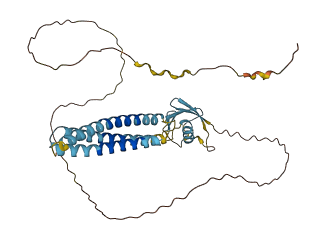
Descriptions
The autoinhibited protein was predicted that may have potential autoinhibitory elements via cis-regPred.
Autoinhibitory domains (AIDs)
Target domain |
|
Relief mechanism |
|
Assay |
cis-regPred |
Accessory elements
No accessory elements
Autoinhibited structure

Activated structure
4 structures for Q60739
| Entry ID | Method | Resolution | Chain | Position | Source |
|---|---|---|---|---|---|
| 1I6Z | NMR | - | A | 226-355 | PDB |
| 2LWP | NMR | - | A | 137-233 | PDB |
| 2M8S | NMR | - | A | 137-233 | PDB |
| AF-Q60739-F1 | Predicted | AlphaFoldDB |
No variants for Q60739
| Variant ID(s) | Position | Change | Description | Diseaes Association | Provenance |
|---|---|---|---|---|---|
| No variants for Q60739 | |||||
1 associated diseases with Q60739
[MIM: 617574]: Ichthyosis, congenital, autosomal recessive 13 (ARCI13)
A form of autosomal recessive congenital ichthyosis, a disorder of keratinization with abnormal differentiation and desquamation of the epidermis, resulting in abnormal skin scaling over the whole body. The main skin phenotypes are lamellar ichthyosis (LI) and non-bullous congenital ichthyosiform erythroderma (NCIE), although phenotypic overlap within the same patient or among patients from the same family can occur. Lamellar ichthyosis is a condition often associated with an embedment in a collodion-like membrane at birth; skin scales later develop, covering the entire body surface. Non-bullous congenital ichthyosiform erythroderma characterized by fine whitish scaling on an erythrodermal background; larger brownish scales are present on the buttocks, neck and legs. {ECO:0000269|PubMed:28173123}. Note=The disease is caused by variants affecting the gene represented in this entry.
Without disease ID
- A form of autosomal recessive congenital ichthyosis, a disorder of keratinization with abnormal differentiation and desquamation of the epidermis, resulting in abnormal skin scaling over the whole body. The main skin phenotypes are lamellar ichthyosis (LI) and non-bullous congenital ichthyosiform erythroderma (NCIE), although phenotypic overlap within the same patient or among patients from the same family can occur. Lamellar ichthyosis is a condition often associated with an embedment in a collodion-like membrane at birth; skin scales later develop, covering the entire body surface. Non-bullous congenital ichthyosiform erythroderma characterized by fine whitish scaling on an erythrodermal background; larger brownish scales are present on the buttocks, neck and legs. {ECO:0000269|PubMed:28173123}. Note=The disease is caused by variants affecting the gene represented in this entry.
1 regional properties for Q60739
| Type | Name | Position | InterPro Accession |
|---|---|---|---|
| conserved_site | Short-chain dehydrogenase/reductase, conserved site | 159 - 187 | IPR020904 |
7 GO annotations of cellular component
| Name | Definition |
|---|---|
| cytoplasm | The contents of a cell excluding the plasma membrane and nucleus, but including other subcellular structures. |
| cytosol | The part of the cytoplasm that does not contain organelles but which does contain other particulate matter, such as protein complexes. |
| membrane | A lipid bilayer along with all the proteins and protein complexes embedded in it an attached to it. |
| mitochondrion | A semiautonomous, self replicating organelle that occurs in varying numbers, shapes, and sizes in the cytoplasm of virtually all eukaryotic cells. It is notably the site of tissue respiration. |
| nucleoplasm | That part of the nuclear content other than the chromosomes or the nucleolus. |
| nucleus | A membrane-bounded organelle of eukaryotic cells in which chromosomes are housed and replicated. In most cells, the nucleus contains all of the cell's chromosomes except the organellar chromosomes, and is the site of RNA synthesis and processing. In some species, or in specialized cell types, RNA metabolism or DNA replication may be absent. |
| perinuclear region of cytoplasm | Cytoplasm situated near, or occurring around, the nucleus. |
3 GO annotations of molecular function
| Name | Definition |
|---|---|
| adenyl-nucleotide exchange factor activity | Binds to and stimulates the hydrolysis and exchange of adenyl nucleotides by other proteins. |
| chaperone binding | Binding to a chaperone protein, a class of proteins that bind to nascent or unfolded polypeptides and ensure correct folding or transport. |
| ubiquitin protein ligase binding | Binding to a ubiquitin protein ligase enzyme, any of the E3 proteins. |
10 GO annotations of biological process
| Name | Definition |
|---|---|
| apoptotic process | A programmed cell death process which begins when a cell receives an internal (e.g. DNA damage) or external signal (e.g. an extracellular death ligand), and proceeds through a series of biochemical events (signaling pathway phase) which trigger an execution phase. The execution phase is the last step of an apoptotic process, and is typically characterized by rounding-up of the cell, retraction of pseudopodes, reduction of cellular volume (pyknosis), chromatin condensation, nuclear fragmentation (karyorrhexis), plasma membrane blebbing and fragmentation of the cell into apoptotic bodies. When the execution phase is completed, the cell has died. |
| chaperone cofactor-dependent protein refolding | The process of assisting in the correct posttranslational noncovalent assembly of proteins, which is dependent on additional protein cofactors. This process occurs over one or several cycles of nucleotide hydrolysis-dependent binding and release. |
| negative regulation of apoptotic process | Any process that stops, prevents, or reduces the frequency, rate or extent of cell death by apoptotic process. |
| negative regulation of motor neuron apoptotic process | Any process that stops, prevents or reduces the frequency, rate or extent of motor neuron apoptotic process. |
| negative regulation of protein phosphorylation | Any process that stops, prevents or reduces the rate of addition of phosphate groups to amino acids within a protein. |
| neuron differentiation | The process in which a relatively unspecialized cell acquires specialized features of a neuron. |
| positive regulation of Schwann cell differentiation | Any process that activates or increases the frequency, rate or extent of Schwann cell differentiation. |
| protein localization to mitochondrion | A process in which a protein is transported to, or maintained in, a location within the mitochondrion. |
| protein phosphorylation | The process of introducing a phosphate group on to a protein. |
| protein stabilization | Any process involved in maintaining the structure and integrity of a protein and preventing it from degradation or aggregation. |
No homologous proteins in AiPD
| UniProt AC | Gene Name | Protein Name | Species | Evidence Code |
|---|---|---|---|---|
| No homologous proteins | ||||
| 10 | 20 | 30 | 40 | 50 | 60 |
| MAGRSAARRP | RGDREPLGPR | LRAPRPAREP | RQSESRAERG | LPPSQRSSVR | SAASGHDRST |
| 70 | 80 | 90 | 100 | 110 | 120 |
| RGAPAGACKP | RVKKKVRPRS | SQSEKVGSSS | RELTRSKKVT | RSKNVTGTQV | EEVTKIEEAT |
| 130 | 140 | 150 | 160 | 170 | 180 |
| QTEEVTVAEE | VTQTDNMAKT | EEMVQTEEME | TPRLSVIVTH | SNERYDLLVT | PQQGNSEPVV |
| 190 | 200 | 210 | 220 | 230 | 240 |
| QDLAQLVEEA | TGVPLPFQKL | IFKGKSLKEM | ETPLSALGMQ | NGCRVMLIGE | KSNPEEEVEL |
| 250 | 260 | 270 | 280 | 290 | 300 |
| KKLKDLEVSA | EKIANHLQEL | NKELSGIQQG | FLAKELQAEA | LCKLDRKVKA | TIEQFMKILE |
| 310 | 320 | 330 | 340 | 350 | |
| EIDTMVLPEQ | FKDSRLKRKN | LVKKVQVFLA | ECDTVEQYIC | QETERLQSTN | LALAE |