Q60738
Gene name |
Slc30a1 (Znt1) |
Protein name |
Zinc transporter 1 |
Names |
ZnT-1, Solute carrier family 30 member 1 |
Species |
Mus musculus (Mouse) |
KEGG Pathway |
mmu:22782 |
EC number |
|
Protein Class |
|
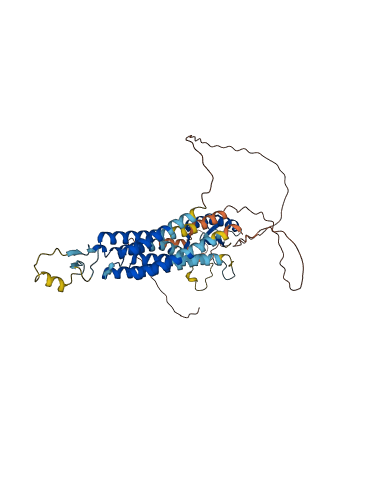
Descriptions
The autoinhibited protein was predicted that may have potential autoinhibitory elements via cis-regPred.
Autoinhibitory domains (AIDs)
Target domain |
|
Relief mechanism |
|
Assay |
cis-regPred |
Accessory elements
No accessory elements
Autoinhibited structure

Activated structure
1 structures for Q60738
| Entry ID | Method | Resolution | Chain | Position | Source |
|---|---|---|---|---|---|
| AF-Q60738-F1 | Predicted | AlphaFoldDB |
20 variants for Q60738
| Variant ID(s) | Position | Change | Description | Diseaes Association | Provenance |
|---|---|---|---|---|---|
| rs3388520722 | 203 | E>D | No | EVA | |
| rs3388520725 | 204 | P>S | No | EVA | |
| rs3388520667 | 221 | L>P | No | EVA | |
| rs8253344 | 227 | N>S | No | EVA | |
| rs8253345 | 230 | A>S | No | EVA | |
| rs3388524214 | 264 | F>I | No | EVA | |
| rs3391169384 | 295 | S>I | No | EVA | |
| rs3391164224 | 296 | T>N | No | EVA | |
| rs3391046533 | 296 | T>P | No | EVA | |
| rs3391181237 | 297 | Q>K | No | EVA | |
| rs3388527575 | 307 | W>* | No | EVA | |
| rs3388522775 | 319 | M>K | No | EVA | |
| rs3388524747 | 353 | K>* | No | EVA | |
| rs3388524234 | 369 | V>I | No | EVA | |
| rs1131768386 | 417 | A>S | No | EVA | |
| rs1134216523 | 418 | S>R | No | EVA | |
| rs1135269227 | 419 | V>F | No | EVA | |
| rs1134376989 | 423 | S>T | No | EVA | |
| rs3388523177 | 428 | C>Y | No | EVA | |
| rs3391171450 | 487 | V>P* | No | EVA |
No associated diseases with Q60738
No regional properties for Q60738
| Type | Name | Position | InterPro Accession |
|---|---|---|---|
| No domain, repeats, and functional sites for Q60738 | |||
Functions
9 GO annotations of cellular component
| Name | Definition |
|---|---|
| cytoplasm | The contents of a cell excluding the plasma membrane and nucleus, but including other subcellular structures. |
| endoplasmic reticulum | The irregular network of unit membranes, visible only by electron microscopy, that occurs in the cytoplasm of many eukaryotic cells. The membranes form a complex meshwork of tubular channels, which are often expanded into slitlike cavities called cisternae. The ER takes two forms, rough (or granular), with ribosomes adhering to the outer surface, and smooth (with no ribosomes attached). |
| Golgi apparatus | A membrane-bound cytoplasmic organelle of the endomembrane system that further processes the core oligosaccharides (e.g. N-glycans) added to proteins in the endoplasmic reticulum and packages them into membrane-bound vesicles. The Golgi apparatus operates at the intersection of the secretory, lysosomal, and endocytic pathways. |
| integral component of membrane | The component of a membrane consisting of the gene products and protein complexes having at least some part of their peptide sequence embedded in the hydrophobic region of the membrane. |
| integral component of postsynaptic density membrane | The component of the postsynaptic density membrane consisting of the gene products and protein complexes having at least some part of their peptide sequence embedded in the hydrophobic region of the membrane. |
| nuclear membrane | Either of the lipid bilayers that surround the nucleus and form the nuclear envelope; excludes the intermembrane space. |
| plasma membrane | The membrane surrounding a cell that separates the cell from its external environment. It consists of a phospholipid bilayer and associated proteins. |
| Schaffer collateral - CA1 synapse | A synapse between the Schaffer collateral axon of a CA3 pyramidal cell and a CA1 pyramidal cell. |
| T-tubule | Invagination of the plasma membrane of a muscle cell that extends inward from the cell surface around each myofibril. The ends of T-tubules make contact with the sarcoplasmic reticulum membrane. |
2 GO annotations of molecular function
| Name | Definition |
|---|---|
| calcium channel inhibitor activity | Binds to and stops, prevents, or reduces the activity of a calcium channel. |
| zinc ion transmembrane transporter activity | Enables the transfer of zinc (Zn) ions from one side of a membrane to the other. |
12 GO annotations of biological process
| Name | Definition |
|---|---|
| cadmium ion transmembrane transport | A process in which a cadmium ion is transported from one side of a membrane to the other by means of some agent such as a transporter or pore. |
| calcium ion import | The directed movement of calcium ions into a cell or organelle. |
| cellular calcium ion homeostasis | Any process involved in the maintenance of an internal steady state of calcium ions at the level of a cell. |
| cellular zinc ion homeostasis | Any process involved in the maintenance of an internal steady state of zinc ions at the level of a cell. |
| detoxification of cadmium ion | Any process that reduces or removes the toxicity of cadmium ion. These may include transport of cadmium away from sensitive areas and to compartments or complexes whose purpose is sequestration of cadmium ion. |
| detoxification of zinc ion | Any process that reduces or removes the toxicity of zinc ion. These include transport of zinc away from sensitive areas and to compartments or complexes whose purpose is sequestration of zinc ion. |
| in utero embryonic development | The process whose specific outcome is the progression of the embryo in the uterus over time, from formation of the zygote in the oviduct, to birth. An example of this process is found in Mus musculus. |
| negative regulation of calcium ion import | Any process that decreases the rate, frequency, or extent of the directed movement of calcium ions into a cell or organelle. |
| negative regulation of neurotransmitter secretion | Any process that stops, prevents, or reduces the frequency, rate or extent of the regulated release of a neurotransmitter. |
| negative regulation of zinc ion transmembrane import | Any process that stops, prevents, or reduces the frequency, rate or extent of zinc ion import. |
| zinc ion transmembrane transport | A process in which a zinc II ion is transported from one side of a membrane to the other by means of some agent such as a transporter or pore. |
| zinc ion transport | The directed movement of zinc (Zn II) ions into, out of or within a cell, or between cells, by means of some agent such as a transporter or pore. |
No homologous proteins in AiPD
| UniProt AC | Gene Name | Protein Name | Species | Evidence Code |
|---|---|---|---|---|
| No homologous proteins | ||||
| 10 | 20 | 30 | 40 | 50 | 60 |
| MGCWGRNRGR | LLCMLLLTFM | FMVLEVVVSR | VTASLAMLSD | SFHMLSDVLA | LVVALVAERF |
| 70 | 80 | 90 | 100 | 110 | 120 |
| ARRTHATQKN | TFGWIRAEVM | GALVNAIFLT | GLCFAILLEA | VERFIEPHEM | QQPLVVLSVG |
| 130 | 140 | 150 | 160 | 170 | 180 |
| VAGLLVNVLG | LCLFHHHSGE | GQGAGHGHSH | GHGHGHLAKG | ARKAGRAGVE | AGAPPGRAPD |
| 190 | 200 | 210 | 220 | 230 | 240 |
| QEETNTLVAN | TSNSNGLKAD | QAEPEKLRSD | DPVDVQVNGN | LIQESDNLEA | EDNRAGQLNM |
| 250 | 260 | 270 | 280 | 290 | 300 |
| RGVFLHVLGD | ALGSVIVVVN | ALVFYFNWKG | CTEDDFCTNP | CFPDPCKSSV | EIINSTQAPM |
| 310 | 320 | 330 | 340 | 350 | 360 |
| RDAGPCWVLY | LDPTLCIIMV | CILLYTTYPL | LKESALILLQ | TVPKQIDIKH | LVKELRDVDG |
| 370 | 380 | 390 | 400 | 410 | 420 |
| VEEVHELHVW | QLAGSRIIAT | AHIKCEDPAS | YMQVAKTIKD | VFHNHGIHAT | TIQPEFASVG |
| 430 | 440 | 450 | 460 | 470 | 480 |
| SKSSVLPCEL | ACRTQCALKQ | CCGTRPQVHS | GKDAEKAPTV | SISCLELSEN | LEKKARRTKA |
| 490 | 500 | ||||
| EGSLPAVVIE | IKNVPNKQPE | SSL |