Q60597
Gene name |
Ogdh (Kiaa4192) |
Protein name |
2-oxoglutarate dehydrogenase complex component E1 |
Names |
E1o, OGDC-E1, OGDH-E1, 2-oxoglutarate dehydrogenase, mitochondrial, Alpha-ketoglutarate dehydrogenase, Alpha-KGDH-E1, Thiamine diphosphate (ThDP)-dependent 2-oxoglutarate dehydrogenase |
Species |
Mus musculus (Mouse) |
KEGG Pathway |
mmu:18293 |
EC number |
1.2.4.2: With a disulfide as acceptor |
Protein Class |
|
Descriptions
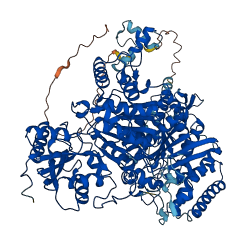
The autoinhibited protein was predicted that may have potential autoinhibitory elements via cis-regPred.
Autoinhibitory domains (AIDs)
Target domain |
|
Relief mechanism |
|
Assay |
cis-regPred |
Accessory elements
No accessory elements
Autoinhibited structure

Activated structure
3 structures for Q60597
| Entry ID | Method | Resolution | Chain | Position | Source |
|---|---|---|---|---|---|
| 3E2H | X-ray | 380 A | Q | 932-940 | PDB |
| 3TF7 | X-ray | 275 A | B/F | 932-940 | PDB |
| AF-Q60597-F1 | Predicted | AlphaFoldDB |
41 variants for Q60597
| Variant ID(s) | Position | Change | Description | Diseaes Association | Provenance |
|---|---|---|---|---|---|
| rs3389141089 | 15 | T>I | No | EVA | |
| rs3389114311 | 36 | Q>H | No | EVA | |
| rs3389139601 | 73 | H>L | No | EVA | |
| rs3401794294 | 183 | D>V | No | EVA | |
| rs3401911637 | 191 | T>N | No | EVA | |
| rs3389141090 | 298 | S>G | No | EVA | |
| rs3389081212 | 330 | F>L | No | EVA | |
| rs3389118534 | 342 | E>Q | No | EVA | |
| rs3389140888 | 346 | D>Y | No | EVA | |
| rs3389140910 | 378 | E>D | No | EVA | |
| rs3389147391 | 436 | G>D | No | EVA | |
| rs3389081260 | 440 | V>M | No | EVA | |
| rs3389138392 | 448 | F>S | No | EVA | |
| rs3389118555 | 462 | T>I | No | EVA | |
| rs3389114404 | 464 | V>M | No | EVA | |
| rs3389134926 | 467 | V>L | No | EVA | |
| rs3389151646 | 474 | H>Y | No | EVA | |
| rs3401960033 | 483 | V>I* | No | EVA | |
| rs3401817408 | 484 | M>I | No | EVA | |
| rs3389140907 | 484 | M>L | No | EVA | |
| rs3389138387 | 523 | Q>H | No | EVA | |
| rs3389143558 | 556 | E>K | No | EVA | |
| rs3389140846 | 592 | F>L | No | EVA | |
| rs3389140858 | 604 | C>R | No | EVA | |
| rs3389153178 | 621 | A>V | No | EVA | |
| rs3389138407 | 624 | V>I | No | EVA | |
| rs3401812039 | 641 | T>I | No | EVA | |
| rs3389130573 | 645 | L>F | No | EVA | |
| rs3389139597 | 670 | H>N | No | EVA | |
| rs3389114352 | 680 | R>Q | No | EVA | |
| rs3389147350 | 681 | G>D | No | EVA | |
| rs3389147389 | 682 | T>S | No | EVA | |
| rs3389138411 | 698 | R>G | No | EVA | |
| rs3389144772 | 741 | V>A | No | EVA | |
| rs3389138423 | 859 | P>H | No | EVA | |
| rs3389141465 | 908 | V>M | No | EVA | |
| rs3389153225 | 945 | A>P | No | EVA | |
| rs3389141078 | 946 | Q>* | No | EVA | |
| rs3389118548 | 972 | R>* | No | EVA | |
| rs260357355 | 980 | A>V | No | EVA | |
| rs3389130625 | 1002 | H>L | No | EVA |
No associated diseases with Q60597
4 regional properties for Q60597
| Type | Name | Position | InterPro Accession |
|---|---|---|---|
| domain | Dehydrogenase, E1 component | 257 - 581 | IPR001017 |
| domain | Transketolase-like, pyrimidine-binding domain | 650 - 866 | IPR005475 |
| domain | Multifunctional 2-oxoglutarate metabolism enzyme, C-terminal | 870 - 1014 | IPR031717 |
| domain | 2-oxoglutarate dehydrogenase E1 component, N-terminal domain | 48 - 86 | IPR032106 |
Functions
| Description | ||
|---|---|---|
| EC Number | 1.2.4.2 | With a disulfide as acceptor |
| Subcellular Localization |
|
|
| PANTHER Family | ||
| PANTHER Subfamily | ||
| PANTHER Protein Class | ||
| PANTHER Pathway Category | No pathway information available | |
4 GO annotations of cellular component
| Name | Definition |
|---|---|
| mitochondrial membrane | Either of the lipid bilayers that surround the mitochondrion and form the mitochondrial envelope. |
| mitochondrion | A semiautonomous, self replicating organelle that occurs in varying numbers, shapes, and sizes in the cytoplasm of virtually all eukaryotic cells. It is notably the site of tissue respiration. |
| nucleus | A membrane-bounded organelle of eukaryotic cells in which chromosomes are housed and replicated. In most cells, the nucleus contains all of the cell's chromosomes except the organellar chromosomes, and is the site of RNA synthesis and processing. In some species, or in specialized cell types, RNA metabolism or DNA replication may be absent. |
| oxoglutarate dehydrogenase complex | A complex of multiple copies of three enzymatic components: oxoglutarate dehydrogenase (lipoamide) (E1), dihydrolipoamide S-succinyltransferase (E2) and dihydrolipoamide dehydrogenase (E3); catalyzes the overall conversion of 2-oxoglutarate to succinyl-CoA and carbon dioxide (CO2). |
6 GO annotations of molecular function
| Name | Definition |
|---|---|
| chaperone binding | Binding to a chaperone protein, a class of proteins that bind to nascent or unfolded polypeptides and ensure correct folding or transport. |
| heat shock protein binding | Binding to a heat shock protein, a protein synthesized or activated in response to heat shock. |
| metal ion binding | Binding to a metal ion. |
| oxoglutarate dehydrogenase (NAD+) activity | Catalysis of the reaction: 2-oxoglutarate + CoA + NAD+ = succinyl-CoA + CO2 + NADH. |
| oxoglutarate dehydrogenase (succinyl-transferring) activity | Catalysis of the reaction: 2-oxoglutarate + lipoamide = S-succinyldihydrolipoamide + CO2. |
| thiamine pyrophosphate binding | Binding to thiamine pyrophosphate, the diphosphoric ester of thiamine. Acts as a coenzyme of several (de)carboxylases, transketolases, and alpha-oxoacid dehydrogenases. |
14 GO annotations of biological process
| Name | Definition |
|---|---|
| 2-oxoglutarate metabolic process | The chemical reactions and pathways involving oxoglutarate, the dianion of 2-oxoglutaric acid. It is a key constituent of the TCA cycle and a key intermediate in amino-acid metabolism. |
| cerebellar cortex development | The process whose specific outcome is the progression of the cerebellar cortex over time, from its formation to the mature structure. The cerebellar cortex is a thin mantle of gray matter that covers the surface of each cerebral hemisphere. It has a characteristic morphology with convolutions (gyri) and crevices (sulci) that have specific functions. Six layers of nerve cells and the nerve pathways that connect them comprise the cerebellar cortex. Together, these regions are responsible for the processes of conscious thought, perception, emotion and memory as well as advanced motor function. |
| generation of precursor metabolites and energy | The chemical reactions and pathways resulting in the formation of precursor metabolites, substances from which energy is derived, and any process involved in the liberation of energy from these substances. |
| glycolytic process | The chemical reactions and pathways resulting in the breakdown of a carbohydrate into pyruvate, with the concomitant production of a small amount of ATP and the reduction of NAD(P) to NAD(P)H. Glycolysis begins with the metabolism of a carbohydrate to generate products that can enter the pathway and ends with the production of pyruvate. Pyruvate may be converted to acetyl-coenzyme A, ethanol, lactate, or other small molecules. |
| hippocampus development | The progression of the hippocampus over time from its initial formation until its mature state. |
| histone succinylation | The modification of a histone by the addition of an succinyl group. |
| NADH metabolic process | The chemical reactions and pathways involving reduced nicotinamide adenine dinucleotide (NADH), a coenzyme present in most living cells and derived from the B vitamin nicotinic acid. |
| olfactory bulb mitral cell layer development | The progression of the olfactory bulb mitral cell layer over time from its initial formation until its mature state. The mitral cell layer is composed of pyramidal neurons whose cell bodies are located between the granule cell layer and the plexiform layer. |
| pyramidal neuron development | The progression of a pyramidal neuron from its initial formation to its mature state. |
| striatum development | The progression of the striatum over time from its initial formation until its mature state. The striatum is a region of the forebrain consisting of the caudate nucleus, putamen and fundus striati. |
| succinyl-CoA metabolic process | The chemical reactions and pathways involving succinyl-CoA, a compound composed of the monovalent acyl group 3-carboxypropanoyl, derived from succinic acid by loss of one OH group, linked to coenzyme A. |
| tangential migration from the subventricular zone to the olfactory bulb | The migration of cells in the telencephalon from the subventricular zone to the olfactory bulb in which cells move orthogonally to the direction of radial migration and do not use radial glial cell processes as substrates for migration. |
| thalamus development | The process in which the thalamus changes over time, from its initial formation to its mature state. |
| tricarboxylic acid cycle | A nearly universal metabolic pathway in which the acetyl group of acetyl coenzyme A is effectively oxidized to two CO2 and four pairs of electrons are transferred to coenzymes. The acetyl group combines with oxaloacetate to form citrate, which undergoes successive transformations to isocitrate, 2-oxoglutarate, succinyl-CoA, succinate, fumarate, malate, and oxaloacetate again, thus completing the cycle. In eukaryotes the tricarboxylic acid is confined to the mitochondria. See also glyoxylate cycle. |
No homologous proteins in AiPD
| UniProt AC | Gene Name | Protein Name | Species | Evidence Code |
|---|---|---|---|---|
| No homologous proteins | ||||
| 10 | 20 | 30 | 40 | 50 | 60 |
| MFHLRTCAAK | LRPLTASQTV | KTFSQNKPAA | IRTFQQIRCY | SAPVAAEPFL | SGTSSNYVEE |
| 70 | 80 | 90 | 100 | 110 | 120 |
| MYCAWLENPK | SVHKSWDIFF | RNTNAGAPPG | TAYQSPLSLS | RSSLATMAHA | QSLVEAQPNV |
| 130 | 140 | 150 | 160 | 170 | 180 |
| DKLVEDHLAV | QSLIRAYQIR | GHHVAQLDPL | GILDADLDSS | VPADIISSTD | KLGFYGLHES |
| 190 | 200 | 210 | 220 | 230 | 240 |
| DLDKVFHLPT | TTFIGGQEPA | LPLREIIRRL | EMAYCQHIGV | EFMFINDLEQ | CQWIRQKFET |
| 250 | 260 | 270 | 280 | 290 | 300 |
| PGIMQFTNEE | KRTLLARLVR | STRFEEFLQR | KWSSEKRFGL | EGCEVLIPAL | KTIIDMSSAN |
| 310 | 320 | 330 | 340 | 350 | 360 |
| GVDYVIMGMP | HRGRLNVLAN | VIRKELEQIF | CQFDSKLEAA | DEGSGDMKYH | LGMYHRRINR |
| 370 | 380 | 390 | 400 | 410 | 420 |
| VTDRNITLSL | VANPSHLEAA | DPVVMGKTKA | EQFYCGDTEG | KKVMSILLHG | DAAFAGQGIV |
| 430 | 440 | 450 | 460 | 470 | 480 |
| YETFHLSDLP | SYTTHGTVHV | VVNNQIGFTT | DPRMARSSPY | PTDVARVVNA | PIFHVNSDDP |
| 490 | 500 | 510 | 520 | 530 | 540 |
| EAVMYVCKVA | AEWRNTFHKD | VVVDLVCYRR | NGHNEMDEPM | FTQPLMYKQI | RKQKPVLQKY |
| 550 | 560 | 570 | 580 | 590 | 600 |
| AELLVSQGVV | NQPEYEEEIS | KYDKICEEAF | TRSKDEKILH | IKHWLDSPWP | GFFTLDGQPR |
| 610 | 620 | 630 | 640 | 650 | 660 |
| SMTCPSTGLE | EDVLFHIGKV | ASSVPVENFT | IHGGLSRILK | TRRELVTNRT | VDWALAEYMA |
| 670 | 680 | 690 | 700 | 710 | 720 |
| FGSLLKEGIH | VRLSGQDVER | GTFSHRHHVL | HDQNVDKRTC | IPMNHLWPNQ | APYTVCNSSL |
| 730 | 740 | 750 | 760 | 770 | 780 |
| SEYGVLGFEL | GFAMASPNAL | VLWEAQFGDF | NNMAQCIIDQ | FICPGQAKWV | RQNGIVLLLP |
| 790 | 800 | 810 | 820 | 830 | 840 |
| HGMEGMGPEH | SSARPERFLQ | MCNDDPDVLP | DLQEENFDIN | QLYDCNWIVV | NCSTPGNFFH |
| 850 | 860 | 870 | 880 | 890 | 900 |
| VLRRQILLPF | RKPLIVFTPK | SLLRHPEART | SFDEMLPGTH | FQRVIPENGP | AAQDPHKVKR |
| 910 | 920 | 930 | 940 | 950 | 960 |
| LLFCTGKVYY | DLTRERKARN | MEEEVAITRI | EQLSPFPFDL | LLKEAQKYPN | AELAWCQEEH |
| 970 | 980 | 990 | 1000 | 1010 | 1020 |
| KNQGYYDYVK | PRLRTTIDRA | KPVWYAGRDP | AAAPATGNKK | THLTELQRFL | DTAFDLDAFK |
| KFS |