Q60437
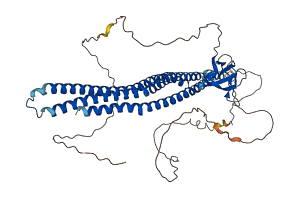
Descriptions
The autoinhibited protein was predicted that may have potential autoinhibitory elements via cis-regPred.
Autoinhibitory domains (AIDs)
Target domain |
|
Relief mechanism |
|
Assay |
cis-regPred |
Accessory elements
No accessory elements
Autoinhibited structure

Activated structure
1 structures for Q60437
| Entry ID | Method | Resolution | Chain | Position | Source |
|---|---|---|---|---|---|
| AF-Q60437-F1 | Predicted | AlphaFoldDB |
No variants for Q60437
| Variant ID(s) | Position | Change | Description | Diseaes Association | Provenance |
|---|---|---|---|---|---|
| No variants for Q60437 | |||||
No associated diseases with Q60437
Functions
5 GO annotations of cellular component
| Name | Definition |
|---|---|
| cytoskeleton | A cellular structure that forms the internal framework of eukaryotic and prokaryotic cells. The cytoskeleton includes intermediate filaments, microfilaments, microtubules, the microtrabecular lattice, and other structures characterized by a polymeric filamentous nature and long-range order within the cell. The various elements of the cytoskeleton not only serve in the maintenance of cellular shape but also have roles in other cellular functions, including cellular movement, cell division, endocytosis, and movement of organelles. |
| cytosol | The part of the cytoplasm that does not contain organelles but which does contain other particulate matter, such as protein complexes. |
| filopodium | Thin, stiff, actin-based protrusion extended by the leading edge of a motile cell such as a crawling fibroblast or amoeba, or an axonal or dendritic growth cone, or a dendritic shaft. |
| membrane | A lipid bilayer along with all the proteins and protein complexes embedded in it an attached to it. |
| ruffle | Projection at the leading edge of a crawling cell; the protrusions are supported by a microfilament meshwork. |
2 GO annotations of molecular function
| Name | Definition |
|---|---|
| cytoskeletal anchor activity | The binding activity of a protein that brings together a cytoskeletal protein (either a microtubule or actin filament, spindle pole body, or protein directly bound to them) and one or more other molecules, permitting them to function in a coordinated way. |
| proline-rich region binding | Binding to a proline-rich region, i.e. a region that contains a high proportion of proline residues, in a protein. |
6 GO annotations of biological process
| Name | Definition |
|---|---|
| actin crosslink formation | The process in which two or more actin filaments are connected together by proteins that act as crosslinks between the filaments. The crosslinked filaments may be on the same or differing axes. |
| actin filament bundle assembly | The assembly of actin filament bundles; actin filaments are on the same axis but may be oriented with the same or opposite polarities and may be packed with different levels of tightness. |
| plasma membrane organization | A process that is carried out at the cellular level which results in the assembly, arrangement of constituent parts, or disassembly of the plasma membrane. |
| regulation of actin cytoskeleton organization | Any process that modulates the frequency, rate or extent of the formation, arrangement of constituent parts, or disassembly of cytoskeletal structures comprising actin filaments and their associated proteins. |
| regulation of cell shape | Any process that modulates the surface configuration of a cell. |
| response to bacterium | Any process that results in a change in state or activity of a cell or an organism (in terms of movement, secretion, enzyme production, gene expression, etc.) as a result of a stimulus from a bacterium. |
No homologous proteins in AiPD
| UniProt AC | Gene Name | Protein Name | Species | Evidence Code |
|---|---|---|---|---|
| No homologous proteins | ||||
| 10 | 20 | 30 | 40 | 50 | 60 |
| MSLSRSEEMH | RLTENVYKTI | MEQFNPSLRN | FIAMGKNYEK | ALAGVTFAAK | GYFDALVKMG |
| 70 | 80 | 90 | 100 | 110 | 120 |
| ELASESQGSK | ELGDVLFQMA | EVHRQIQNQL | EEMLKSFHNE | LLTQLEQKVE | LDSRYLSAAL |
| 130 | 140 | 150 | 160 | 170 | 180 |
| KKYQAEQRSK | GDALDKCQAE | LKKLRKKSQG | SKNPQKYSDK | ELQYIDAISN | KQGELENYVS |
| 190 | 200 | 210 | 220 | 230 | 240 |
| DGYKTALTEE | RRRFCFLVEK | QCAVAKNSAA | YHSKGKELLA | QKLPVWQQAC | ADPNKIPDRA |
| 250 | 260 | 270 | 280 | 290 | 300 |
| VQLMQQIASS | NGSILPSTLS | ASKSNLVISD | PIPGAKPLPV | PPELAPFVGR | MSAQENVPVM |
| 310 | 320 | 330 | 340 | 350 | 360 |
| NGVAGPDSED | YNPWADRKAA | QPKSLSPPQS | QSKLSDSYSN | TLPVRKSVTP | KNSYATTENK |
| 370 | 380 | 390 | 400 | 410 | 420 |
| TLPRSSSMAA | GLERNGRMRV | KAIFSHAAGD | NSTLLSFKEG | DLITLLVPEA | RDGWHYGESE |
| 430 | 440 | 450 | 460 | 470 | 480 |
| KTKMRGWFPF | SYTRVLDSDG | SDRLHMSLQQ | GKSSSTGNLL | DKDDLAVPPP | DYGTSSRAFP |
| 490 | 500 | 510 | 520 | ||
| TQTAGTFKQR | PYSVAVPAFS | QGLDDYGARS | VSSADVEVAR | F |