Q60275
Gene name |
MJECL13 |
Protein name |
Uncharacterized MCM-type protein MJECL13 |
Names |
|
Species |
Methanocaldococcus jannaschii (strain ATCC 43067 / DSM 2661 / JAL-1 / JCM 10045 / NBRC 100440) (Methanococcus jannaschii) |
KEGG Pathway |
mja:MJ_ECL13 |
EC number |
|
Protein Class |
|
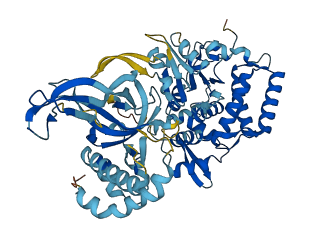
Descriptions
The autoinhibited protein was predicted that may have potential autoinhibitory elements via cis-regPred.
Autoinhibitory domains (AIDs)
Target domain |
|
Relief mechanism |
|
Assay |
cis-regPred |
Accessory elements
No accessory elements
Autoinhibited structure

Activated structure
1 structures for Q60275
| Entry ID | Method | Resolution | Chain | Position | Source |
|---|---|---|---|---|---|
| AF-Q60275-F1 | Predicted | AlphaFoldDB |
No variants for Q60275
| Variant ID(s) | Position | Change | Description | Diseaes Association | Provenance |
|---|---|---|---|---|---|
| No variants for Q60275 | |||||
No associated diseases with Q60275
1 GO annotations of cellular component
| Name | Definition |
|---|---|
| MCM complex | A hexameric protein complex required for the initiation and regulation of DNA replication. |
2 GO annotations of molecular function
| Name | Definition |
|---|---|
| ATP binding | Binding to ATP, adenosine 5'-triphosphate, a universally important coenzyme and enzyme regulator. |
| single-stranded DNA binding | Binding to single-stranded DNA. |
3 GO annotations of biological process
| Name | Definition |
|---|---|
| cell cycle | The progression of biochemical and morphological phases and events that occur in a cell during successive cell replication or nuclear replication events. Canonically, the cell cycle comprises the replication and segregation of genetic material followed by the division of the cell, but in endocycles or syncytial cells nuclear replication or nuclear division may not be followed by cell division. |
| DNA duplex unwinding | The process in which interchain hydrogen bonds between two strands of DNA are broken or 'melted', generating a region of unpaired single strands. |
| DNA replication | The cellular metabolic process in which a cell duplicates one or more molecules of DNA. DNA replication begins when specific sequences, known as origins of replication, are recognized and bound by initiation proteins, and ends when the original DNA molecule has been completely duplicated and the copies topologically separated. The unit of replication usually corresponds to the genome of the cell, an organelle, or a virus. The template for replication can either be an existing DNA molecule or RNA. |
No homologous proteins in AiPD
| UniProt AC | Gene Name | Protein Name | Species | Evidence Code |
|---|---|---|---|---|
| No homologous proteins | ||||
| 10 | 20 | 30 | 40 | 50 | 60 |
| MINMCYNFEN | VKKAYEDQLK | NYIKNSLIPN | LSSHANNEVV | KISMKKLANL | GFGYLVDSTL |
| 70 | 80 | 90 | 100 | 110 | 120 |
| SSITGYYKVR | DWIEELLKEE | LQKSGENKCC | NIVLCDYPEE | FEISMREIPY | YVNKVVKFNG |
| 130 | 140 | 150 | 160 | 170 | 180 |
| VIISASYPCV | LSKKHLYICP | KCGRIKEVYF | SELFWDDKVF | CEFCGGKMEF | ANVMDYENFQ |
| 190 | 200 | 210 | 220 | 230 | 240 |
| ELVVQDLSDE | SEYYGIEKNP | IVWYCGAKPY | YFGHVKITGI | VREVPRSSKS | RIYELIVQAI |
| 250 | 260 | 270 | 280 | 290 | 300 |
| NVEKLGVEKS | LINLTEEDVK | NIKKVAKRGD | IIDILADILI | PPLLCDDAIV | RKAILIQQIA |
| 310 | 320 | 330 | 340 | 350 | 360 |
| PYLEDIGKIN | ILLVTEVGID | KTAILKRIGN | IPGNNFINIA | ALKEEELATP | YDKRSNILGK |
| 370 | 380 | 390 | 400 | 410 | 420 |
| FYTVCGGVIP | RTLGVLCIDD | FNENNKLSTK | LSEAFERNVL | TTNKGSFYCV | PAECSFLCAC |
| 430 | 440 | 450 | 460 | 470 | 480 |
| YPKTKFRKFD | QKKSIIKQIG | ISSILLKNFD | LIFPIRDIPD | KDRDEEVAKY | IFLKYINSDN |
| 490 | 500 | 510 | 520 | 530 | 540 |
| EEIEGYDYVF | VDVGGEKIKI | DFEFLKKYVV | YSRQITPKIT | DEVIEKISNW | YDEMRKNHYI |
| 550 | 560 | 570 | 580 | 590 | 600 |
| TAKQLNTVIK | LSIAVARAKL | KECVDEDDVK | EAIDIIMHYL | KQVVYNPKKG | IIDVILLYKN |
| KT |