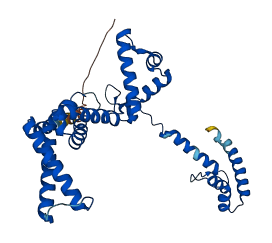
Descriptions
The autoinhibited protein was predicted that may have potential autoinhibitory elements via cis-regPred.
Autoinhibitory domains (AIDs)
Target domain |
|
Relief mechanism |
|
Assay |
cis-regPred |
Accessory elements
No accessory elements
Autoinhibited structure

Activated structure
1 structures for Q60012
| Entry ID | Method | Resolution | Chain | Position | Source |
|---|---|---|---|---|---|
| AF-Q60012-F1 | Predicted | AlphaFoldDB |
No variants for Q60012
| Variant ID(s) | Position | Change | Description | Diseaes Association | Provenance |
|---|---|---|---|---|---|
| No variants for Q60012 | |||||
No associated diseases with Q60012
9 regional properties for Q60012
| Type | Name | Position | InterPro Accession |
|---|---|---|---|
| domain | RNA polymerase sigma-70 | 124 - 137 | IPR000943-1 |
| domain | RNA polymerase sigma-70 | 148 - 156 | IPR000943-2 |
| domain | RNA polymerase sigma-70 | 272 - 284 | IPR000943-3 |
| domain | RNA polymerase sigma-70 | 293 - 319 | IPR000943-4 |
| domain | RNA polymerase sigma-70 region 3 | 179 - 255 | IPR007624 |
| domain | RNA polymerase sigma-70 region 2 | 100 - 169 | IPR007627 |
| domain | RNA polymerase sigma-70 region 4 | 269 - 321 | IPR007630 |
| domain | RNA polymerase sigma-70 region 1.2 | 34 - 67 | IPR009042 |
| domain | RNA polymerase sigma-70 like domain | 96 - 321 | IPR014284 |
No GO annotations of cellular component
| Name | Definition |
|---|---|
| No GO annotations for cellular component |
2 GO annotations of molecular function
| Name | Definition |
|---|---|
| DNA binding | Any molecular function by which a gene product interacts selectively and non-covalently with DNA (deoxyribonucleic acid). |
| sigma factor activity | Sigma factors act as the promoter specificity subunit of eubacterial and plant plastid multisubunit RNA polymerases, whose core subunit composition is often described as alpha(2)-beta-beta-prime. Although sigma does not bind DNA on its own, when combined with the core to form the holoenzyme, the sigma factor binds specifically to promoter elements. The sigma subunit is released once elongation begins. |
1 GO annotations of biological process
| Name | Definition |
|---|---|
| DNA-templated transcription initiation | The initial step of transcription, consisting of the assembly of the RNA polymerase preinitiation complex (PIC) at a gene promoter, as well as the formation of the first few bonds of the RNA transcript. Transcription initiation includes abortive initiation events, which occur when the first few nucleotides are repeatedly synthesized and then released, and ends when promoter clearance takes place. |
No homologous proteins in AiPD
| UniProt AC | Gene Name | Protein Name | Species | Evidence Code |
|---|---|---|---|---|
| No homologous proteins | ||||
| 10 | 20 | 30 | 40 | 50 | 60 |
| MATRAVARRQ | SATGETADSA | SSVRAHGGEI | ADRDLVGMYL | DEIARTPLLD | AAKEVELSQT |
| 70 | 80 | 90 | 100 | 110 | 120 |
| IEAGVFAQQV | LDGEEESRTD | ATREELQALV | DAGERAKDVF | IRSNLRLVVA | VARRYPRSGL |
| 130 | 140 | 150 | 160 | 170 | 180 |
| PLLDLIQEGN | AGLVRAVEKF | DYRKGFKFST | YATWWIRQAI | TRSIADQSRT | IRLPVHLVEE |
| 190 | 200 | 210 | 220 | 230 | 240 |
| LGRIRRVQRE | FNREHGRDPE | PAEVAAELGS | TPERVIDVLD | WARDPVSLNM | AVDDAGETQF |
| 250 | 260 | 270 | 280 | 290 | 300 |
| GDLLEDTSAV | SPEQSVLTLL | RSEELDDLIG | RLDQRTASII | KMRYGIDDGR | ERTLTEVGKE |
| 310 | 320 | 330 | |||
| HGLTRERIRQ | IEKHALLELK | KLARDTGFDA | AA |